

 News
News  Coin Information
  About us
  Customer Service


 Add as a preferred source on Google
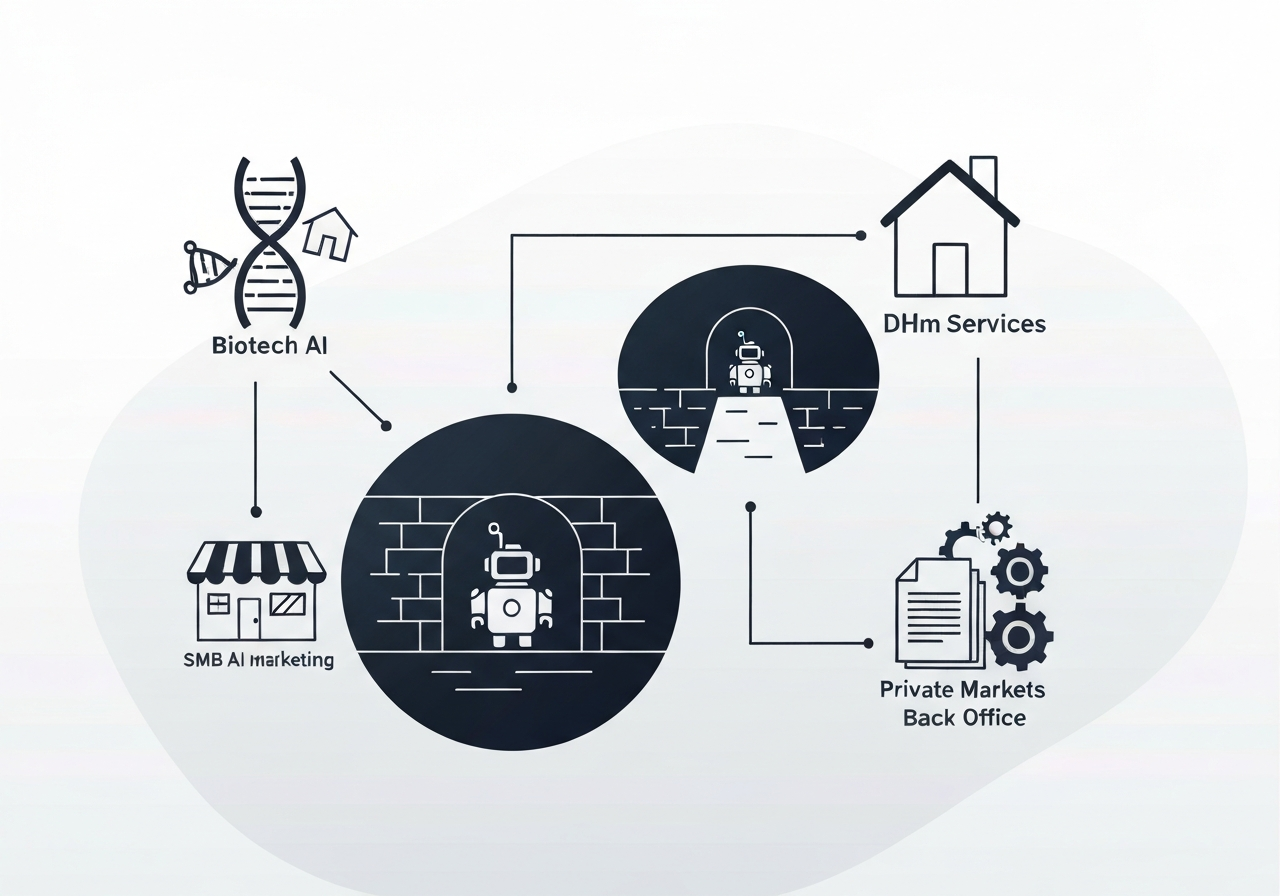
Even as headline-grabbing mega-rounds dominated parts of last month’s venture market, a cluster of quieter early-stage financings signaled where investors believe AI can deliver the most immediate payoff: rebuilding ‘labor-heavy’ industries by removing operational bottlenecks that have long resisted digitization.
Across five seed and pre-seed deals spanning life-sciences AI, home-services operations, subterranean defense technology, AI-driven marketing for small businesses, and private-market back-office automation, a common thesis emerged. Rather than betting on generic models, investors are leaning into ‘vertical AI’—software designed to understand domain workflows end-to-end, automate routine decision-making, and compress cycles that typically depend on scarce human expertise.
Radical Numerics emerges with $50M seed to build ‘general-purpose biological intelligence’
San Francisco-based Radical Numerics disclosed a $50 million seed round last month and exited stealth, in one of the largest seed financings in the life-sciences AI category this year. Emergence Capital led the round, with participation from Obvious Ventures, Triatomic Capital, Factory, and First Spark Ventures. Stripe co-founder Patrick Collison was listed as a pre-seed backer.
The company was founded by members of the team behind ‘Evo,’ an early foundation-model effort aimed at reading and generating DNA at scale. Radical Numerics says it is building ‘general-purpose biological intelligence’ capable of jointly interpreting DNA, RNA, proteins, and other biological data types—an approach intended to accelerate drug discovery, cancer diagnostics, and biosecurity.
Alongside the funding, the company introduced a next-generation genome language model it calls ‘OmniAI.’ The pitch goes beyond automating lab workflows: Radical Numerics is positioning its platform to both advance therapeutic development and help detect and defend against AI-enabled biological threats—an explicit nod to the dual-use risks now central to bio-AI debates.
CEO Eric Nguyen argued that AI could ultimately progress from pattern recognition to actively controlling biological function and designing new forms of life. That vision underscores why life-sciences AI is increasingly viewed as one of the most commercially powerful application layers—and one likely to attract heightened regulatory and national-security scrutiny.
ProBook raises $40M to modernize dispatch and scheduling for home-services businesses
New York-based ProBook secured $40 million in new financing, combining a $34 million Series A led by Andreessen Horowitz and a $6 million seed round led by Sequoia Capital. Sequoia also participated in the Series A.
ProBook describes its product as an ‘AI operating system’ for plumbers, electricians, HVAC providers, and other home-services operators. The company’s emphasis is not on simply adding a chatbot, but on building an integrated platform centered on dispatch—bundling lead intake, scheduling, customer messaging, and external communications in a single workflow designed to reduce technician idle time and ease administrative staffing burdens.
The target market remains notably under-digitized, with many operators still relying on phone calls, clipboards, and spreadsheets. That lag is precisely the opportunity: in businesses with thin margins and variable demand, incremental utilization gains can translate directly into profitability. The round also reflects a broader investor pivot toward ‘vertical AI’ products that solve highly specific, operationally complex problems—especially in service sectors where automation has room to run.
Traysa brings ‘subterranean battlefield’ concept to defense tech with $25M seed
Austin-based Traysa raised a $25 million seed round led by Silent Ventures, with Lux Capital, Aura Global, Never Lift Ventures, Mana Ventures, and Impatient Ventures participating. Strategic angel investors included founders and executives affiliated with Anduril Industries, the Ereborn founding team, and entrepreneur Steve Blank.
Traysa is branding itself as the first ‘subterra’ defense technology company, arguing that modern defense innovation has disproportionately focused on air, sea, and ground systems while overlooking underground terrain. The startup is developing robots designed to autonomously explore, map, and breach tunnel networks, as well as a high-speed tunneling platform intended to create new underground access routes and transport equipment, sensors, or explosives.
The thesis tracks recent shifts in warfare, where the growing threat from drones and precision strikes has pushed critical assets underground—cited examples include Iranian nuclear facilities, tunnel networks in Gaza, and subterranean military infrastructure in Ukraine. As concealment increases, so does demand for detection, navigation, and access technologies tailored to underground environments.
According to Crunchbase data cited in the report, global defense-tech startups raised roughly $15.8 billion in the first half of 2026, though the bulk of capital flowed into air, land, and sea platforms. Traysa’s round suggests investors are beginning to fund ‘underexplored’ layers of defense infrastructure where the technical barriers are high and competition remains limited.
Pie raises $23.7M to help small businesses show up in AI search—and answer the phone with AI
New York-based Pie raised $23.7 million last month and emerged from stealth. A $19.5 million Series A was led by Lightspeed Venture Partners, with Capital One Ventures, SciFi VC (founded by Max Levchin), F-Prime, Commerce Ventures, Restive, Cambrian Ventures, and Wex Venture Capital also participating.
Pie is building an AI-driven growth platform aimed at local merchants such as cafes and restaurants, helping them become more discoverable across AI search tools—such as ChatGPT and Claude—alongside established discovery channels like Google Maps, Facebook, and Yelp. The bet is that consumer intent is increasingly expressed through conversational AI interfaces rather than traditional search engines, creating a new marketing surface area that small businesses are poorly equipped to manage.
The company also unveiled ‘Front Desk,’ an AI agent that handles 24/7 phone calls, bookings, and customer inquiries—targeting a familiar pain point for owner-operators who cannot reliably answer calls during peak hours or after closing.
In a market often dominated by enterprise AI narratives, Pie’s fundraising stands out as a wager on ‘Main Street’ adoption. The founding team’s background at Square and Toast signals a product mindset shaped by payments and point-of-sale ecosystems, where small operational improvements can have outsized business impact.
Nomera raises $2M pre-seed to automate private-market back-office paperwork
Berlin-based Nomera raised a $2 million pre-seed round led by 14Peaks Capital, with participation from Redstone.VC and individuals connected to KKR and Intapp, according to the report.
Nomera is developing AI agents to automate operational work in private capital markets, where processes often remain fragmented across email threads, PDFs, spreadsheets, and disconnected vendor tools. Unlike public markets—supported by standardized infrastructure—private markets still face persistent ‘paperwork bottlenecks’ that slow execution, increase error risk, and consume expensive professional time.
Broader implications: capital follows workflow friction, not novelty
Taken together, the five deals illustrate a maturing AI investment lens: the most compelling early-stage opportunities are increasingly tied to measurable workflow friction rather than model novelty. Whether the domain is biology, field services, defense, local commerce, or private capital, the common promise is the same—software that reduces dependence on scarce human coordination and makes previously manual operations more scalable.
If this pattern holds, the next wave of AI winners may be defined less by broad platform ambition and more by deep integration into specific industries—where the hardest problems are not just technical, but operational, regulatory, and trust-driven.






















Comment 0