

 News
News  Coin Information
  About us
  Customer Service


 Add as a preferred source on Google
Taurus has rolled out full-stack support for Hedera (HBAR) across its digital asset infrastructure, a move that could simplify how banks and regulated financial institutions custody crypto and issue tokenized products within a single platform.
The Swiss crypto infrastructure provider said Tuesday ET that it completed end-to-end integration of Hedera’s technology stack through a strategic collaboration with the Hashgraph Association, expanding capabilities available to more than 40 banks and regulated institutions that use Taurus’s platform, including Deutsche Bank, State Street, and others.
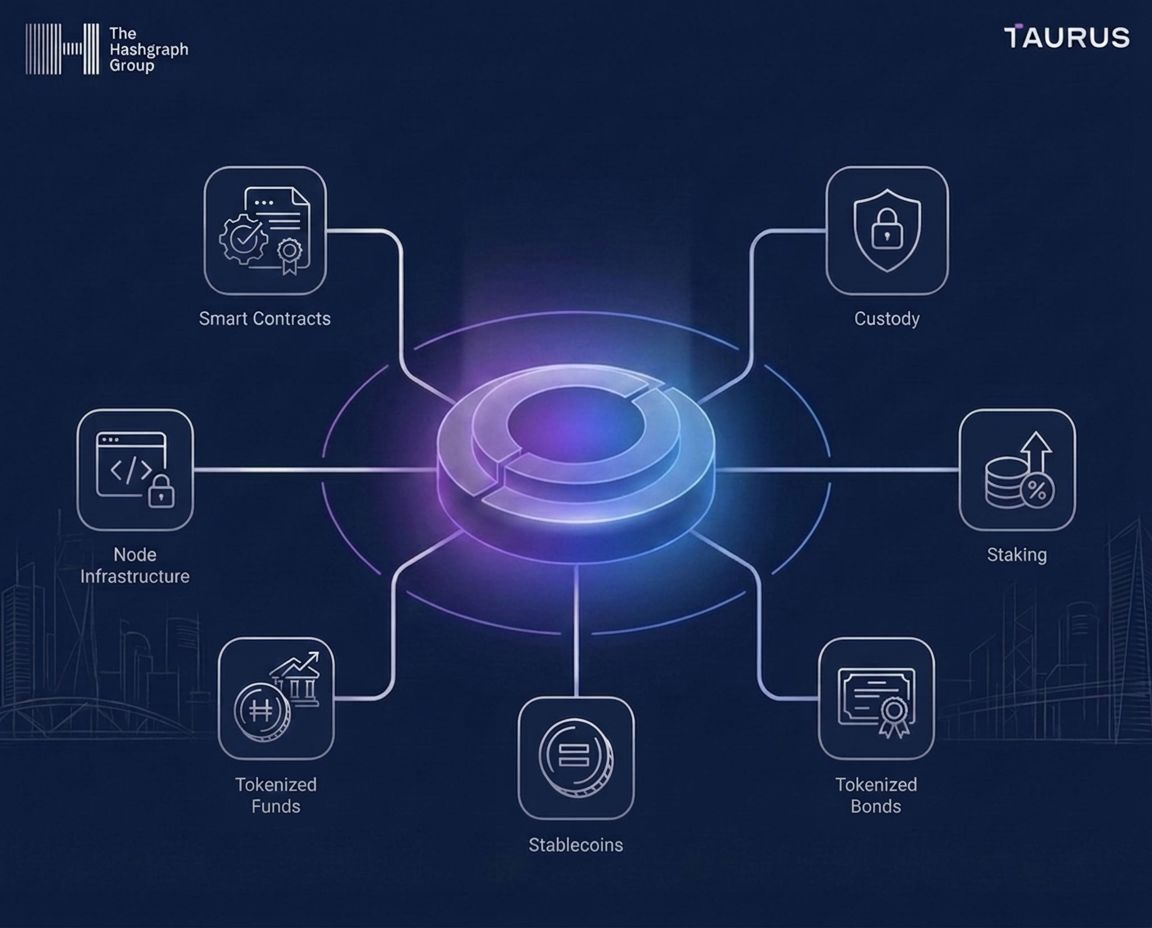
The expansion was implemented in three phases over roughly 18 months, culminating in the addition of smart contract functionality. With that final stage live, institutional clients can now custody and stake Hedera’s native asset, HBAR, while also issuing tokens and managing programmable products—such as tokenized bonds, funds, and stablecoins—inside the same Taurus environment. Taurus said the same due diligence and risk management framework applies across these activities, aiming to reduce the operational overhead that typically comes with adding new networks or product lines.
In practical terms, Taurus is positioning the Hedera rollout as an answer to a persistent institutional pain point: banks often deploy separate providers for custody and tokenization, then repeat procurement, integration, and risk assessment cycles each time strategy expands. By supporting the full Hedera stack natively, Taurus argued that launching new Hedera-based offerings becomes closer to a configuration change than a fresh vendor onboarding process—an efficiency pitch that resonates as tokenization moves from pilots toward scaled deployments.
The integration spans Taurus Protect, Taurus Explorer, and Taurus Capital, covering custody, staking, node infrastructure, and native token issuance via the Hedera Token Service. Taurus also added support for deploying smart contracts through Hedera’s Ethereum Virtual Machine (EVM)-compatible service, enabling institutions and technology partners to build using Solidity and standard Ethereum developer tooling.
That tooling compatibility is expected to broaden appeal beyond banks themselves. Tokenization engine providers, stablecoin issuers, and fund administrators can operate Hedera-based services under Taurus’s custody framework without standing up separate infrastructure, potentially accelerating time-to-market for bank-facing products while keeping controls aligned with regulated operational standards.
The Hashgraph Association, a Swiss non-profit focused on expanding the Hedera ecosystem globally, said it supported the build-out through funding, education, and ecosystem development programs. The two organizations announced a strategic partnership in 2025, and Taurus joined the association’s global membership program earlier this year.
“As Europe’s MiCA framework comes into effect and U.S. discussions around the CLARITY Act advance, institutional investors and highly regulated financial institutions are finding it easier to enter Web3 with greater confidence,” said Kamal Youssefi, president of the Hashgraph Association, framing the Taurus integration as a timely step toward compliant adoption.
Taurus co-founder and managing partner Lamine Brahimi said institutions are increasingly asking for consolidation rather than point solutions. “Financial institutions want a single platform that supports their broader digital asset strategy—not infrastructure that only covers one use case,” he said, adding that full Hedera support allows clients to use ‘native tokenization’, smart contracts, and custody within regulated infrastructure they already trust.
Micha Roon, head of engineering at Hashgraph Group, emphasized the operational benefits of consolidation, arguing that a one-platform approach reduces the technical friction created by multiple vendors and allows teams to expand from basic custody into programmable tokenization without additional integration projects.
Hedera is a public distributed ledger network governed by a council of global organizations that includes Google, IBM, Deutsche Telekom, Standard Bank, and, more recently, Accenture and FedEx. The network has processed more than 70 billion transactions to date.
The announcement lands as stablecoin rules mature in major markets and tokenization steadily shifts from experimentation to procurement-led deployment. In that environment, banks evaluating infrastructure providers are increasingly focused on how comprehensively a provider supports a given network’s features—including custody, staking, issuance frameworks, and smart contracts—alongside the risk controls required for regulated operations.
🔎 Market Interpretation
- Taurus adds full-stack Hedera (HBAR) support, positioning itself as an all-in-one rails provider for regulated institutions that want custody, staking, issuance, and smart contracts on a single platform.
- Institutional market signal: consolidation over point solutions. The rollout targets a common bank pain point—separate vendors for custody vs. tokenization—by reducing repeat procurement, integration, and risk-review cycles when expanding products.
- Tokenization moving from pilots to scaled deployment. Taurus frames Hedera enablement as a “configuration change” rather than a fresh onboarding, aligning with procurement-led rollouts and operational efficiency demands.
- Regulatory tailwinds (Europe’s MiCA implementation and U.S. CLARITY Act discussions) are cited as increasing confidence for banks entering Web3, raising demand for compliant, audit-ready infrastructure.
- Developer-access expansion via EVM compatibility. Hedera’s EVM-compatible service and Solidity tooling support can attract non-bank ecosystem players (tokenization engines, stablecoin issuers, fund admins) to build bank-facing products on Hedera under Taurus controls.
- Competitive framing: infrastructure providers are increasingly evaluated on breadth of native network feature coverage (custody + staking + issuance + smart contracts) and how seamlessly controls extend across each activity.
💡 Strategic Points
- What Taurus integrated: Taurus Protect (custody), Taurus Explorer (node infrastructure/operations), and Taurus Capital (issuance/tokenization workflows), now spanning the full Hedera stack.
- Key new capabilities for institutions:
- Custody of HBAR within Taurus’s regulated infrastructure.
- Staking support for HBAR (yield/participation) under the same operational framework.
- Native token issuance using Hedera Token Service (HTS) for products like tokenized bonds, funds, and stablecoins.
- Smart contract deployment via Hedera’s EVM service using Solidity and standard Ethereum developer tooling.
- Operational impact: one due diligence and risk-management framework applied across custody, staking, issuance, and programmable products—reducing duplication of controls and vendor management overhead.
- Time-to-market advantage: by keeping Hedera support native inside Taurus, launching new Hedera-based offerings can be faster than multi-vendor stacks that require repeated integrations and audits.
- Ecosystem enablement: third-party providers (stablecoin issuers, tokenization engines, fund administrators) can run Hedera-based services while relying on Taurus custody and governance standards—potentially accelerating bank-grade product launches.
- Adoption pathway implied: institutions can start with basic custody, then expand to staking and programmable tokenization without changing platforms—lowering internal project friction.
- Partnership leverage: the Hashgraph Association supported the build-out with funding, education, and ecosystem programs, reinforcing long-horizon integration (three phases over ~18 months) rather than a quick connector.
📘 Glossary
- Taurus: Swiss digital asset infrastructure provider offering custody, issuance/tokenization, and related services for banks and regulated institutions.
- Hedera (HBAR): Public distributed ledger network governed by a council of global organizations; HBAR is its native asset.
- Full-stack (end-to-end) integration: Support across the core functions needed to operate on a network—custody, staking, issuance, node infrastructure, and smart contracts—inside one platform.
- Custody: Secure holding/management of digital assets for institutions, typically including policy controls, approvals, and auditability.
- Staking: Mechanism to participate in network operations and potentially earn rewards by delegating/locking assets (here, HBAR).
- Tokenization: Converting real-world or financial assets (e.g., bonds, funds) into on-chain tokens for issuance, transfer, and lifecycle management.
- Stablecoin: A token designed to maintain a stable value, usually pegged to fiat currency, often requiring strong compliance and reserve controls.
- Hedera Token Service (HTS): Native Hedera framework for creating and managing tokens with built-in governance features.
- Smart contracts: Self-executing on-chain programs enabling programmable financial products and automated workflows.
- EVM-compatible: Able to run Ethereum-style smart contracts, enabling use of familiar tools and languages like Solidity.
- Solidity: The predominant programming language for Ethereum smart contracts.
- MiCA: European Union’s Markets in Crypto-Assets regulatory framework governing crypto assets and service providers.
- CLARITY Act: A U.S. legislative proposal discussed as part of efforts to clarify digital asset market structure and oversight.

















Comment 0