

 News
News  Coin Information
  About us
  Customer Service


 Add as a preferred source on Google
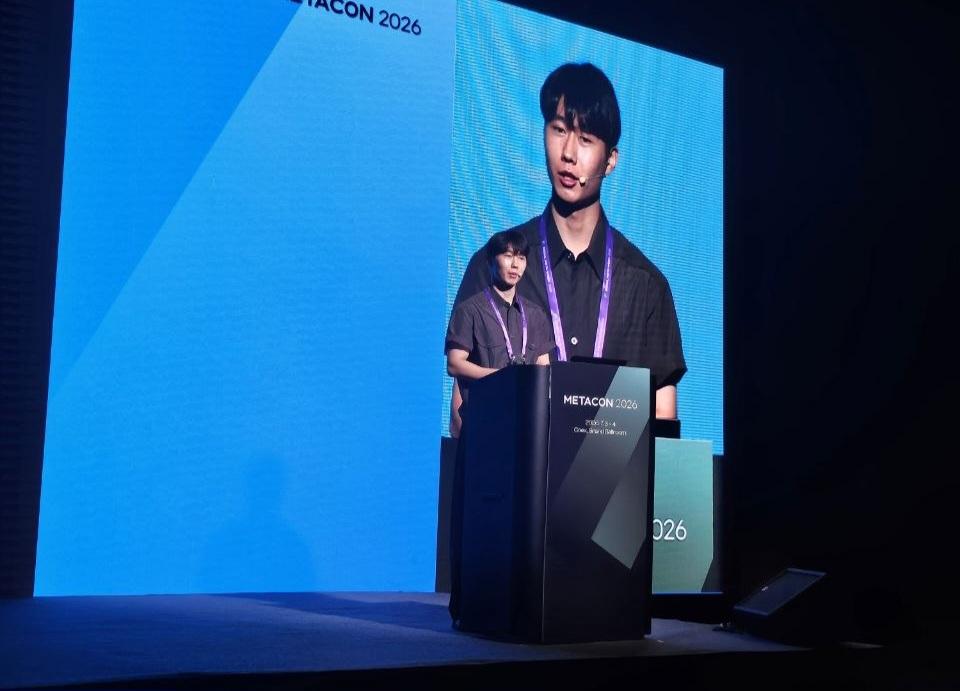
As AI tools make it easier than ever to build new products, the harder problem is increasingly finding users—and keeping their attention long enough to prove value. That was the central message at MetaCon 2026 in Seoul, where speakers argued that in an era of infinite content and near-zero production costs, 'attention' has become the scarcest resource.
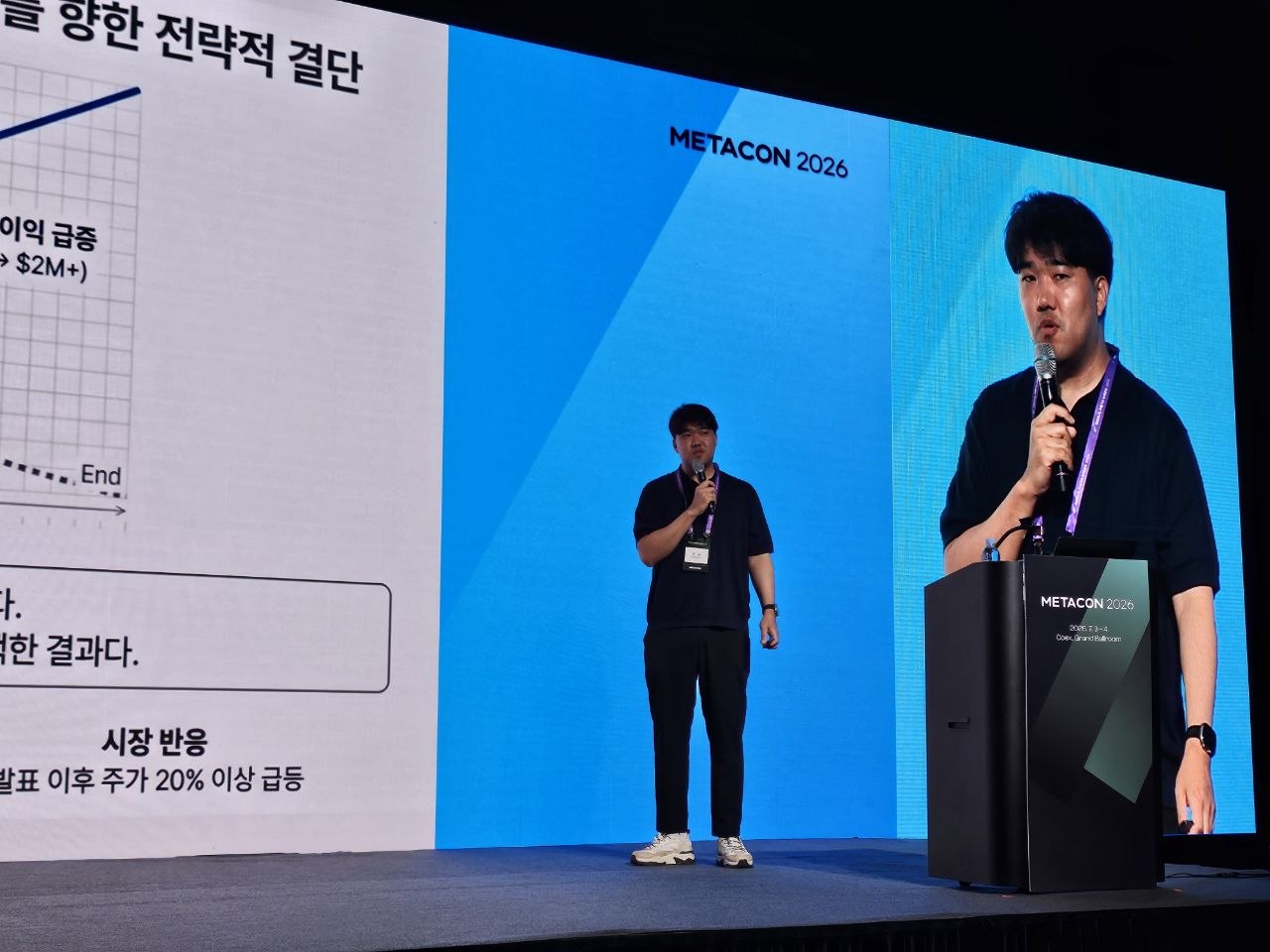
Lee Joo-hyung, a manager at Infograb, delivered a session titled “How do AI-built products reach users?” on Friday UTC (July 3–4 in Seoul), during MetaCon 2026, a major South Korean AI conference hosted by TV Chosun with Tokenpost as co-organizer. Lee framed the challenge in blunt terms: the democratization of product creation does not translate into democratized distribution. “As more people can build, the cost of earning attention rises,” he said, pointing to the growing gap between building quickly and validating demand in the real world.
Lee anchored his talk in the concept of the 'attention economy'—the idea that when information is abundant, human attention becomes the limiting factor. In practical terms, he argued that successful products in the AI era require two parallel disciplines: defining a user problem precisely enough to create meaningful value, and designing an effective way to 'hook' users amid relentless noise.
To operationalize that thesis, Lee introduced an approach Infograb calls 'EAM (Engineering as Marketing)'. Rather than leading with promotional content, EAM treats engineering output itself as the marketing surface: a team releases a single, narrowly scoped feature as a standalone free tool, then measures real user interest and feedback before committing to a broader product roadmap.
The advantage, Lee argued, is that the method proves capability through working software rather than claims. By splitting the product lifecycle into smaller iterations—weeks or even days rather than months—teams can observe market pull quickly, discard weak ideas early, and double down on the ones that generate strong organic traction. Users, meanwhile, receive a useful free asset, creating what Lee described as a mutually beneficial exchange.
Infograb runs this pipeline through a virtual agent it calls “Gary Agent,” which is designed to identify and validate potential product ideas from within the organization’s own workflow. According to Lee, the agent analyzes internal context stored across Notion-based wikis, Slack conversations, customer feedback, and code repositories to surface recurring friction points, high-leverage AI skills already used internally, and unmet customer requests that could be turned into tools.
Before any build proceeds, the team applies a structured validation process inspired by Y Combinator-style office hours. Lee said an idea must clear four questions: whether users truly experience the pain point, how they currently solve it, what the smallest viable unit of functionality would be, and whether there is supporting market signal or data. If the team cannot answer all four, the concept does not advance.
As a case study, Lee pointed to a tool built to diagnose issues inside an internal automation system, M8N. The team observed common operational problems—unused or abandoned nodes, insufficient error handling, and workflows that continued running even after their original creators had left the company. Using Gary Agent, Infograb produced an “M8N workflow complexity analyzer” and released it publicly, where it drew strong user response. That validation, Lee said, helped justify development of a larger commercial product called “Napper.”
Beyond product validation, Lee also described how Infograb uses agent-based workflows to scale marketing production—particularly AI-generated brand video. The company operates pipelines for automatically producing product demos and AI-based user-generated-content-style testimonials, organized as a multi-agent “team” rather than a single general agent. Lee argued this structure matters because video work requires heavy context management and multiple specialized tasks; concentrating everything in one agent can degrade both quality and speed.
In Infograb’s setup, a “CEO agent” coordinates task allocation, maintains shared context, and performs quality checks, while final approval remains with a human—an approach commonly referred to as 'human in the loop'. Lee said the pipeline integrates multiple tools for search, generation, editing, and rendering, including Higgsfield for video generation, Gemini TTS for voice, Playwright for automation, and FFmpeg for post-processing.
To improve output quality, the team pre-defines references for characters and environments, analyzes product strengths and market pain points to generate storyboards and copy, and—rather than relying on script-only prompts—creates scene-by-scene still images first and feeds them into the video model as additional guidance.
Lee concluded that shipping AI products is increasingly less about raw building speed and more about proving relevance in the marketplace. Whether or not teams adopt complex agent systems, he urged builders to test demand by extracting a small capability into a free tool, learning from real usage, and competing directly for user attention—the decisive currency of the AI era.
MetaCon 2026 was held July 3–4 in Seoul at the COEX Grand Ballroom under the theme “AI Makers Rise,” bringing together speakers across technology, business innovation, marketing, and investment to examine how AI is reshaping industries and day-to-day work.
🔎 Market Interpretation
- Attention is the binding constraint: As AI lowers product-building costs and accelerates shipping, the scarce resource shifts to user attention—making distribution, retention, and proof of value the primary differentiators.
- Democratized creation ≠ democratized distribution: More builders entering the market increases competition for the same finite audience, raising the effective cost of acquiring and keeping users.
- Validation speed becomes a competitive moat: Teams that can test real demand in days/weeks (not months) can prune weak ideas early and reallocate resources toward products with organic pull.
- Working software outperforms marketing claims: The article frames proof-by-tooling (shipping a useful free feature) as a stronger market signal than promotional messaging alone.
💡 Strategic Points
- EAM (Engineering as Marketing): Treat engineering output as the marketing surface by releasing a single narrowly scoped feature as a standalone free tool, then measure usage and feedback before expanding into a full product.
- Iteration structure: Break the product lifecycle into small releases (days/weeks) to (1) observe market pull quickly, (2) discard weak concepts early, and (3) double down on features that earn organic traction.
- Idea mining via internal context: Infograb’s “Gary Agent” scans internal sources (Notion, Slack, customer feedback, code repositories) to surface recurring friction points, repeated requests, and high-leverage internal capabilities that can be productized.
- Four-question gate for validation (YC-style):
- Do users truly feel the pain?
- How do they solve it today?
- What is the smallest viable unit of functionality?
- Is there supporting market signal/data?
Ideas that cannot clear all four do not proceed.
- Case study: internal pain → public tool → commercial product: Operational issues in an automation system (unused nodes, weak error handling, orphaned workflows) led to a public “M8N workflow complexity analyzer,” which generated strong response and justified building a paid product, “Napper.”
- Agent-based marketing production at scale: For brand video, Infograb uses a multi-agent workflow rather than a single general agent to handle context-heavy, specialized tasks (research, scripting, scene planning, generation, edits, rendering).
- Human-in-the-loop governance: A “CEO agent” coordinates tasks, preserves shared context, and performs QA, while a human retains final approval—balancing speed with brand and accuracy control.
- Toolchain integration for automated content: The pipeline combines Higgsfield (video generation), Gemini TTS (voice), Playwright (automation), and FFmpeg (post-processing) to produce demos and UGC-style testimonial videos.
- Quality tactics for generative video: Pre-define character/environment references, derive storyboards from product strengths and market pains, and guide models with scene-by-scene still images (not prompts alone) to improve consistency and fidelity.
📘 Glossary
- Attention economy: A market dynamic where abundant information/content makes human attention the limiting factor, turning attention into a scarce, valuable currency.
- EAM (Engineering as Marketing): A go-to-market approach where shipping small, useful, working tools functions as marketing and demand discovery.
- Market pull / market signal: Evidence of real demand (usage, shares, sign-ups, feedback, repeat use) indicating users actively want the solution.
- Minimum viable unit (MVU): The smallest slice of functionality that can deliver value and generate measurable learning about user demand.
- Agent-based workflow / multi-agent system: Multiple specialized AI agents collaborating on different tasks with shared context, often coordinated by an orchestrator agent.
- Human in the loop: A control pattern where humans review/approve or intervene in AI-driven processes to reduce errors and maintain quality.
- Organic traction: User adoption and engagement driven by word-of-mouth or intrinsic utility rather than paid promotion.
- Validation: Testing whether a problem is real and the solution is desired by observing real user behavior and outcomes, not just opinions.





















Comment 0