

 News
News  Coin Information
  About us
  Customer Service


 Add as a preferred source on Google
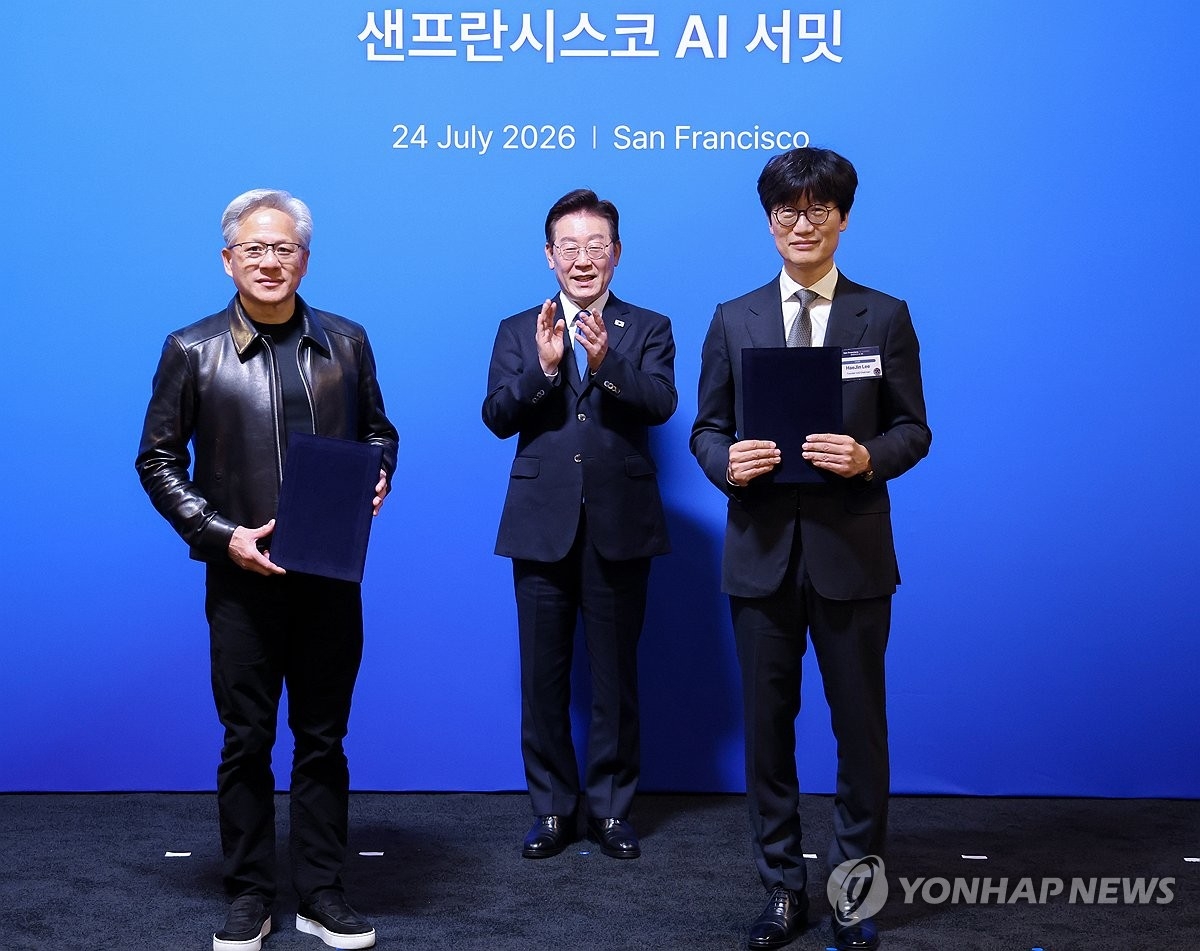
South Korea’s leading technology groups are escalating the race to build ‘gigawatt-class’ AI data centers, partnering with global heavyweight investors and chip suppliers as the market shifts from software-led competition to a contest over power, servers, and supply chains.
In developments disclosed this week, Naver—the operator of one of Korea’s largest internet platforms—said it is moving to formalize plans for a ‘global AI factory’ with backing from Nvidia ($NVDA) and Brookfield. The concept refers to an integrated production base that combines large-scale GPU clusters, hyperscale data centers, power procurement, and cooling systems to train and run AI models at industrial scale.
At an AI-related event held in San Francisco, Naver board chair Lee Hae-jin said on Thursday U.S. local time (early Friday UTC) that the company expects a combined $10 billion in investment and infrastructure support. Under the outline shared, Naver would secure a $1 billion strategic investment from Nvidia to expand GPU supply and deepen technical collaboration, while Brookfield would provide up to $9 billion in funding and infrastructure support aimed at building gigawatt-scale facilities.
The partnerships highlight how Korean firms are attempting to translate domestic data-center operating experience into global infrastructure plays. Naver has spent years designing and running data centers to support search, e-commerce, content, and cloud services, but scaling that know-how into hyperscale projects requires capital intensity and internationally resilient procurement. Brookfield brings experience in financing large infrastructure—particularly data centers and energy-related assets—while Nvidia remains the dominant provider of GPUs, the core component of today’s AI computing stacks.
Lee also framed the initiative as part of a broader push to avoid AI capabilities becoming overly concentrated among a small number of mega-platforms. He said the company aims to support an ecosystem in which more countries, businesses, and individuals can develop and utilize their own AI—language that echoes a growing global debate over ‘sovereign AI’ and access to compute.
Other Korean groups are advancing parallel alliances. SK Telecom ($SKM) is pursuing construction and expansion of AI data centers with Nvidia at a scale of up to 2 gigawatts, and said it has reached an understanding on priority allocation for Nvidia’s next-generation GPU system referred to as ‘Vera Rubin.’ The telecom operator is also in discussions with AI startup Anthropic to invest in and collaborate on domestic gigawatt-scale data-center projects. Building on an ongoing AI data-center effort in Ulsan with Amazon Web Services, SK Telecom outlined plans to broaden cooperation to major hubs across the country to secure large AI computing capacity.
Samsung SDS (Samsung SDS) also announced a strategic partnership with Anthropic, targeting the enterprise AI market while cooperating on training AI engineers—an acknowledgement that corporate adoption will depend not only on models, but also on integration expertise, security controls, and a sustained talent pipeline.
Industry and government messaging around the announcements suggests Korea is treating AI infrastructure as a national competitiveness issue rather than a series of isolated fundraising events. The combined initiatives discussed by Korean companies and global partners point to data-center investment cooperation tied to roughly 5 gigawatts of power capacity and an estimated two million GPUs on an Nvidia B200-equivalent basis—figures that underscore how rapidly AI has become an energy- and hardware-driven industry.
Put simply, the AI race is no longer won by model quality alone. Competitive advantage increasingly hinges on ‘liquidity inflow’ for capex-heavy buildouts, access to advanced semiconductors, power-grid readiness, land availability, and cooling technology—constraints that can bottleneck even well-funded projects. Korea’s presidential office described the latest wave of partnerships as a core investment base for three mega-project categories: semiconductors, AI data centers, and ‘physical AI’ initiatives that connect AI systems to real-world machines and environments.
The central question now is execution speed. AI data centers require synchronized progress across permitting, grid interconnection, construction, and long-lead equipment procurement, meaning delays can erase first-mover advantages. If the announced alliances translate quickly into deployed capacity, Korea’s major IT groups could increasingly evolve from service-centric operators into full-scale AI infrastructure providers—reshaping competitive dynamics across Asia’s compute market without signaling any immediate change in near-term consumer services.











Comment 0