

 News
News  Coin Information
  About us
  Customer Service


 Add as a preferred source on Google
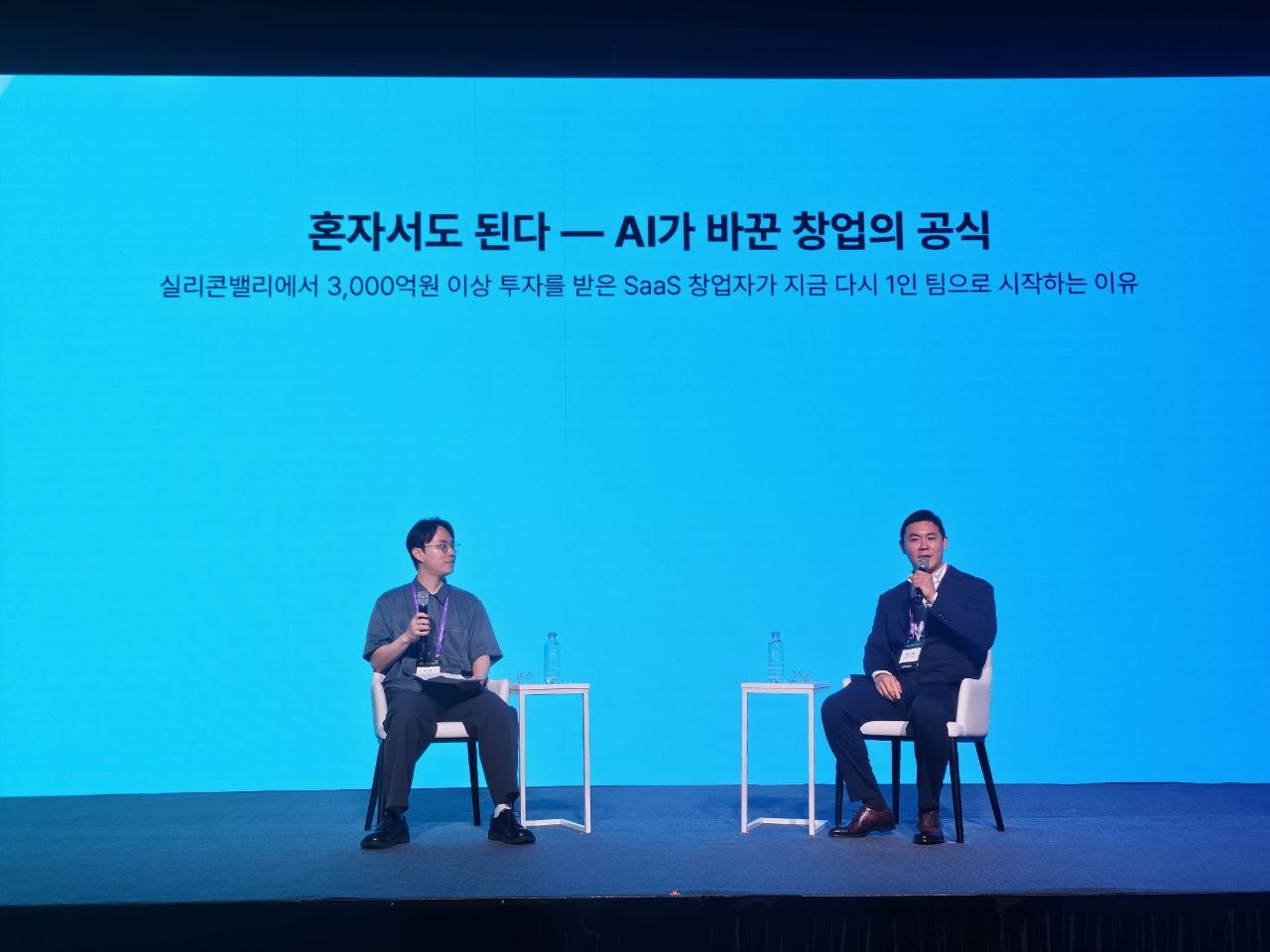
As AI tools increasingly handle tasks once reserved for engineering teams, the startup playbook is being rewritten—shifting the decisive advantage from capital and headcount toward execution speed, product judgment, and the ability to encode taste into machines.
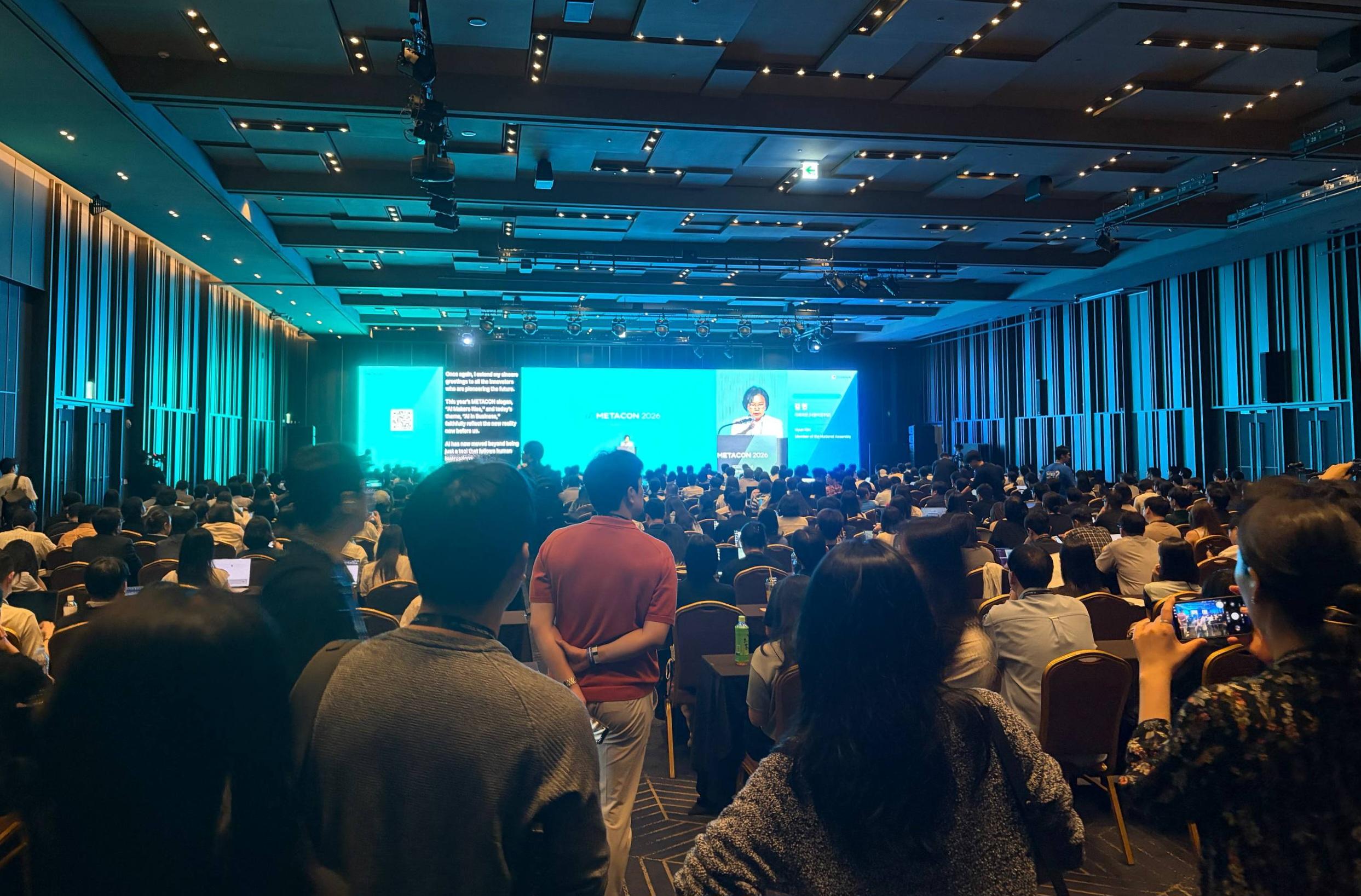
That was the central message from Ryu Gi-baek, founder of Palette Studios, during a fireside discussion with Evan, CEO of VRL, at ‘MetaCon 2026’, a major AI conference held in Seoul on Friday UTC (Thursday ET). The event ran July 3–4 at COEX’s Grand Ballroom and was hosted by TV Chosun with TokenPost as co-organizer under the theme “AI Makers Rise.”
Ryu drew on his Silicon Valley experience as the founder of recruiting SaaS company Fountain, which previously raised roughly 300 billion won (about $220 million) from backers including Y Combinator and SoftBank, to argue that AI has sharply reduced development costs—weakening the traditional assumption that venture capital is a required step for ambitious companies.
“In the past, seed and Series A were almost a formula,” Ryu said, describing how taking institutional funding can narrow strategic freedom by implicitly committing founders to an ‘exit’ path such as an IPO or M&A. “Now there are many more ways to grow without VC.” He added that with AI tooling effectively acting like low-cost labor—“an AI employee” that can be run for around $200 a month—teams can prototype, test, and ship with far less upfront capital than before.
Ryu also offered a clear-eyed view of where Korea is best positioned in the global AI stack. While the U.S. benefits from deep pools of data, capital, and GPU infrastructure—and China has a massive domestic market and platform leverage—Korea is structurally less advantaged in building frontier large language models, he said. The opportunity, instead, lies in the application layer: building products, workflows, and user experiences on top of foundational models.
He argued that this is also the first moment when Korean software can more naturally travel abroad. As enterprise tooling, collaboration patterns, and UI/UX conventions converge globally, “the possibility that services built in Korea can be exported to overseas markets is much higher than before,” he said.
Competitive edge in the AI era: teaching machines ‘taste’
A key theme of the discussion was that startups do not need to build their own models to create defensible value. Instead, Ryu emphasized the importance of developing proprietary ‘skills’ and ‘evaluation sets’—structured ways of defining what “good” looks like and training AI systems to align with that standard.
Ryu described a ‘skill’ as a practical guide that captures expert knowledge—often in the form of text—documenting how a team prefers to work, what it prioritizes, and the order of operations it follows. He outlined two paths to build such skills. The first is incremental: adding rules one by one during production (“don’t do it this way; do it that way”), which can be hard to validate across diverse real-world use cases. The second begins by defining an ‘evaluation set’—a formal benchmark for quality—so the AI can iterate toward passing that standard through repeated self-improvement.
“If you decide first what conditions a good result must satisfy, the AI can keep refining until it meets them,” he said, arguing that designing evaluation criteria may become more crucial than writing prompts or choosing a model.
At Palette Studios, Ryu said the company is attempting to “datafy” expert judgment by capturing how specialists explain their decisions. As an example, he described recording designers’ spoken feedback while reviewing portfolios—why something works or doesn’t—then extracting signals such as color harmony, typography, and brand sensibility to build multiple-choice style evaluation frameworks.
Ryu framed this as part of a wider shift in the AI industry: away from ‘data labeling’ tasks with clear right answers—such as identifying “person” or “car” in autonomous driving datasets—and toward markets centered on subjective evaluation, where the training signal comes from human preference and professional judgment, like “which writing is better” or “how would an expert revise this.” With that shift, he said, companies focused on evaluation and alignment are seeing rapid growth.
As AI systems take over more “average” production work, Ryu argued, human sensibility becomes more—not less—valuable. While AI can increasingly cover routine UI/UX and even significant portions of software development, standout creative work that breaks the sameness of machine-generated output—graphic design, brand identity, marketing design—will matter more for differentiation.
He added that Korea’s strengths in taste-driven industries such as K-pop, beauty, video, and interior design could translate into competitive advantage if local teams codify their own workflows and evaluation standards. “There is plenty of opportunity to build ‘Korean’ workflows and evaluation criteria,” he said.
The rise of lean teams and ‘one-person companies’
On organizational change, Ryu said work is increasingly organized not just around people, but around shared datasets and institutionalized judgment—what the team collectively considers good. The result is a structural shift in how companies operate: AI can handle lead generation, draft outbound emails, and write code, compressing the time from idea to testable product.
He pointed to emerging examples of companies reaching valuations in the hundreds of billions to trillions of won with minimal or even no full-time employees, arguing that the barrier is no longer building the first version but building something people genuinely want—and distributing it effectively.
In closing, Ryu urged builders to move beyond using AI tools as assistants and instead turn them into products others can use and pay for. With training resources and tooling widely available, he said, the most valuable education now comes from shipping to the market and learning from real adoption.
🔎 Market Interpretation
- Startup advantage is shifting from capital to execution: AI tooling reduces development labor and costs, making speed, product judgment, and iteration the key differentiators rather than headcount or fundraising.
- VC is becoming optional for more companies: With “AI employees” available at low monthly cost and faster prototyping, founders can reach product-market signals without immediately taking on VC constraints (exit pressure via IPO/M&A expectations).
- Korea’s strongest leverage is the application layer: Compared with the U.S. (data/capital/GPU depth) and China (domestic market/platforms), Korea is less structurally advantaged in frontier LLMs—creating a clearer opportunity to win via products, workflows, and UX built on top of foundation models.
- Global software export conditions are improving: As enterprise tools and UI/UX conventions converge globally, Korean-built software can more easily target international markets than in previous cycles.
- AI market is moving from objective labeling to subjective judgment: Growth is accelerating in evaluation/alignment businesses where “quality” is preference-based (e.g., better writing/design decisions), not binary ground truth labeling.
- Lean teams and even ‘one-person companies’ are more viable: AI compresses the path from idea → prototype → launch, enabling high valuation outcomes with minimal staff—shifting the bottleneck to demand creation and distribution.
💡 Strategic Points
- Don’t compete by training a new model—compete by encoding taste: Build defensibility through proprietary “skills” (work standards and processes) and “evaluation sets” (benchmarks that define what good looks like).
- Start with evaluation criteria to drive iteration: Define pass/fail (or graded) conditions first; then let the AI repeatedly refine outputs until it meets the benchmark. This can matter more than prompt tricks or model selection.
- Operationalize expert judgment (“datafy” decisions): Capture how experts explain choices (e.g., designers reviewing portfolios), extract signals (color harmony, typography, brand fit), and convert them into structured evaluation frameworks (e.g., multiple-choice rubrics).
- Build a library of workflows, not just prompts: Codify sequences of work (priority order, constraints, review steps). Prompts change; institutionalized workflows compound.
- Differentiate with human-led creativity where AI output becomes ‘same-y’: As AI covers average execution (UI/UX drafts, code generation), standout brand identity, marketing design, and creative direction become more valuable for differentiation.
- Turn internal AI usage into sellable products: Move beyond using AI as an assistant; package repeatable workflows and evaluation methods into tools others can pay for.
- Distribution becomes the core risk: When building is cheaper, the harder problems are finding a real user need, reaching users, and converting adoption—optimize go-to-market early, not after engineering.
- Explore “Korean taste” as a product moat: Leverage strengths in K-pop/beauty/video/interior design by formalizing localized workflows and evaluation standards that competitors can’t easily replicate.
📘 Glossary
- Application layer: Products and workflows built on top of foundation models (LLMs), focusing on user experience and business outcomes rather than training the core model.
- Foundation model / LLM: A large, general-purpose AI model trained on broad data that can be adapted for many tasks (e.g., text generation, reasoning, summarization).
- Skill (in this context): A structured description of how experts work—preferences, constraints, steps, and standards—used to guide AI behavior consistently.
- Evaluation set: A benchmark dataset/rubric that defines quality criteria so an AI system can be tested and iteratively improved toward a measurable target.
- Alignment: Methods to make AI outputs match human values, preferences, or professional standards (especially important when “correctness” is subjective).
- Data labeling: Annotating data with “right answers” (e.g., identifying objects in images). The article contrasts this with preference-based evaluation.
- AI employee: A framing for low-cost AI tooling that substitutes for certain labor tasks (drafting, coding, outreach), reducing dependence on large teams.
- Exit (IPO/M&A): A liquidity event expected by many institutional investors; taking VC can implicitly steer strategy toward these outcomes.
- One-person company: A business operated by a solo founder leveraging AI and automation to perform functions previously requiring a team.


















Comment 0