

 News
News  Coin Information
  About us
  Customer Service


 Add as a preferred source on Google
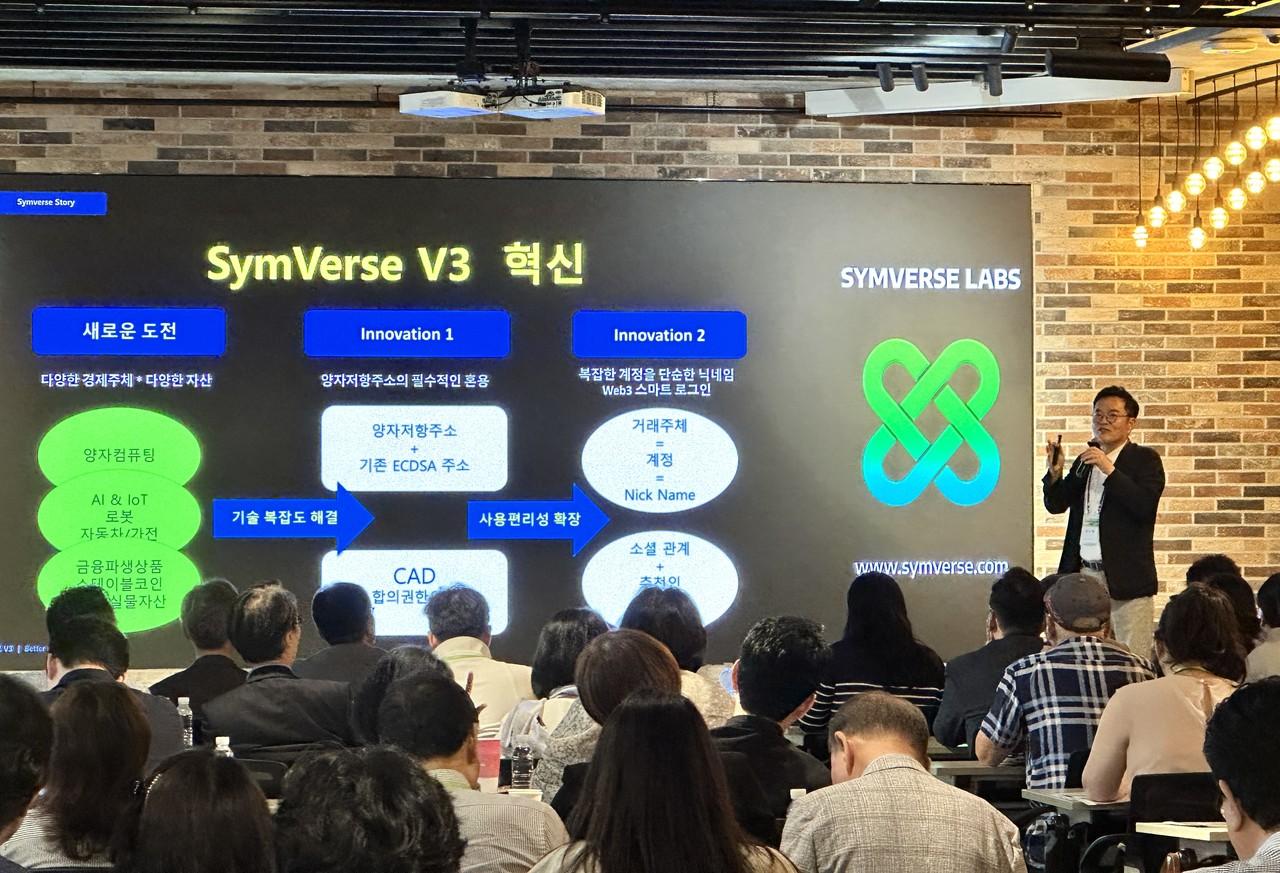
SymVerse Labs has unveiled the core of its next-generation mainnet, ‘SymVerse 3.0,’ positioning the network as an early mover in ‘quantum-resistant’ blockchain security while also rolling out an upgraded Web3 platform, ‘Sallt 2.0,’ aimed at consumer-facing social and AI applications.
The company held a business seminar on Wednesday ET (July 9) under the theme “SymVerse 2026: The Future of Quantum-Resistant Social Mainnet and Web3 Infrastructure,” bringing together blockchain business partners and media representatives. The event focused on how post-quantum cryptography could reshape blockchain security assumptions, and how SymVerse intends to expand toward “value-driven” infrastructure for real-world applications.
The program opened with remarks from SymVerse Labs CEO Suhyeok Choi, followed by congratulatory addresses from leaders of Korean industry groups, including the Digital Convergence Industry Association and the Korea Web3 Blockchain Association. A keynote speech by Hyoung-joong Kim, head of the Korea Fintech Society, framed the discussion around shifting Web3 paradigms—particularly the growing emphasis on identity, usability, and compliance-ready infrastructure as tokenized finance expands.
In the first technical session, Choi and SymVerse Labs CTO Hyukjun Ko presented what they described as a ‘quantum-resistant multi-cryptography mainnet.’ Their core argument: as quantum computing advances, it could eventually undermine the cryptographic foundations used to prove ownership of digital assets on most blockchains today. To prepare for that scenario, SymVerse 3.0 is designed to maintain compatibility with the widely used Elliptic Curve Digital Signature Algorithm (ECDSA) while adding support for multiple cryptographic schemes, including ML-DSA-87—reported by the company as aligned with the highest security level (Level 5) in U.S. National Institute of Standards and Technology (NIST) classifications.
A key challenge with post-quantum cryptography (PQC) is performance: signatures tend to be larger, which can bloat blocks and increase network overhead. SymVerse Labs said it addresses this through a method it calls ‘Consensus Authority Digest (CAD),’ compressing PQC signature outcomes into 32 bytes. The company framed that approach as a way to preserve scalability without sacrificing decentralization—an increasingly important trade-off as networks attempt to harden security while keeping transaction costs manageable.
SymVerse 3.0 also introduced a consumer-oriented identity model centered on a ‘nickname-based Web3 social graph mainnet.’ Building on its existing self-sovereign identity (SSI) structure, the company proposed a model where “blockchain address = nickname,” anchored by a 10-byte identifier. In practice, the idea is to shift account data ownership away from platform operators and toward users, while embedding link and referral functions at the protocol or platform layer to support social discovery and network-driven growth. SymVerse Labs pitched the model as a foundation for integrating digital finance with a broader data economy, emphasizing portability and user control.
The second session focused on ‘Sallt 2.0,’ SymVerse Labs’ updated Web3 platform. Taehyun Kim, a team lead at the company, showcased features and outlined an API and SDK guide for business integrations. The platform’s design leans on an intuitive nickname and referral system, which the company says can bolster retention for AI-driven and social decentralized applications (dApps) while reducing marketing costs. A live demo highlighted a “daily-use” wallet experience combining multichain connectivity, asset trading, chat, news, and gamified earning features such as “work” and lottery-style mechanics.
Attendees also participated in on-site engagement activities, including receiving token airdrops through the Sallt 2.0 app during networking breaks—an increasingly common tactic at ecosystem events to both stress-test user onboarding and seed early community activity.
The third session showcased partner implementations already deployed in the SymVerse ecosystem, aiming to demonstrate that the stack can support real-world workflows beyond experimental token use cases. Presentations included MediID, a medical-data AI initiative; a project from the National Delivery Riders Association focused on SSI and identity verification; UbCycle, a city waste-recycling initiative; and HH1446, a cultural heritage co-ownership project related to the historic Korean text Hunminjeongeum Haerye. Organizers emphasized these as examples of social and AI-integrated dApps operating on SymVerse infrastructure across multiple industries.
A closing Q&A featured Choi discussing the company’s global business roadmap and fielding questions on commercialization strategy. “This seminar was a meaningful opportunity to demonstrate SymVerse 3.0’s world-class security and cost efficiency directly to industry stakeholders,” Choi said, adding that the company aims to compete in segments that demand high-performance blockchain infrastructure, including stablecoins, security token offerings (STO), and real-world assets (RWA).
The rollout comes as blockchain builders increasingly confront two parallel pressures: advancing cryptographic threats on the long horizon, and near-term demands from institutions and consumer markets for simpler identity, smoother UX, and predictable costs. If SymVerse Labs can translate its post-quantum positioning and nickname-based identity layer into sustained developer adoption, the company could carve out a niche in Web3 infrastructure where ‘security hardening’ and ‘user-owned identity’ are becoming central competitive narratives.



















Comment 0