

 News
News  Coin Information
  About us
  Customer Service


 Add as a preferred source on Google

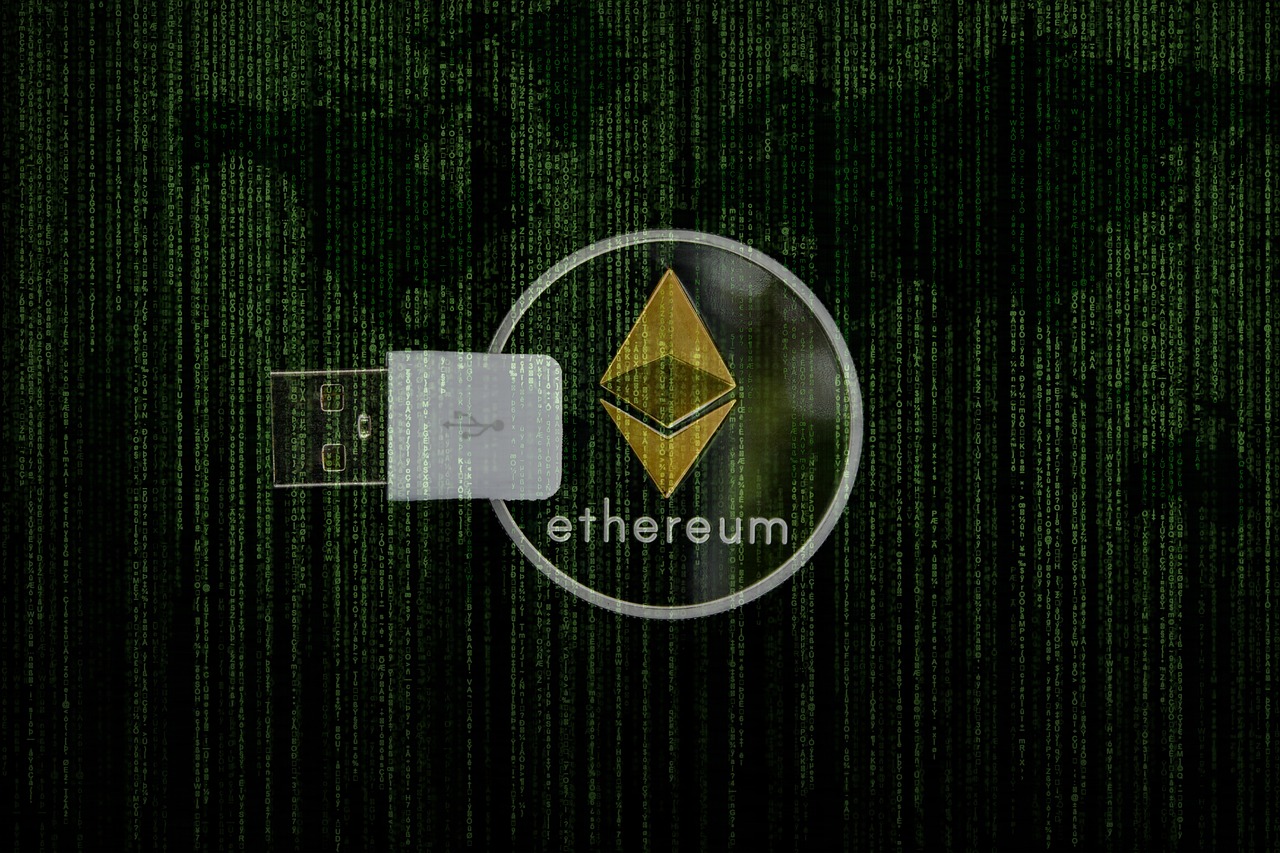
Ethereum co-founder Vitalik Buterin has outlined a 3–4 year “Lean Ethereum” roadmap that would overhaul core verification, security assumptions, and state management—an effort that could reshape the network’s long-term scalability and fees as competition among smart-contract platforms intensifies.
According to local reports citing Wu Blockchain, Buterin’s plan centers on introducing ‘recursive STARKs’ as a native verification component. STARKs (Scalable Transparent Arguments of Knowledge) are cryptographic proofs used to verify computation efficiently; recursion allows proofs to be aggregated, potentially reducing verification costs and improving throughput for rollups and other scaling systems.
Just as notably, the roadmap calls for replacing existing cryptography that may be vulnerable to quantum computers with ‘quantum-resistant’ alternatives. While practical large-scale quantum attacks remain speculative, the inclusion signals Ethereum’s intent to harden base-layer security well ahead of any real-world threat window.
Buterin also referenced a new ‘scalable state’ type targeted for introduction by 2030, with an ambition of supporting up to 100 terabytes of state. If achieved, this could allow certain tokens to transact with fees falling to less than one-tenth of current levels, addressing one of Ethereum’s persistent friction points: the cost and complexity of state growth.
On privacy, Buterin said Ethereum is considering a RISC-V or “Lean ISA” virtual machine approach to enable ‘programmable privacy’—a concept that aims to provide customizable confidentiality while maintaining compliance and verifiability. He added that the planned “Glasterdam” upgrade is expected to raise Ethereum’s gas limit significantly, a change that would increase block capacity, though it can also heighten performance and centralization trade-offs if not paired with broader client and network optimizations.
Ethereum (ETH) traded above $1,800 on OKX data, fluctuating around $1,802.43 at the time of reporting, up roughly 0.62% over 24 hours. The move came as the broader digital-asset market continued to digest shifting liquidity conditions, with traders weighing protocol-level fundamentals against macro-sensitive risk appetite.
In parallel, crypto exchange Kraken said it has expanded collateral options for eligible users outside the U.S., allowing certain tokenized equities and exchange-traded funds to be used as collateral for futures and margin trading. The initial lineup includes Apple ($AAPL), Nvidia ($NVDA), Tesla ($TSLA), Strategy ($MSTR), SPDR S&P 500 ETF ($SPY), and Invesco QQQ Trust ($QQQ), among a total of 10 assets, enabling users to open leveraged positions without selling their tokenized holdings.
Kraken set asset-specific collateral caps: up to $1 million for large ETFs, $250,000 for most single-stock tokens, and $100,000 for tokenized gold and tokenized Circle equity offerings, according to the report. The exchange noted that caps and haircuts may be adjusted periodically based on market conditions—reflecting a risk-management approach similar to traditional prime-broker margin frameworks, but applied to on-chain representations of off-chain securities.
Speculative activity also appeared to be building on BNB Chain amid renewed attention to meme coins tied to Changpeng Zhao (“CZ”), after he reposted an influencer’s cryptic message and responded with a phrase translated as “drop water into the BNB wallet,” according to local coverage. Several CZ-themed tokens briefly surged, highlighting how social-media catalysts can still drive short-term ‘liquidity inflow’ into high-beta microcaps, even as the sector faces recurring concerns over extreme volatility and rug-pull risk.
In South Korea, new token listings slowed sharply at major exchanges in the first half of 2026. An analysis of Upbit, Bithumb, Coinone, Korbit, and Gopax showed net new listings—new trading support minus delistings—fell to 49 compared with 191 a year earlier, a drop of about 74%. New listings were down 44% year over year, while delistings rose 258%, suggesting that exchanges are shifting from expansionary listing strategies toward tighter screening, liquidity management, and regulatory alignment as trading volumes and fee revenue come under pressure.
From an institutional perspective, asset manager Hashdex and brokerage Charles Schwab argued that Bitcoin’s recent relative softness versus U.S. equities may be temporary. Hashdex CIO Samir Kerbage said capital has rotated toward AI infrastructure, IPOs, and rate-sensitive trades rather than signaling deterioration in crypto fundamentals. He pointed to stablecoin transaction volumes in the first half of 2026 already exceeding the full-year total for 2025, alongside real-world asset tokenization expanding more than 60% year-to-date—data that, in his view, underscores resilient on-chain activity even as market pricing lags.
Charles Schwab’s head of digital asset research, Jim Fiorillo, said Bitcoin’s behavior still broadly matches historical post-halving patterns. He added that inefficient miners face production costs near $95,000 while the market’s average cost basis is around $80,000, conditions that could generate intermittent sell pressure during rebounds as some holders and miners manage balance-sheet risk.
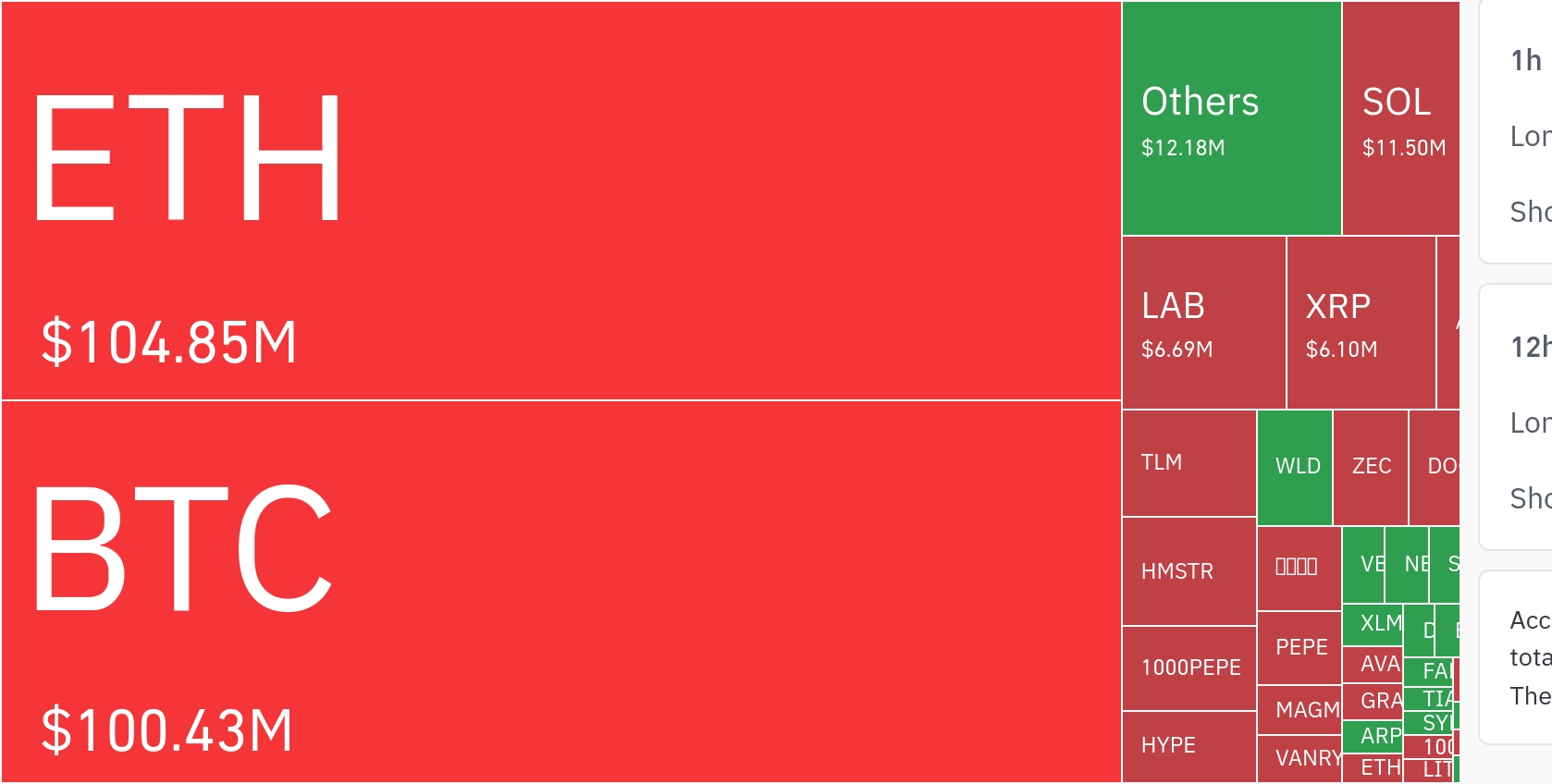
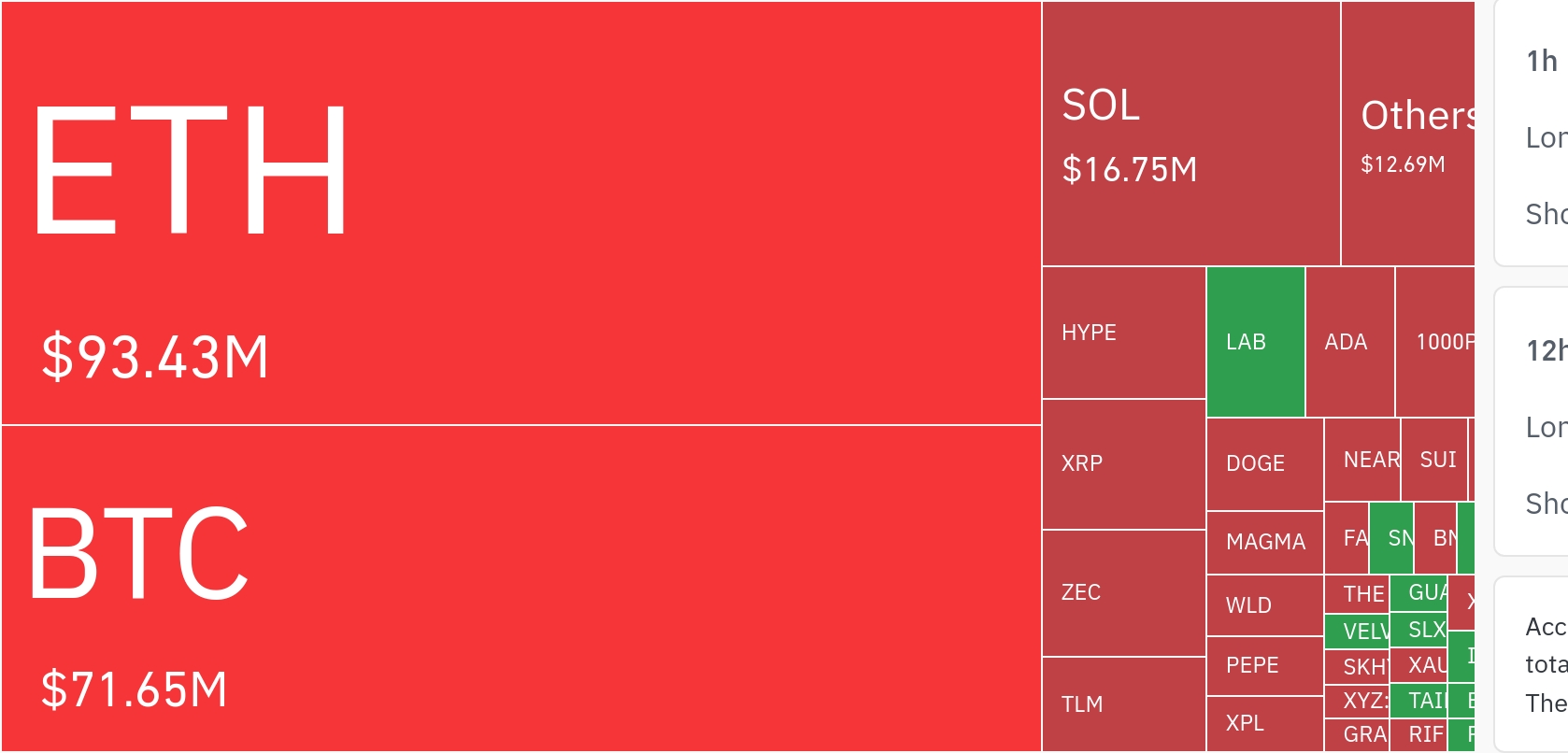
Leverage risks remained visible in derivatives markets. On-chain tracking account Onchain Lens reported that a whale using 40x leverage on a Bitcoin short position experienced four partial liquidations over the past 24 hours. The liquidated amount totaled about 97.99 BTC (roughly $6.18 million), with realized losses estimated at $298,750. The trader reportedly still holds a 67.98 BTC short position valued around $4.26 million, with an unrealized loss of about $179,220 and a liquidation price roughly $902 above the current market level.
Macro concerns also featured in the day’s briefing, with reports noting U.S. national debt rising to roughly $39 trillion—about the scale of annual U.S. GDP—while annual interest expense is estimated near $1 trillion, exceeding defense spending. The growing debt load has become a recurring backdrop for Bitcoin’s ‘store-of-value’ narrative, though markets continue to balance that thesis against real-rate dynamics and near-term liquidity conditions. The Penn Wharton Budget Model has warned that debt-to-GDP levels above about 210% could pose sustainability risks; the U.S. is near 100% today, while the Congressional Budget Office projects the ratio could climb to 175% by 2056.
In tokenization and asset management, New York Life Investments said blockchain could enable mass-scale personalization of portfolios—an idea that aligns with the broader shift toward individualized indexing and customized risk allocation. Thomas Seo, head of multi-asset solutions, told CoinDesk that tokenization can streamline back-office processes such as transfer agency and settlement, cutting costs and expanding investor access. New York Life Investments has previously partnered with Centrifuge to bring portions of a high-yield corporate bond strategy on-chain.
Finally, a widely shared social post from the “Bitcoin Historian” account cited Blockstream CEO Adam Back as saying he has placed a standing bid to buy 21 million Bitcoin at $0.02—an offhand remark meant to underscore confidence that Bitcoin will not go to zero, rather than a market-moving disclosure or policy development.
🔎 Market Interpretation
- Ethereum’s medium-term thesis pivots from “just scaling” to “scaling + provable verification + future-proof security”: Vitalik Buterin’s 3–4 year “Lean Ethereum” roadmap highlights recursive STARK-based verification, quantum-resistant cryptography, and state scalability—signaling a deliberate re-architecture of trust and performance assumptions at the base layer.
- Cheaper verification could reinforce rollups and modular scaling economics: Native/standardized recursive STARK verification implies lower proof-checking costs and better aggregation, which can improve rollup throughput and potentially reduce L2-to-L1 security overhead over time.
- Gas-limit expansion is a near-term lever but comes with decentralization trade-offs: The proposed “Glasterdam” gas-limit increase may raise block capacity, but it can pressure node requirements and client performance unless paired with broader optimizations—forcing a balance between throughput and network accessibility.
- Tokenization and collateral innovation is broadening market plumbing: Kraken’s use of tokenized equities/ETFs as collateral (outside the U.S.) suggests exchanges are importing prime-broker style margin frameworks into crypto, potentially increasing capital efficiency and cross-asset leverage pathways.
- Risk appetite remains bifurcated across the ecosystem: Meme-coin bursts on BNB Chain and a 40x leveraged BTC short with repeated partial liquidations show speculative behavior persists, while Korean exchanges cutting net listings indicates tightening standards amid regulatory and revenue pressure.
- Macro backdrop stays relevant to the “store-of-value” narrative but not determinative short-term: U.S. debt/interest cost concerns continue to support Bitcoin’s long-run hedge narrative, yet price action is still heavily influenced by liquidity conditions, rates, and positioning.
💡 Strategic Points
- Watch for “recursive STARKs” as a key execution milestone: Progress indicators include Ethereum research/spec proposals, client implementation timelines, and how rollups adapt their proof systems to benefit from recursion and standardized verification.
- Quantum-resistance is a slow-burn catalyst with credibility impact: Even before quantum threats are practical, migration planning (wallet/key schemes, signature systems, backward compatibility) can become a major engineering and coordination storyline for long-duration ETH investors and infrastructure providers.
- State growth is the fee-and-UX battleground: A “scalable state” target (up to ~100TB by 2030) frames a path to materially lower fees for certain token activity (<1/10 current levels in the stated ambition). Track proposals that change state storage costs, pruning, statelessness, or new state representations.
- Lean VM (RISC-V / Lean ISA) + programmable privacy could expand enterprise-grade use cases: If Ethereum can offer configurable confidentiality with verifiability/compliance, it may attract regulated workflows—but adoption depends on tooling maturity and auditability.
- Kraken collateral caps imply controlled rollout; monitor haircuts and eligible-asset growth: Caps ($1M for large ETFs, $250k for most stock tokens, $100k for tokenized gold/Circle equity offerings) and adjustable haircuts are key risk knobs—changes can signal rising/lowering volatility tolerance.
- Derivatives positioning remains a primary liquidation catalyst: The 40x BTC short with multiple partial liquidations underscores how quickly forced flows can appear; traders should monitor liquidation clusters and funding/OI for short-term risk management.
- Korean listing contraction suggests a quality/filter regime shift: Net new listings down ~74% (49 vs. 191 YoY) points to stricter screening and delisting willingness, which can affect liquidity for mid/small caps and reduce “listing-premium” speculation.
📘 Glossary
- Recursive STARKs: A STARK proof system where proofs can verify other proofs, enabling aggregation into a single compact proof—often improving scalability and verification efficiency.
- STARK (Scalable Transparent Argument of Knowledge): A cryptographic proof that allows one party to prove computation was performed correctly with efficient verification and typically no trusted setup (“transparent”).
- Quantum-resistant cryptography: Cryptographic schemes designed to remain secure even against quantum computers (e.g., post-quantum signatures), intended to mitigate future key/signature break risks.
- State (Ethereum state): The database of accounts, balances, smart-contract storage, and related data that nodes must track to validate the chain; state growth can raise node costs and influence fees.
- Programmable privacy: Privacy features that can be selectively applied via code (e.g., confidentiality for certain fields/participants) while preserving auditability or compliance constraints.
- RISC-V / Lean ISA VM: A virtual machine approach based on a standardized instruction set architecture, potentially simplifying execution, verification, and tooling compared with bespoke VMs.
- Gas limit: The maximum total gas allowed per block; raising it increases throughput but can increase resource demands on nodes and affect decentralization.
- Haircut (collateral): A risk discount applied to collateral value (e.g., $100 collateral might count as $80) to buffer against price moves and liquidation risk.
- Tokenized equities/ETFs: On-chain tokens that represent exposure to real-world stocks or funds; used for trading/collateral while relying on off-chain custody/issuance arrangements.
- Partial liquidation: A forced position reduction by an exchange to restore margin health, rather than closing the entire leveraged position at once.
- Post-halving pattern (Bitcoin): Historically observed market cycles following Bitcoin’s block reward halving, often discussed in relation to supply issuance and timing of bull/bear phases.

















Comment 0