

 News
News  Coin Information
  About us
  Customer Service


 Add as a preferred source on Google
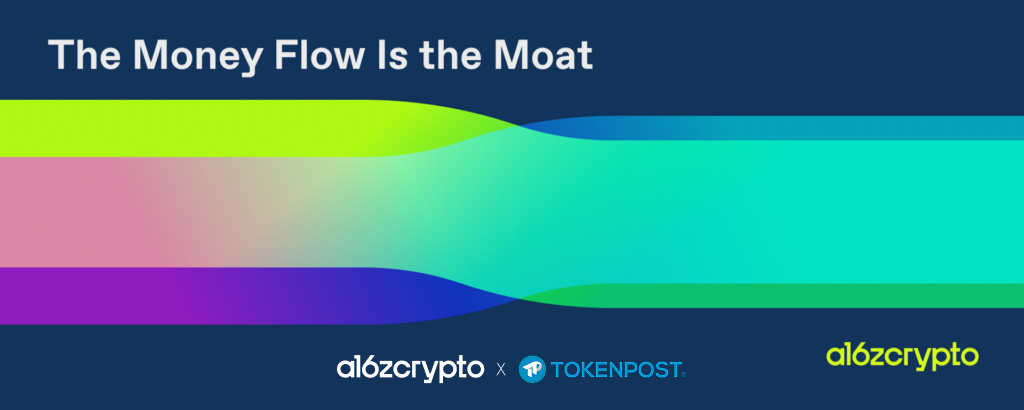
a16z crypto research argues that the real battleground for crypto is not token prices, but who controls the ‘center of capital flows’—the point where value is created, transferred, and settled, and where fees and network effects compound. In a new analysis, the firm frames blockchains and network tokens as rare pieces of infrastructure designed to sit directly in the path of economic activity, positioning crypto’s long-term upside as structural rather than speculative.
The argument is based on a report published on June 10, 2026, by Jason Rosenthal. The report draws a historical parallel: the most durable businesses often did not win by making a better product, but by owning the rails that commerce runs on. Railroads monetized freight moving over tracks rather than locomotives themselves, while firms like Visa ($V) and large market makers built models where revenue scales with transaction volume because they operate at the heart of payment and order flow.
From that perspective, blockchains resemble network businesses by design. Transactions are recorded and settled on shared ledgers, and as participation grows, more developers, users, and complementary services cluster around the same infrastructure. a16z crypto research contends that crypto founders can capture parts of ‘network effects’ from day one—an advantage that traditional companies often spend years and heavy capital expenditures trying to build.
Network tokens, the report adds, can amplify these effects by aligning stakeholders—users, developers, suppliers, validators, and protocol operators—around a single objective: network growth. In well-designed systems, incentives and rewards are distributed in proportion to contribution, turning what platform companies typically manage through contracts and business development into something enforced at the protocol level. The result, in theory, is a flywheel where adoption strengthens security and liquidity, which in turn attracts more activity.
To illustrate why flow-centric businesses can be so powerful, the report points to financial market incumbents. Visa processed $15.7 trillion in payment volume in fiscal 2024 and generated $35.9 billion in net revenue, underscoring the economics of sitting in the middle of transactions at global scale. It also cites Jane Street’s $20.5 billion in net trading revenue last year—out-earning major banks such as Citigroup ($C) and Bank of America ($BAC) on the same metric—along with data indicating that the top five U.S. market makers handle 87% of payment-for-order-flow-related activity.
The common denominator is not predicting market direction; it is being positioned where every order or payment must pass. As volumes rise, revenue rises with them. Network effects reinforce the dynamic: more cardholders increase the value to merchants and vice versa, while deeper participation in order-flow markets tightens spreads and improves liquidity, making the network more attractive and harder to displace. In the report’s view, the combination of ‘capital flow’ plus ‘network effects’ creates one of the strongest forms of business defensibility.
Crypto’s opportunity, the analysis suggests, lies in challenging the persistence of high margins across legacy financial rails. Visa and Mastercard ($MA) still operate atop networks designed in the 1960s, with interchange fees commonly cited at 2–3%, while remittance costs can reach 6–9% depending on corridor and service. Prime brokers and custodians take a cut of securities activity, and even after the U.S. shift to T+1 settlement in 2024, capital can remain operationally idle overnight—creating structural costs that new infrastructure could potentially compress.
Rosenthal invokes Amazon founder Jeff Bezos’ maxim—“Your margin is my opportunity”—to argue that payments, custody, lending, FX, securitization, settlement execution, and market making represent a broad target set for crypto entrepreneurs. If costs fall and speed increases, the size of the overall market can expand, the report claims, pointing to the ways Stripe and Block have grown by simplifying payments. On this view, blockchain-based financial infrastructure could represent the next phase of competition over financial ‘plumbing’ rather than a narrow contest over speculative trading.
Stablecoins receive particular emphasis as a practical bridge between crypto infrastructure and real-world value movement. The report describes stablecoins as enabling money to move at ‘internet speed,’ with 24/7 settlement and end-to-end programmability—features that can support new business models on open rails where unit economics are more transparent. That framing positions stablecoins not as a side product of crypto markets, but as a core mechanism for rewiring payments and settlement globally.
The thesis extends beyond finance. a16z crypto research highlights other arenas where programmable networks could reorganize how value and resources move: computing and GPU marketplaces, memory chips, AI training data, energy, robotics, space, and critical materials such as rare earth metals. Industries with weaker entrenched infrastructure or fewer durable intermediaries may offer more room to build new flow-based networks from the ground up, the report argues.
Ultimately, the report proposes a set of founder-level questions: Are you positioned at the ‘center of flows’? If activity on your product increases tenfold, does revenue scale in tandem? And where, specifically, is the bottleneck extracting the largest margin in the target market? a16z crypto research concludes that crypto’s enduring opportunity is less about volatility-driven price discovery and more about capturing the infrastructure layer where global value movement is routed—suggesting the sector’s next chapter may be written in settlement, payments, and network design rather than charts alone.
🔎 Market Interpretation
- Core claim: The durable upside in crypto is structural—owning the center of capital flows (where value is created, transferred, and settled)—not short-term token price appreciation.
- Business model lens: The most defensible winners historically control the rails (e.g., railroads, Visa, major market makers) and monetize volume flowing through them rather than betting on direction.
- Network effects as compounding moat: Shared ledgers attract users, developers, liquidity, and services; as activity grows, security/liquidity improve, reinforcing adoption and making displacement harder.
- Tokens as coordination infrastructure: Network tokens can turn stakeholder alignment (users, builders, validators, suppliers) into protocol-level incentive design, potentially accelerating network formation versus traditional go-to-market.
- Legacy margins signal disruption targets: Persistent fees in payments (e.g., 2–3% interchange), remittances (often 6–9%), custody/prime brokerage “tolls,” and settlement frictions suggest room for cost compression via new rails.
- Stablecoins positioned as the bridge: Stablecoins are framed as the most practical mechanism to move real-world value on crypto rails—24/7 settlement, programmability, internet-speed transfer—enabling new payment and treasury models.
- Beyond finance: The thesis extends to other “flow” markets (compute/GPU, memory, AI data, energy, robotics, space, critical materials) where programmable networks could reorganize allocation and exchange.
💡 Strategic Points
- Design for flow capture: Build products that sit directly in the path of high-frequency, high-volume activity (payments, settlement, execution, custody workflows) so revenue scales with throughput.
- Measure volume-to-revenue elasticity: Stress-test: if transactions/users grow 10×, do fees, spreads, or protocol revenues grow proportionally—or do costs/complexity rise faster?
- Target the biggest bottleneck: Identify where incumbents extract the largest “toll” (fees, float, operational friction, balance-sheet constraints) and replace it with cheaper/faster automated settlement.
- Use stablecoins tactically: Prioritize stablecoin rails for cross-border payments, B2B settlement, payroll/contracting, merchant acquiring, and onchain treasury management where 24/7 finality matters.
- Leverage protocol-enforced incentives: Align participants via transparent, rules-based rewards (liquidity provision, validation, data/compute contribution) rather than relying solely on contracts and BD.
- Compete on transparency and programmability: Offer verifiable fees, auditable settlement, and composable integrations to create second-order ecosystems (wallets, lending, analytics, compliance tooling).
- Choose arenas with weaker incumbents: Non-financial resource markets with fragmented intermediaries may allow new networks to form faster than heavily regulated, entrenched payment monopolies.
- Founder checklist (from the thesis):
- Are you truly at the center of flows or merely adjacent?
- Does defensibility improve as usage grows (security, liquidity, data, integrations)?
- Which margin pool are you compressing—and what new volume does that unlock?
📘 Glossary
- Center of capital flows: The chokepoint layer where value movement is routed (creation, transfer, settlement) and where fees and network effects can compound.
- Flow-based business: A model that monetizes transaction/order/payment volume passing through a network rather than relying on price direction or one-off sales.
- Network effects: Value increases as more participants join (e.g., more users attract more merchants; more liquidity improves execution and draws more flow).
- Settlement: Final transfer of assets/payment completing a transaction; faster settlement reduces counterparty risk and “idle” capital.
- T+1 settlement: Trade settlement occurring one business day after execution; even at T+1, operational frictions can keep capital idle overnight.
- Interchange fee: A card payment fee (often cited ~2–3%) paid between banks within card networks, contributing to overall payment costs.
- Remittance corridor: A specific country-to-country route for cross-border money transfers, often with distinct fees and liquidity constraints.
- Stablecoin: A token designed to track a fiat currency value (e.g., USD), used for faster transfer/settlement and programmable payments.
- Programmability: The ability to encode rules/logic into transfers (escrow, conditional payments, automated compliance, streaming payouts).
- Market maker: A liquidity provider quoting bids/asks; profits often scale with flow and spreads, benefiting from network participation.
- Payment-for-order-flow (PFOF): A practice where brokers route orders to market makers in exchange for compensation; concentrates activity in major liquidity venues.




















Comment 0