

 News
News  Coin Information
  About us
  Customer Service


 Add as a preferred source on Google
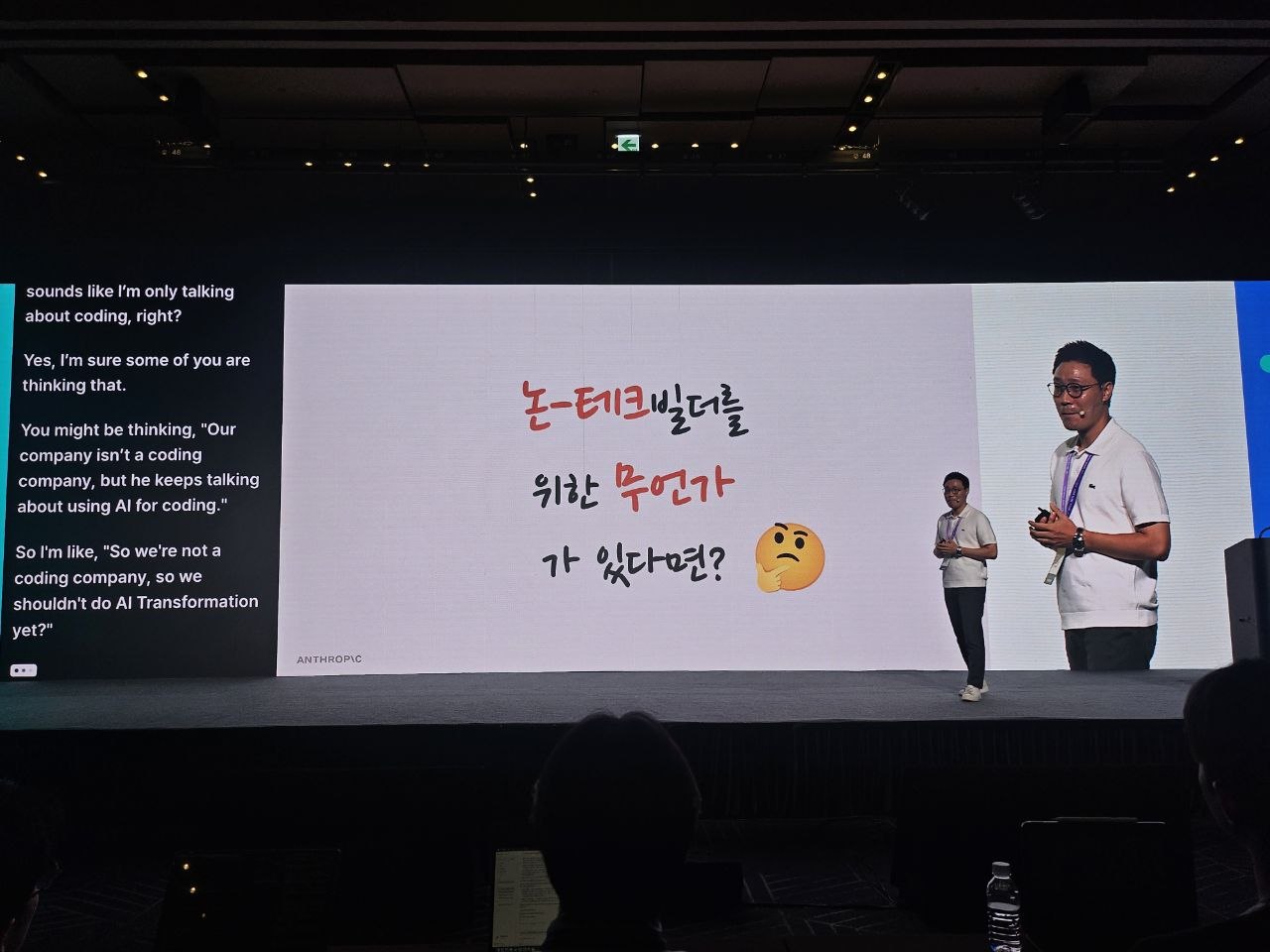
Software is shifting from a tool people operate into a workplace ‘colleague’ that can execute tasks end-to-end—an evolution that could push AI adoption beyond developers and into the broader ranks of ‘knowledge workers’, according to Anthropic’s applied AI team.
Speaking Thursday ET (Wednesday UTC) at MetaCon 2026, a major AI conference co-hosted by TokenPost in Seoul, Jang Dongjin, Applied AI Architect at Anthropic, outlined how AI agents are reshaping day-to-day work inside organizations and what companies should prioritize as they pursue ‘AX’ (AI transformation). His session, titled “Agent Evolution: AI Has Started Working”, centered on the idea that the decisive variable in AI transformation is not only model capability, but the redesign of human roles around delegation and verification.
Jang argued that the relationship between people and software has changed fundamentally over the past two decades. From the 2000s through the early 2020s, he said, software primarily boosted performance and quality as a ‘tool’. Now, as agentic systems mature, users increasingly share goals rather than issue step-by-step instructions—and expect completed outputs rather than isolated answers—leading software to be perceived as a ‘colleague’ that can collaborate on outcomes.
At the heart of that shift is the rise of AI agents structured around a repeating cycle of ‘planning–action–reflection’. In Jang’s framing, this loop enables systems to set sub-goals, execute tasks, validate results, and iterate when shortcomings are detected—moving large language models beyond one-shot Q&A into continuous, work-oriented execution.
He pointed to code assistants as a clear example of how role redefinition can unlock measurable gains. Early coding copilots typically suggested snippets, leaving engineers to integrate and complete the work. With the emergence of tools such as ‘Claude Code’, he said, the workflow increasingly flips: AI generates large portions of code while humans set direction, define constraints, and review output for correctness and intent. That pattern, he added, is spreading from individual productivity improvements to team-level throughput as organizations change how work is assigned and validated.
Jang cited global companies including Spotify as examples where software engineering roles are increasingly oriented toward reviewing and steering AI-produced output rather than writing every line manually. “The most important success factor in AI transformation is changing the user’s role,” he said, arguing that adoption accelerates when execution is delegated to AI and humans focus on judgment—setting objectives, assessing quality, and deciding what ships.
In his view, the next major expansion is not another developer tool, but agent adoption across the everyday responsibilities of office work. He emphasized that the ‘next target after developers is knowledge workers’, describing a future in which agents handle routine but complex tasks such as meeting-note summarization, action-item extraction, document drafting, and prototyping—triggered primarily through natural language prompts.
During the session, Jang demonstrated agent-driven workflows including a desktop agent dubbed ‘Claude Core’ designed to carry out multi-step tasks, and a design canvas called ‘Claude Design’ that can generate prototypes through conversational instructions. While the demos served as proof points, Jang stressed that the key story is the broadening scope of labor that can be delegated—not any single product feature.
For enterprises mapping out an ‘AX’ roadmap, Jang recommended moving in stages: start with individual productivity, expand into process automation, and then push toward product and service innovation. He laid out three principles for implementation: focus first on problems with clear objectives and measurable evaluation criteria; build ‘context’ and connectors so AI systems can securely use internal data and institutional knowledge; and delegate work aggressively to AI while establishing verification frameworks to manage risk and quality.
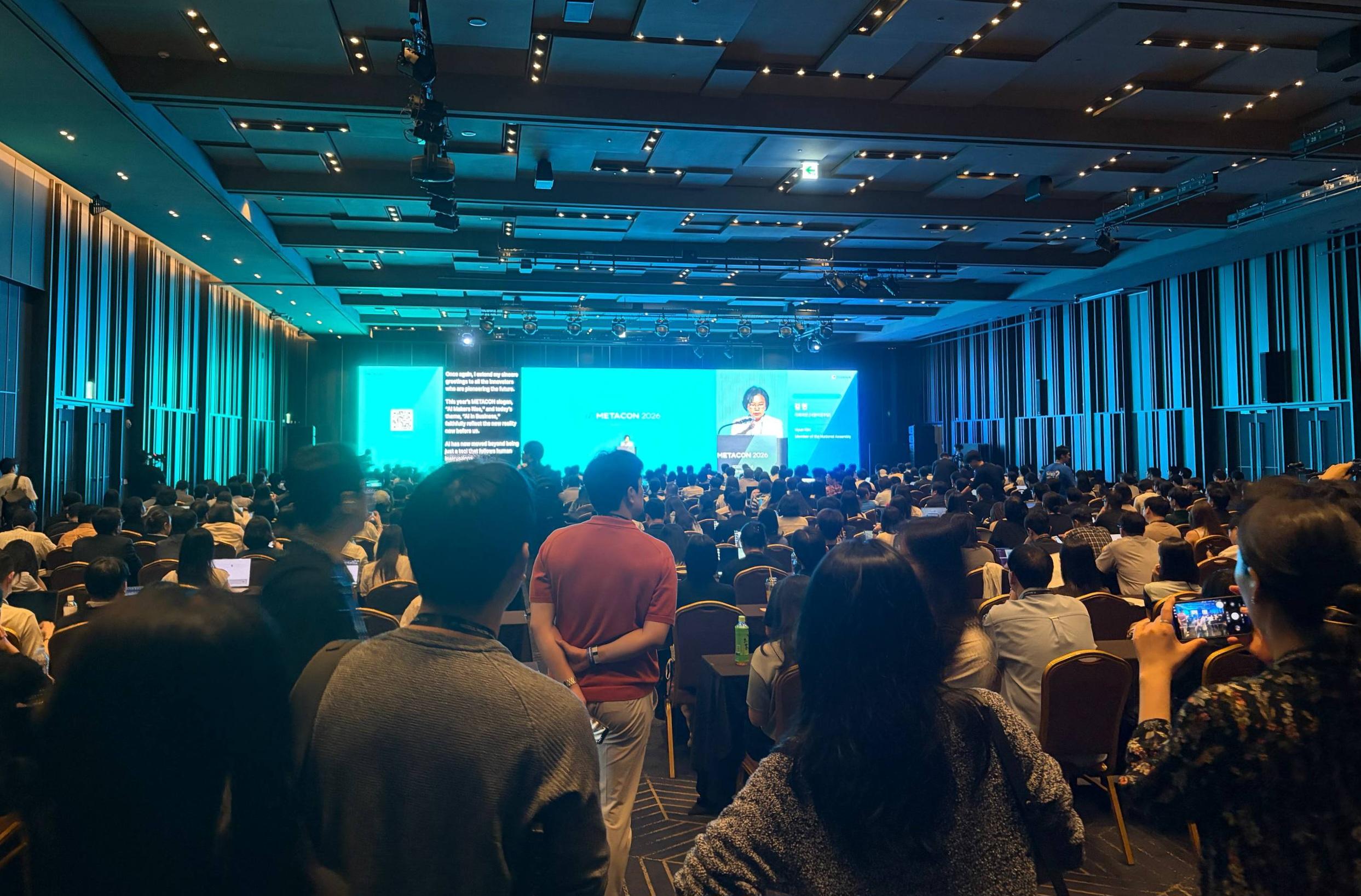
MetaCon 2026 runs July 3–4 in Seoul at COEX Grand Ballroom under the theme “AI Makers Rise,” bringing together companies and builders to share strategies and execution experience spanning enterprise innovation, marketing, and investment. Jang’s remarks underscored a growing industry consensus: as agentic systems become more reliable, competitive advantage may hinge less on introducing AI and more on redesigning workflows so humans and machines can co-produce outcomes at scale.
🔎 Market Interpretation
- Software is moving up the value chain: Enterprise AI is shifting from “assistive tools” (answering questions, suggesting snippets) to agentic coworkers that can execute multi-step work end-to-end (plan → act → reflect), changing how organizations allocate labor.
- Adoption hinges on workflow redesign, not just model quality: Anthropic’s message is that AI transformation (“AX”) succeeds when companies redefine roles around delegation + verification, rather than treating AI as a plug-in productivity add-on.
- Developer-first is giving way to office-wide expansion: Coding is the early proof point (e.g., Claude Code), but the next growth wave targets knowledge workers (notes, drafts, action items, prototyping) via natural language interfaces.
- Competitive advantage shifts to operating model: As agent reliability improves, differentiation increasingly comes from how fast firms re-architect processes, add secure context/data access, and build governance for AI-produced outputs.
💡 Strategic Points
- Redefine human roles explicitly: Move humans toward goal-setting, constraints, and final approval; move AI toward execution. Treat “review and steer” as a formal job responsibility, not an ad-hoc step.
- Adopt in staged milestones (AX roadmap):
- Individual productivity (personal agent support, faster drafting/coding)
- Process automation (repeatable workflows with measurable outcomes)
- Product/service innovation (new offerings enabled by agentic capabilities)
- Start where evaluation is clear: Prioritize tasks with unambiguous objectives and measurable success criteria (quality checks, completion rates, time-to-delivery), enabling safe iteration and ROI tracking.
- Invest in “context” and connectors: Build secure pathways to internal knowledge (documents, tickets, wikis, codebases) so agents can act with organizational awareness while respecting permissions and compliance.
- Scale delegation with guardrails: Establish verification frameworks—human-in-the-loop review, automated tests, approval gates, audit logs, and rollback procedures—to manage risk as agents take on more autonomy.
- Team throughput comes from assignment redesign: The biggest gains appear when managers change how work is assigned (AI does bulk generation; humans validate intent and correctness) rather than only giving individuals a better assistant.
- Use demos as patterns, not products: Tools like “Claude Core” (desktop agent) and “Claude Design” (prototype canvas) illustrate repeatable operating patterns: multi-step execution, iterative refinement, and conversational control.
📘 Glossary
- AI Agent (Agentic System): A system that can pursue a goal across multiple steps, using tools and feedback loops to complete tasks rather than returning a single response.
- Planning–Action–Reflection: A recurring loop where the agent plans sub-tasks, executes actions, evaluates results, and iterates to fix errors or improve quality.
- AX (AI Transformation): Organizational change program focused on integrating AI into work processes, roles, and products—analogous to “DX” (digital transformation), but centered on AI-driven execution.
- Delegation & Verification Model: Operating approach where AI performs the work and humans verify outcomes—checking correctness, intent alignment, risk, and final readiness.
- Knowledge Workers: Roles primarily handling information and decisions (e.g., analysts, marketers, PMs, HR, operations) that can benefit from drafting, summarization, research, and workflow automation.
- Context / Connectors: Data access layers and integrations (e.g., to internal docs, databases, repos) that provide agents with relevant organizational information under security controls.
- Copilot vs. Colleague: “Copilot” assists within a human-driven workflow; “colleague” implies the AI can own execution and deliver completed outputs with humans supervising.






















Comment 0