

 News
News  Coin Information
  About us
  Customer Service


 Add as a preferred source on Google
Solana (SOL) is back in focus as traders weigh a slate of network upgrades that could reshape the chain’s economics and throughput, even as near-term price action remains stuck in a tight range. The token was trading around the mid-$73 level on Wednesday UTC, leaving the market torn between bearish chart warnings and optimism tied to upcoming protocol changes.
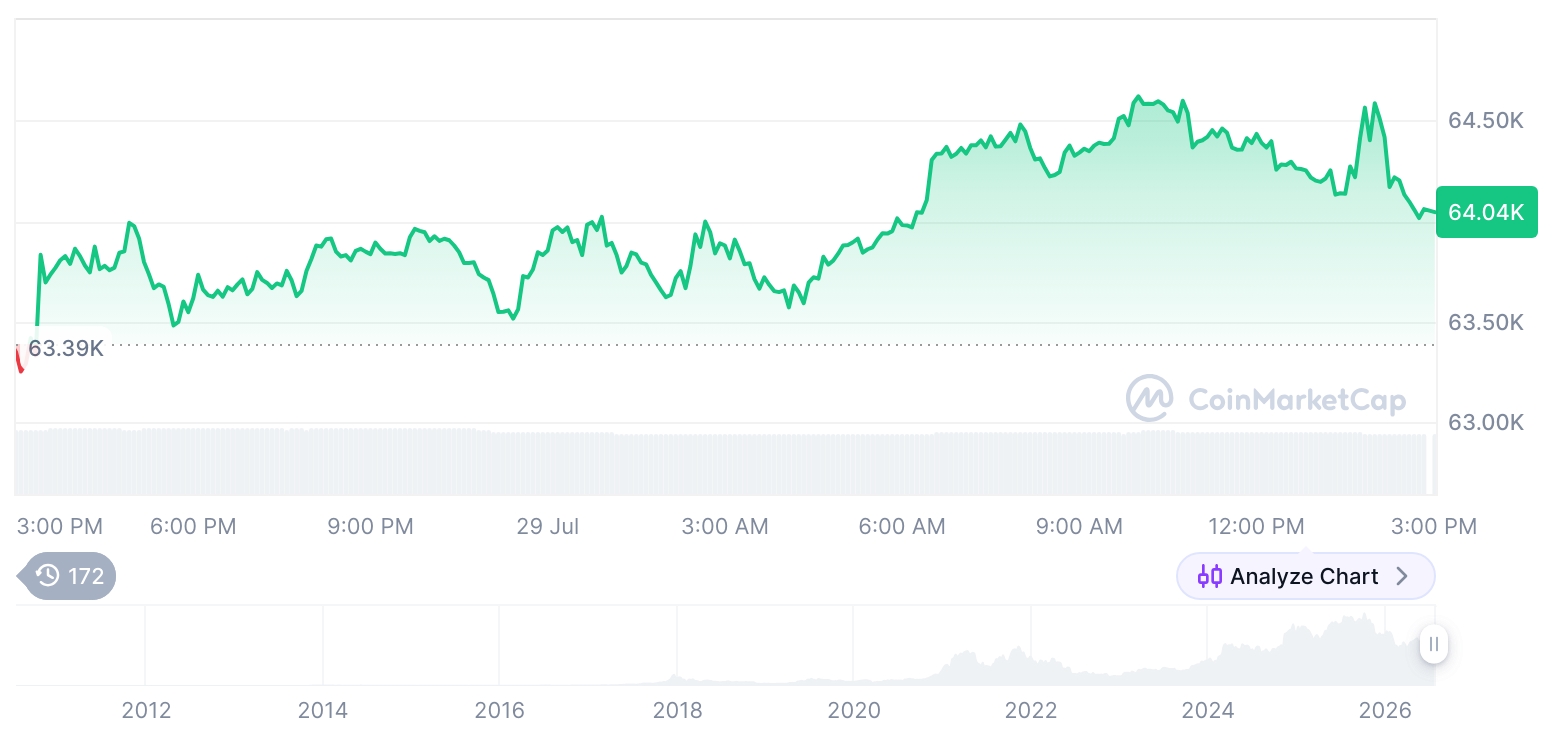
According to CoinMarketCap data as of 9:40 a.m. UTC on July 30, Solana changed hands at $73.39, down 0.64% over the past 24 hours. Its market capitalization stood at roughly $42.54 billion, keeping SOL in the No. 7 spot among cryptocurrencies by market value. Daily trading volume was approximately $1.87 billion, about 2.87% lower than the previous day—an easing that suggests activity has cooled slightly as participants wait for clearer catalysts.
The key narrative driver is the expected ‘Alpenglow upgrade,’ which multiple market commentators say is scheduled for a window between August and October. The upgrade is framed as a push to improve ‘fee revenue’ and boost overall network efficiency—two factors that often matter as much as user growth in determining whether a layer-1 can sustain long-term value accrual. While exact implementation details and timelines can evolve, the market is already positioning around the idea that Solana’s economics could become more attractive if fee capture improves and execution becomes smoother at scale.
Technical signals, however, paint a more conflicted picture. Trading outlet Mitrade pointed to signs of a potential ‘double top’ pattern near the $73–$74 area. If confirmed, that formation is commonly interpreted as a bearish reversal setup, with the analysis flagging downside risk of roughly 21% and identifying support around $72. In practical terms, the $72 level is shaping up as the line bulls need to defend to prevent momentum from tilting decisively lower.
Other analysts are leaning the other way. Analytics Insight highlighted record stablecoin adoption on Solana and rising network activity as potential support for a move above $80. In that view, the immediate supply zone sits in the $76–$80 band, where sellers have tended to step in. A clean break and sustained hold above that region could shift market psychology toward a more constructive trend, particularly if on-chain usage continues to increase alongside the upgrade narrative.
Some market coverage has also put the math of a bigger rally into context: 247wallst noted that turning a hypothetical $5,000 investment into $10,000 would require SOL to climb to roughly $147.90—about a 100% move from around $73.95. While such framing is not a forecast, it underscores how far SOL would need to travel to revisit the kind of acceleration seen in prior market cycles.
Beyond Alpenglow, Solana is also pursuing a separate capacity-oriented initiative: an expansion toward ‘100 million compute unit (CU) blocks.’ As described in coverage from OpenPR, raising per-block compute capacity would allow Solana to pack more activity—ranging from decentralized applications and decentralized exchanges (DEXs) to gaming and payments—into each block. The goal is to reduce capacity constraints and support higher throughput without degrading user experience, a recurring challenge for high-performance chains during demand spikes.
On the demand side, stablecoin growth is being cited as a tangible signal of real economic activity. Analytics Insight reported that stablecoins on Solana surpassed $15 billion in market capitalization for the first time. In crypto markets, stablecoin supply on a given chain is often interpreted as a proxy for ‘liquidity inflow’ and utility, because stablecoins are widely used for trading, DeFi collateral, payments, and cross-border transfers. A rising stablecoin base can make it easier for applications to scale and for users to transact without taking on immediate volatility risk.
CoinMarketCap data shows Solana’s circulating supply at about 579.59 million SOL, with total supply around 631.25 million. Performance over broader horizons has been subdued: SOL was down 6.27% over the past seven days, 1.12% over 30 days, and 11.80% over 90 days, reflecting the broader stop-start tone seen across major altcoins.
Corporate adoption is also surfacing as a secondary theme. Forward Industries said it plans to hold a conference call on Aug. 12, 2026, to discuss financial results and provide an update on its SOL treasury strategy, highlighting that some public companies continue to experiment with crypto-linked balance sheet approaches.
Trading venue data illustrates where liquidity currently resides. CoinMarketCap figures indicated that the bulk of SOL’s reported 24-hour trading volume came from centralized exchanges (CEXs), while decentralized exchange volume was minimal by comparison in the cited snapshot. That skew suggests that, for now, price discovery remains heavily CEX-driven—even as Solana’s on-chain ecosystem continues to market itself as a hub for DeFi and consumer applications.
Solana is a proof-of-stake (PoS) layer-1 blockchain launched in April 2020, designed for high-throughput execution and low transaction costs. For traders, the immediate roadmap catalysts—Alpenglow and the 100 million CU block push—are increasingly the focal points as the market tries to determine whether network upgrades can translate into more durable ‘fee-based value capture’ and renewed momentum.
In the near term, analysts broadly expect SOL to oscillate between support near $72 and resistance in the $76–$80 range. A successful rollout of planned upgrades, paired with continued stablecoin growth, could provide the fundamental justification needed to challenge that ceiling. Until then, SOL appears set to trade as a tug-of-war between cautious chart readers and investors betting that improving network economics will eventually win out.
🔎 Market Interpretation
- Price remains range-bound: SOL trades near $73, with near-term direction constrained by clear technical levels (~$72 support vs $76–$80 resistance).
- Cooling activity signals “wait-and-see”: 24h volume (~$1.87B) eased versus the prior day, suggesting traders are holding for stronger catalysts (upgrade clarity, breakout/breakdown confirmation).
- Fundamentals vs. charts are in conflict: Bearish technicians cite a potential double top around $73–$74, while bullish narratives focus on stablecoin growth and protocol upgrades that could improve throughput and fee dynamics.
- Liquidity and price discovery are still CEX-led: Reported volume is concentrated on centralized exchanges, implying the market’s short-term pricing is driven more by CEX flow than on-chain DEX activity in the cited snapshot.
- Upside framing vs. reality check: A “double your money” scenario (from $5,000 to $10,000) would require SOL near $147.90—highlighting the distance to a full cycle-style rally even if sentiment improves.
💡 Strategic Points
- Key catalyst window: The expected Alpenglow upgrade (discussed as Aug–Oct) is a primary narrative driver; any confirmed timeline, testnet success, or spec finalization could move expectations quickly.
- Watch the “value accrual” angle: Market focus is shifting from raw user growth to whether Solana can improve fee revenue and fee capture—metrics that influence long-term token economics and investor confidence.
- Capacity expansion as a throughput bet: The push toward 100M compute unit (CU) blocks is positioned as an effort to reduce congestion risk and support heavier app usage (DEXs, gaming, payments) during demand spikes.
- Stablecoins as demand proxy: Stablecoin market cap on Solana surpassing $15B is interpreted as liquidity inflow and utility growth—often supportive for DeFi scaling, trading depth, and on-chain payment activity.
- Technical map for traders:
- Support to defend: ~$72; losing it could reinforce bearish momentum and validate reversal fears.
- Supply/resistance zone: $76–$80; a sustained break above may shift positioning toward a more constructive trend.
- Context on trend strength: Despite headline catalysts, recent performance remains soft (down across 7D/30D/90D), implying upgrades may need to translate into visible network/economic improvements to change the broader tape.
- Secondary narrative: Corporate treasury experimentation (e.g., Forward Industries discussing a SOL treasury strategy) can influence sentiment, but likely remains a headline driver rather than a core fundamental engine.
📘 Glossary
- Alpenglow upgrade: A proposed Solana network upgrade discussed as targeting improved network efficiency and potentially stronger fee revenue; timing cited as a possible Aug–Oct window (subject to change).
- Fee revenue / fee capture: Transaction fees generated on the network and the degree to which those fees economically benefit the system/token ecosystem (often tied to sustainability and long-term value accrual).
- Double top: A chart pattern where price tests a similar high twice and fails, often interpreted as a potential bearish reversal if breakdown confirmation follows.
- Support / resistance: Price zones where buying (support) or selling (resistance) historically appears; here, ~$72 is key support and $76–$80 is a key resistance band.
- Stablecoins: Tokens typically pegged to fiat (e.g., USD) used for trading, payments, and DeFi collateral; rising supply on a chain is often viewed as a proxy for liquidity and usage.
- Compute Units (CU): A measure of per-transaction computational resource usage on Solana; increasing CU per block can raise overall per-block capacity.
- CU blocks (100 million CU blocks): A capacity initiative to increase how much compute can fit in each block, aiming to improve throughput under high demand.
- PoS (Proof-of-Stake): A consensus mechanism where validators stake tokens to help secure the network and produce blocks, generally enabling energy-efficient security.
- Layer-1: A base blockchain network (like Solana) that processes and finalizes transactions directly, rather than relying on another chain for security.
- CEX vs. DEX: Centralized exchanges (custodial, order-book-driven venues) vs decentralized exchanges (on-chain protocols). The article notes SOL’s volume skewed toward CEXs in the cited snapshot.














Comment 0