
 Add as a preferred source on Google
Bitcoin ETFs See $696 Million Outflows, Extending Six-Day Redemption Streak
U.S. spot Bitcoin ETFs recorded $696 million in outflows on June 25, extending a six-day streak led by heavy redemptions from BlackRock and Fidelity funds.


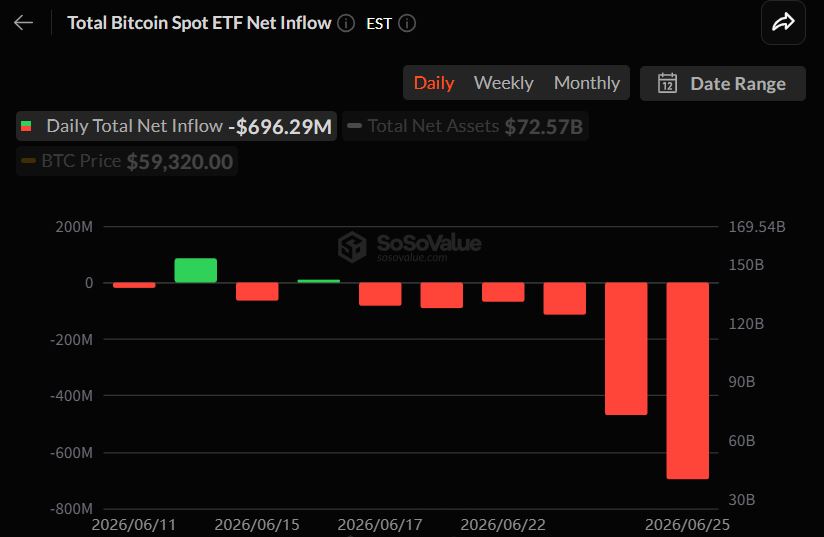
U.S. spot Bitcoin (BTC) exchange-traded funds (ETFs) extended their losing streak to a sixth consecutive trading session on Wednesday ET, underscoring a renewed phase of 'institutional outflows' even as the products continue to hold a meaningful share of Bitcoin’s overall market value.
According to data compiled by SoSoValue, U.S.-listed spot Bitcoin ETFs recorded a combined net outflow of $696.29 million on June 25 ET. The latest figure marked an acceleration from Tuesday’s $469.08 million in net redemptions and continued a run of daily outflows that has persisted since June 17 ET.
Despite the near-term pullback, cumulative net inflows across the category still stood at $52.05 billion, reflecting the scale of capital that entered the market earlier this year and the extent to which spot ETFs have reshaped access to Bitcoin for traditional investors.
Flow data showed a broadly risk-off session across the 13-ETF group. Morgan Stanley’s MSBT was the only fund to post net inflows, adding $9.17 million. The heaviest redemptions were seen in Fidelity’s FBTC (-$274.48 million) and BlackRock’s IBIT (-$265.68 million), followed by ARK 21Shares’ ARKB (-$82.11 million) and Invesco’s BTCO (-$53.03 million). Additional outflows were reported from VanEck’s HODL (-$11.72 million), Bitwise’s BITB (-$7.07 million), Franklin’s EZBC (-$6.84 million), and Valkyrie’s BRR (-$4.51 million).
Trading activity remained robust even as capital exited the products. Total spot Bitcoin ETF turnover reached $3.5 billion for the day, led by BlackRock’s IBIT at $2.5 billion, Fidelity’s FBTC at $454.76 million, and Grayscale’s GBTC at $136.51 million. The combination of high volumes and net outflows suggests active repositioning rather than a simple collapse in participation, with investors potentially rotating exposure, trimming risk, or responding to short-term macro and volatility conditions.
Total net assets across the spot Bitcoin ETF complex were valued at $72.57 billion, representing roughly 6.09% of Bitcoin’s total market capitalization. By assets under management, BlackRock’s IBIT remained the clear leader at $44.43 billion, followed by Fidelity’s FBTC at $10.34 billion and Grayscale’s GBTC at $8.17 billion.
The persistence of outflows over nearly two weeks of trading highlights how quickly sentiment can shift in the ETF channel, which has become a key barometer for marginal demand. Market participants will likely focus on whether redemptions stabilize in the coming sessions, as sustained ETF selling can amplify near-term price pressure through the underlying spot market—even while longer-term adoption through regulated vehicles continues to deepen.
Article Summary by TokenPost.ai
🔎 Market Interpretation
Six-session outflow streak deepens: U.S. spot Bitcoin ETFs posted -$696.29M net outflows on June 25 (ET), accelerating from -$469.08M the prior day and extending daily redemptions that have persisted since June 17 (ET).
Risk-off broad-based selling: Outflows were widespread across the 13-ETF group, indicating a sector-wide de-risking rather than an isolated fund event.
Participation remains high despite withdrawals: Total turnover hit $3.5B (IBIT alone $2.5B), implying active repositioning/rotation rather than a collapse in engagement.
ETF channel still structurally important: Spot BTC ETFs hold $72.57B in net assets (~6.09% of BTC market cap). Even with near-term selling, cumulative net inflows remain large at $52.05B, highlighting the longer-term footprint of ETFs in BTC access.
Potential price impact mechanism: Persistent redemptions can translate into underlying spot selling, potentially amplifying short-term price pressure even as regulated adoption continues.
💡 Strategic Points
Watch for stabilization signals: A slowdown in daily outflows, a return to mixed flows, or consecutive inflow days would be key indicators that marginal demand is recovering.
Leaders drove most redemptions: The largest withdrawals came from FBTC (-$274.48M) and IBIT (-$265.68M), suggesting investors may be reducing core exposure, meeting liquidity needs, or reallocating across vehicles.
Rotation and hedging likely: High volume alongside net outflows is consistent with portfolio rebalancing (e.g., switching issuers, reducing beta, or pairing ETF sales with derivatives/other risk controls).
Relative strength pocket: MSBT was the only fund with inflows (+$9.17M), which may indicate selective preference for specific fee/liquidity structures or broker/channel-specific activity.
Concentration still matters: By AUM, IBIT ($44.43B) dominates, followed by FBTC ($10.34B) and GBTC ($8.17B); flow changes in the top funds can disproportionately influence headline totals and market narrative.
Short-term vs long-term framing: Near-term ETF selling can pressure spot prices, but the category’s large cumulative inflows suggest the broader adoption trend remains intact unless outflows persist and broaden further.
📘 Glossary
Spot Bitcoin ETF: An exchange-traded fund designed to track Bitcoin’s price by holding (or referencing) spot BTC exposure, enabling traditional investors to access BTC via brokerage accounts.
Net inflow/outflow: The day’s creations minus redemptions. A net outflow means more shares were redeemed than created, often requiring the fund to reduce underlying holdings.
Redemptions: The process where authorized participants exchange ETF shares for underlying assets/cash, shrinking the fund’s assets under management.
Turnover (trading volume): The total dollar value of ETF shares traded in a session; high turnover can occur even when net flows are negative.
AUM / Net assets: Total value of assets managed by the ETF (proxy for size and market influence).
Marginal demand: The incremental buying/selling pressure that can move prices at the margin; ETF flows are often monitored as a proxy for this in crypto markets.
Risk-off: A market posture where investors reduce exposure to higher-volatility assets and shift toward safer or more liquid positions.