

 News
News  Coin Information
  About us
  Customer Service


 Add as a preferred source on Google

Ripple’s XRP is struggling to regain momentum, stuck in a tug-of-war around the $1.04 level as a mix of U.S. policy uncertainty and sustained 'ETF outflows' weighs on near-term sentiment. Despite a sharp jump in trading activity, price action remains fragile—underscoring concerns that selling pressure is still dominating flows.
As of Thursday, Aug. 7 (UTC), XRP was trading at $1.0362, according to CoinMarketCap data, sitting below the closely watched $1.05 area that many traders treat as a key support-turned-resistance zone. XRP’s 24-hour trading volume rose 43.7% to roughly $1.51 billion, but the token was down 2.30% on the day, 4.68% over the past week, and 6.96% over the past month. Over a 90-day window, XRP has declined 27.45%, highlighting the scale of the drawdown from recent highs.
XRP’s market capitalization stood at about $64.8 billion, giving it roughly 2.95% 'market dominance' across the crypto sector. Fully diluted valuation (FDV)—a metric that assumes maximal token supply—is around $103.6 billion. Circulating supply is approximately 62.53 billion XRP, or about 62.5% of the 100 billion maximum.
Technical analysts continue to flag a bearish setup. FXStreet said XRP’s current structure favors downside scenarios, warning that failure to reclaim $1.05 could invite additional selling and extend the decline. The surge in volume without a corresponding price rebound has also been read as a sign of distribution rather than accumulation, with participants using liquidity to exit positions.
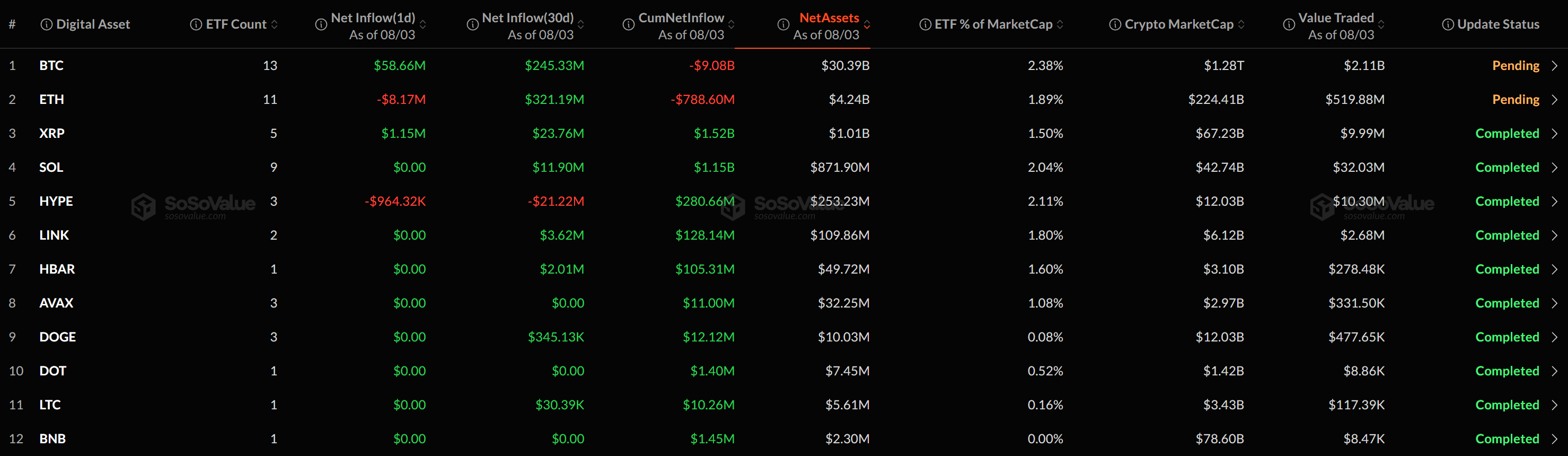
Flows in U.S.-listed spot XRP products have added to the headwinds. FXStreet reported that spot XRP ETFs saw net outflows of $3.58 million on Wednesday, signaling that short-term demand has not stabilized. While the headline figures are modest compared with larger Bitcoin (BTC) and Ethereum (ETH) vehicles, sustained outflows can materially affect thinner marginal demand conditions for altcoins.
More notably, TheStreet reported that Grayscale has sold approximately $180.78 million worth of XRP during redemption activity in the first half of 2026 tied to its XRP trust/ETF structure. Market participants widely interpret large-scale trust selling as a proxy for institutional de-risking—whether driven by profit-taking, portfolio rebalancing, or reduced conviction amid regulatory ambiguity. CryptoNews also noted that XRP is hovering near a critical support band, with the direction of 'institutional flows' likely to be decisive for the next leg of the trend.
On the policy front, a key U.S. legislative catalyst has been pushed back. CoinSpeaker reported that the U.S. Senate postponed a vote on the CLARITY Act—short for the Digital Asset Market Clarity initiative—a bill viewed by parts of the industry as pivotal for defining how digital assets are classified and regulated. For XRP specifically, delays are being watched closely because clearer statutory definitions could influence how exchanges, market makers, and institutional allocators assess compliance risk.
The longer the vote remains shelved, the more the market risks pricing in a prolonged gap in U.S. regulatory clarity. That uncertainty can chill incremental demand, slow listing expansion, and keep risk premiums elevated—particularly for assets that sit near the center of regulatory debate.
While U.S. policy remains a near-term drag, Ripple is making regulatory progress in Europe. Futunn reported that Ripple recently secured a Crypto Asset Service Provider (CASP) license from Luxembourg’s financial regulator, the CSSF. The approval positions the firm to operate under the European Union’s MiCA framework, which sets region-wide standards for licensing, disclosures, and operational requirements for crypto service providers.
Ripple said the MiCA-aligned authorization strengthens its push into Europe’s B2B payments market. With the Luxembourg approval included, the company’s portfolio of regulatory licenses now exceeds 75 jurisdictions, a milestone that could broaden long-term channels for compliant 'institutional adoption' even as U.S. timelines remain uncertain.
Development on the XRP Ledger (XRPL) is also continuing in parallel. FXStreet reported that an upgrade has been proposed to move multisignature coordination fully 'on-chain'—handling signer coordination directly on the ledger rather than relying on off-ledger processes. Proponents argue that the change could improve transaction security and strengthen reliability for integrations that depend on consistent execution guarantees.
In addition, XRPL’s interoperability story is drawing attention as it connects with Axelar, a cross-chain protocol designed to enable asset transfers across more than 80 blockchains without bespoke bridge infrastructure for each route. If adoption follows, interoperability could serve as a structural tailwind for ecosystem growth, even if it does not immediately offset macro and policy-related headwinds driving spot price action.
For now, the market’s focus remains tightly anchored to whether XRP can defend the $1.04 region and reclaim $1.05. With ETF flows negative and U.S. legislative momentum delayed, near-term sentiment looks constrained. Still, Europe-facing licensing progress and ongoing XRPL upgrades remain the key constructive variables that longer-horizon participants are watching as potential drivers of renewed demand once the U.S. policy outlook becomes clearer.





















Comment 0