

 News
News  Coin Information
  About us
  Customer Service


 Add as a preferred source on Google
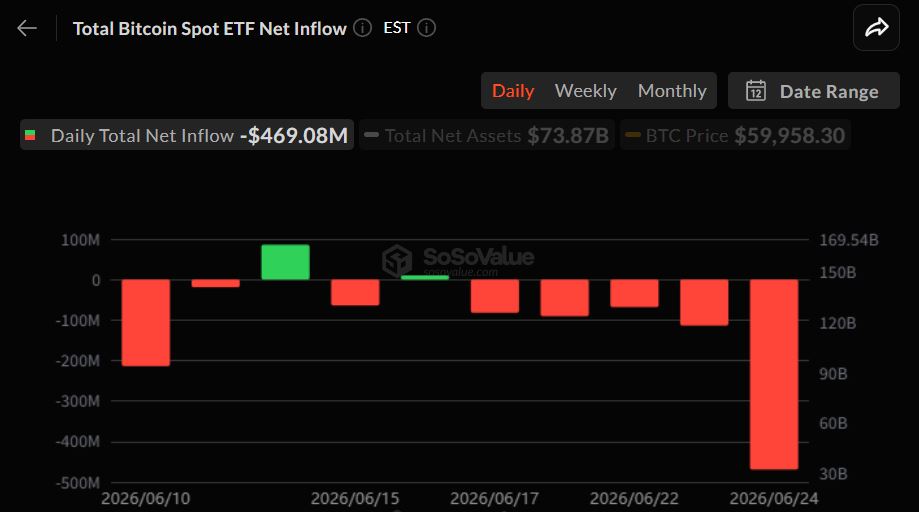
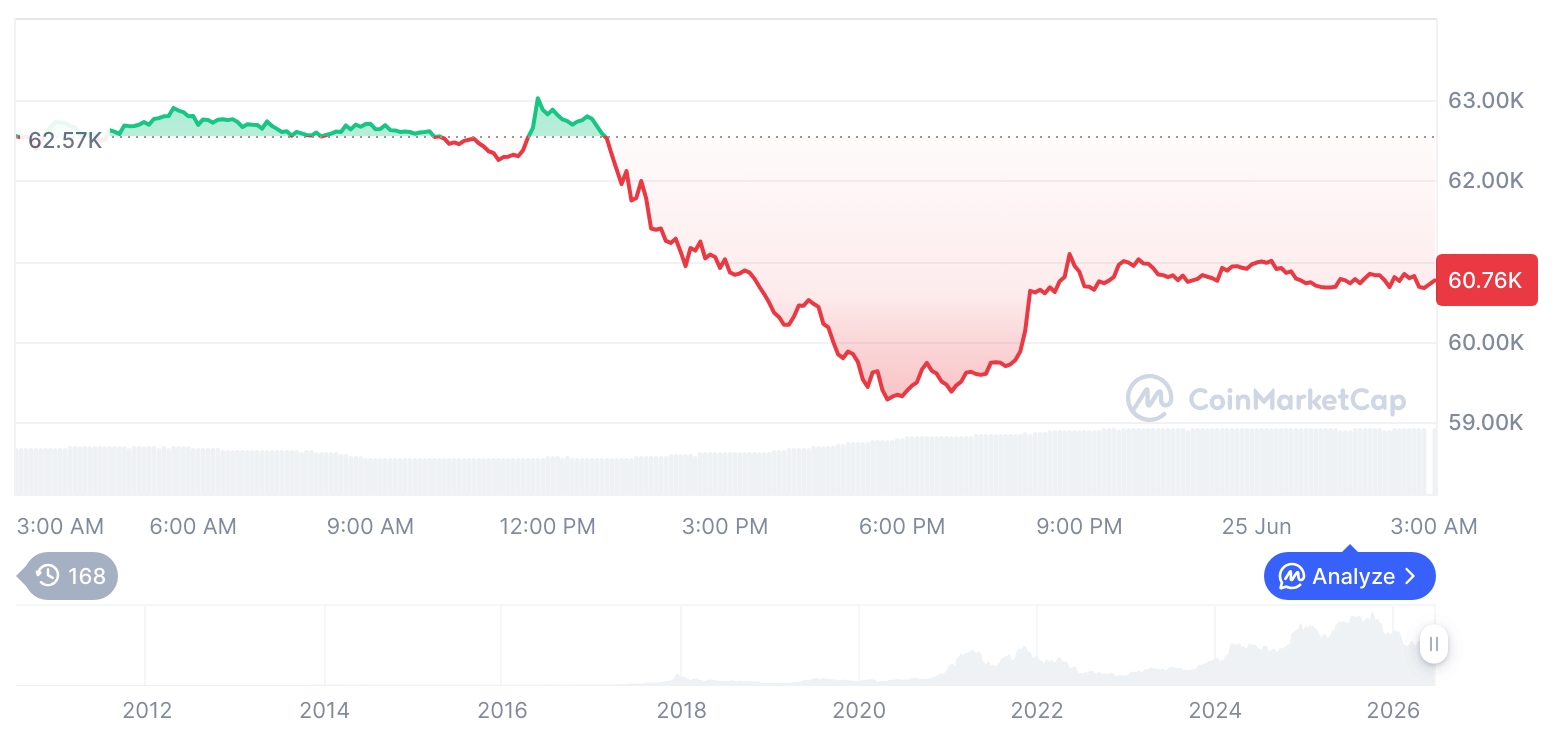
Solana (SOL) held up better than most major cryptocurrencies during a sharp market downturn that pushed Bitcoin (BTC) below the $60,000 level, underscoring investor focus on the network’s expanding institutional products and real-world asset tokenization activity.
As of Wednesday UTC (June 25), SOL was changing hands around $66.26, down roughly 5% over the past week, according to a market flash report from KuCoin. The move compared favorably with broader weakness across large-cap tokens, including a steeper decline in XRP, as risk-off sentiment dominated digital assets.
KuCoin analysts described Solana as among the most resilient large-cap assets during the selloff, highlighting the $66 area as a key near-term level. They pointed to a lower support zone around $62–$63 and said a break below that band could open the door to deeper downside if BTC weakness persists. On the upside, they framed $72 as an initial trigger point, with $78–$85 representing a heavier resistance corridor that would need to be cleared for a more convincing reversal.
RoboForex echoed the cautious near-term tone, noting that SOL had been sliding for three consecutive trading sessions amid heightened risk aversion following BTC’s drop below $60,000. The firm flagged a potential ‘double top’ technical setup, arguing that confirmation could pull prices toward the $60.80–$58.85 range. Even so, RoboForex maintained that Solana’s medium- to long-term backdrop remains constructive, citing accelerating product development and adoption across multiple verticals.
That longer-term narrative has increasingly centered on ‘institutional demand’ and a rapidly intensifying push to bring Solana exposure to traditional investors via exchange-traded products. Grayscale said in a June 25 SEC filing that it will cut the management fee on its Solana staking ETF, GSOL, from 0.35% to 0.19%. The firm also reduced the share of staking rewards collected as fees to 7% from 23%, a change designed to make the product more competitive as issuers race to capture flows.
Data cited by Solana Compass suggested the new 0.19% fee places GSOL in line with Franklin Templeton’s SOEZ (0.19%), while undercutting or matching peers such as Bitwise’s BSOL (0.20%), 21Shares’ TSOL (0.21%), Fidelity’s FSOL (0.25%), and VanEck’s VSOL (0.30%).
Competition may tighten further if Morgan Stanley’s proposed Solana trust, MSOL, proceeds with a 0.14% management fee—an aggressive level that would set a new low for the segment. RoboForex said Morgan Stanley recently updated its filing to incorporate in-house staking functionality, arguing that the combination of low fees and staking yield could strengthen the case for traditional capital inflows over time.
Beyond investment wrappers, Solana’s on-chain economy is also showing signs of rotation toward ‘real-world assets’ (RWA). Solana Compass reported that tokenized assets have overtaken memecoins in Solana spot trading activity, with daily tokenized-stock volume hitting a record $644 million. The shift is being watched as a signal that speculative flows may be giving way—at least at the margin—to use cases tied to regulated financial rails and tokenized settlement.
A key catalyst highlighted in the report was Paxos bringing Pax Gold (PAXG) to Solana via Sunrise, marking what it described as the first OCC-regulated gold token to be listed on the network. Market participants see the development as part of a broader effort to position Solana as a compliant venue for tokenized commodities and other regulated instruments.
Infrastructure metrics have also drawn attention. Pyth Network, a major oracle provider in the Solana ecosystem, processed $110 billion—about 52%—of global RWA perpetual futures volume in May 2026, according to figures cited in the report, reinforcing claims about Solana’s scaling capacity for high-throughput markets. Separately, GetBlock said it increased Solana RPC computing unit limits by up to 75% at the same price, a move intended to improve performance for developers and high-demand applications.
Adoption efforts are extending into payments as well. RoboForex said South Korea’s Toss Bank has launched a pilot program using Solana to test faster, lower-cost cross-border transfers and payments. The report added that Xweave has introduced Solana for stablecoin treasury settlement across the Asia-Pacific region, another sign that ‘stablecoin settlement’ is becoming a mainstream design choice for enterprise payment flows.
Governance and brand visibility are also contributing to the network’s momentum. Helium (HNT) opened a seven-day vote on HIP-149, described as one of the project’s most consequential governance decisions since migrating to Solana. Metaplex DAS, meanwhile, has started indexing on-chain AI agents through major Solana RPC providers, expanding tooling for AI-enabled on-chain applications.
On the marketing front, Solana is set to appear as a sponsor of the World Series of Poker during an ESPN broadcast on July 2, Solana Compass reported—an example of the ecosystem’s push into mainstream media channels as it competes for mindshare beyond crypto-native audiences.
Still, analysts cautioned that short-term risks remain elevated despite the improving medium-term setup. RoboForex warned that a major market participant has reportedly increased a SOL short position by 20x, adding to volatility risk at a time when macro-driven deleveraging is weighing on crypto assets broadly.
Technically, RoboForex highlighted $68.05 and $64.05 as critical levels, with failure to hold support potentially pushing SOL toward the high-$50s. KuCoin similarly emphasized the $62–$63 zone as a line in the sand, while noting that reclaiming $72—and then breaking through $78–$85—would strengthen the case that Solana’s relative outperformance could evolve into a sustained trend.
For now, markets appear split between near-term caution and a growing consensus that fee compression in Solana investment products, alongside rising RWA and payments activity, is reinforcing the ecosystem’s longer-term trajectory—even as broader crypto conditions remain fragile.
🔎 Market Interpretation
- Relative resilience amid selloff: Solana (SOL) declined about 5% on the week to ~$66.26 while Bitcoin fell below $60,000, with SOL holding up better than several large-cap peers during the risk-off move.
- Key technical battleground: Market focus centers on the $66 area, with major support at $62–$63. A breakdown below that band could accelerate losses if BTC weakness continues.
- Upside triggers and resistance: Analysts frame $72 as the first reclaim level; a more durable reversal likely requires clearing the heavier $78–$85 resistance corridor.
- Near-term caution signals: RoboForex flags a possible double-top pattern that, if confirmed, could pull SOL toward $60.80–$58.85, while reports of a major participant increasing a SOL short position add volatility risk.
- Structural tailwinds: Despite short-term fragility, the medium/long-term narrative is supported by ETF fee compression, expanding institutional access, and accelerating real-world asset (RWA) + payments activity on Solana.
💡 Strategic Points
- Watch the “line in the sand” support zone: The $62–$63 area is repeatedly cited as primary support. A sustained break may shift positioning toward downside scenarios (high-$50s) rather than dip-buying.
- Use a level-based roadmap:
- Bear path: Lose $62–$63 → potential move to ~$60.80–$58.85; risk increases if BTC remains under pressure.
- Base/recovery path: Hold $62–$63 and reclaim $72 → improves short-term momentum; still needs $78–$85 breakout for trend confirmation.
- Institutional product catalyst = fee war: Grayscale cut GSOL’s management fee to 0.19% and reduced staking-reward fees, matching Franklin Templeton’s 0.19% and tightening competition versus Bitwise, 21Shares, Fidelity, and VanEck. If Morgan Stanley’s proposed MSOL launches at 0.14%, fee compression could intensify and reshape inflows toward the lowest-cost access points.
- RWA rotation is a key behavioral signal: Solana spot activity is reportedly shifting from memecoins toward tokenized assets, with record $644M daily tokenized-stock volume. If sustained, this may indicate higher-quality, utility-driven volume rather than purely speculative churn.
- Compliance-linked assets may broaden adoption: Paxos bringing Pax Gold (PAXG) to Solana via Sunrise (described as an OCC-regulated gold token on the network) is positioned as a step toward regulated commodity tokenization and more institution-friendly on-chain markets.
- Infrastructure capacity supports high-throughput use cases: Pyth processing a large share of global RWA perpetual futures volume and GetBlock raising RPC computing unit limits by up to 75% at the same price both point to efforts to improve performance and scalability for demanding applications.
- Payments pilots add “real economy” optionality: Toss Bank’s cross-border pilot and Xweave’s stablecoin treasury settlement rollout in APAC reinforce Solana’s positioning for enterprise payment flows where cost and speed matter.
- Governance + ecosystem tooling as secondary drivers: Helium’s HIP-149 vote and Metaplex DAS indexing AI agents suggest ongoing ecosystem maturation beyond price action, while mainstream sponsorship (World Series of Poker/ESPN) aims to expand awareness.
📘 Glossary
- Support / Resistance: Price zones where buying (support) or selling (resistance) historically becomes stronger, often shaping short-term trading decisions.
- Double Top: A bearish chart pattern where price fails twice near a similar high, sometimes preceding a decline if the “neckline” support breaks.
- Exchange-Traded Product (ETP/ETF): A regulated, exchange-listed vehicle that gives investors exposure to an asset (here, SOL) without directly holding the token.
- Management Fee: Annual percentage charged by a fund/ETP issuer for operating the product; lower fees can be decisive in attracting inflows.
- Staking Rewards / Staking Fee: Yield earned by participating in network consensus (staking). Some products pass rewards to holders but take a percentage as fees.
- Real-World Assets (RWA): Tokenized representations of off-chain assets such as stocks, commodities, or credit instruments traded and settled on-chain.
- Oracle (Pyth Network): Infrastructure that delivers external market data (e.g., prices) to smart contracts for trading, lending, and derivatives.
- RPC (Remote Procedure Call): Node infrastructure developers/apps use to read from and write to the blockchain; higher compute limits can improve throughput and reliability.
- Perpetual Futures (Perps): Derivatives without expiry that track an underlying asset price, commonly used for leveraged trading.
- Stablecoin Treasury Settlement: Using stablecoins to settle corporate cash movements and payments, often aiming for faster and cheaper cross-border transfers.









Comment 0