

 News
News  Coin Information
  About us
  Customer Service


 Add as a preferred source on Google

Charles Schwab, one of the largest U.S. brokerages with roughly $12.6 trillion in client assets, has officially rolled out spot Bitcoin (BTC) trading—another step in traditional finance’s accelerating push to bring crypto access onto mainstream investment platforms. The launch comes as Bitcoin slid below key psychological levels and U.S. lawmakers signaled growing confidence that long-awaited market structure legislation can clear Congress.
According to Bitcoin Magazine, Schwab’s new service allows customers to trade Bitcoin directly, broadening access beyond ETFs and crypto-linked products. For the market, the move is significant not because it changes Bitcoin’s fundamentals overnight, but because it expands the rails for 'institutional demand' and everyday brokerage users who prefer regulated, familiar venues over dedicated crypto exchanges.
The debut arrives amid a mounting political push in Washington to clarify how digital assets are regulated. Rep. French Hill, chair of the House Financial Services Committee, said in an interview with Fox that the “Bitcoin Clarity Act” has the votes needed to pass. Referencing momentum behind the bill, Hill suggested Washington is moving quickly toward a framework that could deliver 'regulatory clarity' for the U.S. crypto market—an issue the industry has long argued is essential for deeper participation by banks, asset managers, and conservative allocators.
On the Senate side, Sen. Cynthia Lummis told Fox Business that a companion “Clarity” bill is expected to be brought to the Senate floor in July. The proposals broadly aim to define market oversight responsibilities for U.S. regulators and set clearer rules for digital asset market structure, an area that has remained fragmented amid overlapping jurisdictional claims and enforcement-led policy making.
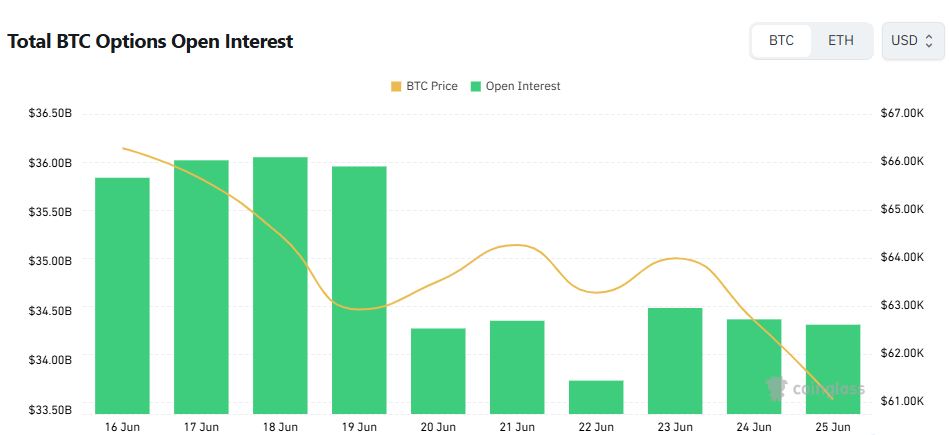
While policy headlines leaned constructive, prices weakened. Bitcoin fell below $61,000 and later briefly dipped under $60,000, according to OKX data cited by PANews. Ethereum (ETH) also slipped below $1,600, trading around $1,599.99—an area many short-term traders treat as a sentiment line, though the day’s decline remained relatively moderate.
On-chain and derivatives activity pointed to risk-off positioning. Whale Alert reported that 1,000 BTC—worth roughly $61 million at the time—was transferred from an unknown wallet to Coinbase, a move traders often monitor for potential sell-side intent when coins move onto centralized exchanges. Separately, Lookonchain data cited by Odaily indicated a large trader closed an 800 BTC long position as Bitcoin broke below $61,000, realizing an estimated loss of about $1.26 million on a position valued near $48.8 million.
Stablecoin flows also drew attention after Whale Alert flagged a transfer of approximately 135.6 million USDC into Aave, a leading DeFi lending protocol on Ethereum. The purpose of the transaction was not disclosed, but such movements can reflect large-scale collateral repositioning, liquidity provision, or preparation for leverage in on-chain markets.
In traditional markets adjacent to crypto, Strategy’s preferred stock STRC fell below $82 to a record low near $81.83, down 6.3% on the day, according to Odaily. Because Strategy has leaned heavily on preferred issuance to support its Bitcoin accumulation, persistent trading below par can signal that investors are demanding higher yields—raising questions about 'funding costs' and how cheaply the company can finance future purchases if market appetite continues to soften.
Taken together, the day’s developments highlight a familiar dynamic: adoption infrastructure and legislative tailwinds are building, but near-term price action remains sensitive to leverage unwinds, exchange flows, and shifting risk appetite. If Washington advances market structure rules in the coming weeks, it could reshape how U.S. capital engages with crypto—but the market’s immediate focus is still on liquidity conditions and downside volatility.



















Comment 0