

 News
News  Coin Information
  About us
  Customer Service


 Add as a preferred source on Google
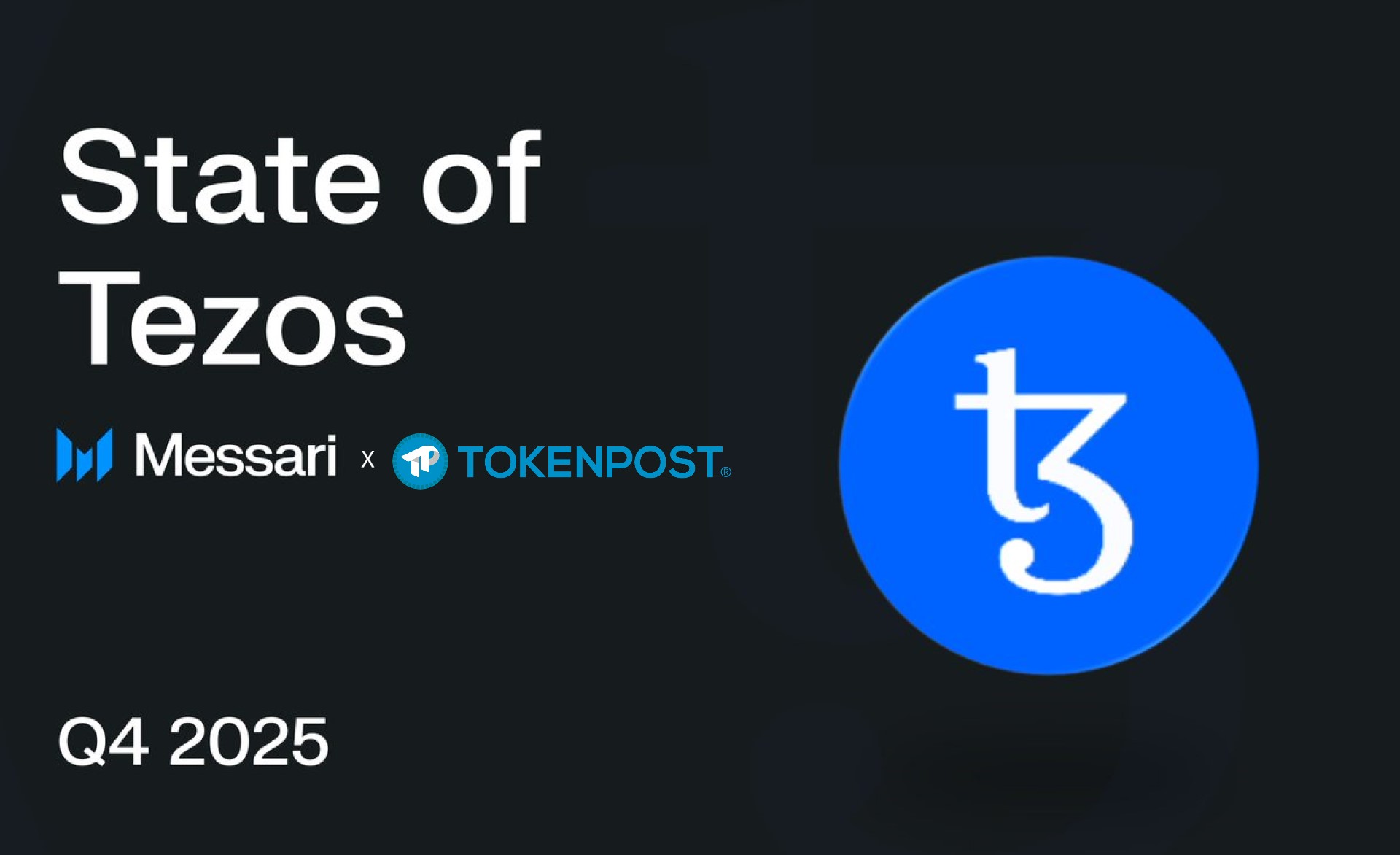
Tezos (XTZ) is seeing a sharp acceleration in activity on its Etherlink execution layer, with a new Messari Research report pointing to scaling upgrades and rising governance participation as key pillars for longer-term ecosystem growth—even as DeFi liquidity continues to drift lower.
According to Messari’s findings for Q4 2025, Etherlink processed 18.6 million transactions, up 50% from the prior quarter, while daily active addresses climbed to roughly 9,860—nearly doubling over the same period. The research firm framed the surge as evidence that Etherlink is increasingly functioning as a core 'execution layer' within the broader Tezos stack, expanding the network’s capacity to host higher-throughput applications without relying solely on Tezos L1.
Messari attributed much of the throughput growth to two kernel upgrades rolled out in October and December 2025, respectively: 'Ebisu' and 'Farfadet.' Ebisu lifted Etherlink’s processing capacity to around 14 million gas per second, while Farfadet pushed it further to approximately 27 million gas per second—more than doubling the post-Ebisu ceiling. In practical terms, the upgrades were designed to let Etherlink absorb more transactions without a proportional rise in costs, a key consideration for developers and users as rollup-like environments compete on both latency and fees.
The report also highlighted qualitative improvements beyond raw throughput. Messari said the upgrades introduced 'instant transaction finality' and improved execution efficiency through fee-structure optimization, changes that can meaningfully affect user experience for on-chain trading, gaming, and other high-frequency activities where confirmation speed and predictable fees are often decisive.
Still, the expansion in activity has not translated into stronger DeFi balance sheet metrics. Messari noted that total value locked (TVL) declined across both Etherlink and the Tezos base layer over the quarter, with Etherlink TVL down 39.3% to about $37.2 million. Curve accounted for more than half of the TVL erosion, underscoring how concentrated liquidity can amplify swings in reported on-chain capital when a major venue contracts.
On the Tezos L1 side, Messari pointed to a separate bright spot: governance participation reached an all-time high in Q4 2025. The network’s throughput also rose more than threefold, which the report linked to the same broader theme of protocol-level optimization. Observers are now watching how these improvements could set the stage for the upcoming 'Talin' upgrade, particularly around block-time dynamics and the potential for smoother execution across the stack.
Messari’s overall takeaway was that Etherlink’s scaling trajectory and Tezos’ governance momentum are strengthening the foundation for sustained ecosystem development into 2026 and beyond, even as liquidity metrics in DeFi signal that user capital remains selective and sensitive to broader market conditions.
🔎 Market Interpretation
{
"network_activity_signal": [
{
"point": "Etherlink usage is accelerating sharply, indicating growing product-market fit for Tezos’ execution-layer approach.",
"evidence": "Q4 2025: 18.6M transactions (+50% QoQ); ~9,860 daily active addresses (nearly 2x QoQ).",
"why_it_matters": "Rising transactions and active users suggest Etherlink is increasingly absorbing application demand that might otherwise be constrained on L1."
},
{
"point": "Scaling gains are being driven by concrete protocol upgrades rather than one-off spikes.",
"evidence": "Kernel upgrades: Ebisu (~14M gas/sec) then Farfadet (~27M gas/sec), more than doubling capacity after Ebisu.",
"why_it_matters": "Sustained throughput increases can improve competitiveness versus other rollup-like environments on fees and latency."
},
{
"point": "User experience improvements (finality + fee optimization) can attract high-frequency app categories.",
"evidence": "Messari cites 'instant transaction finality' and execution efficiency improvements via fee-structure optimization.",
"why_it_matters": "Faster confirmations and predictable costs are key for on-chain trading, gaming, and other interactive use cases."
},
{
"point": "DeFi capital is not following usage growth yet—liquidity is contracting despite higher throughput.",
"evidence": "Etherlink TVL -39.3% QoQ to ~$37.2M; TVL also declined on Tezos L1.",
"why_it_matters": "Adoption can be 'activity-heavy but capital-light' in risk-off conditions; this can limit DeFi depth even when transactions rise."
},
{
"point": "TVL weakness is amplified by liquidity concentration in a few venues.",
"evidence": "Curve drove more than half of Etherlink’s TVL decline.",
"why_it_matters": "When a dominant protocol shrinks, headline TVL can swing sharply—masking broader, smaller pockets of stability or growth."
},
{
"point": "Tezos L1 governance engagement is strengthening alongside performance improvements.",
"evidence": "Governance participation hit an all-time high in Q4 2025; L1 throughput rose more than threefold.",
"why_it_matters": "High governance participation can signal stronger social consensus and faster iteration capacity heading into future upgrades (e.g., Talin)."
}
],
"near_term_read": {
"bullish_factors": [
"Rapid Etherlink throughput and address growth",
"Major kernel upgrades lifting capacity and improving finality",
"Record Tezos L1 governance participation and higher throughput"
],
"bearish_factors": [
"Declining TVL on Etherlink and Tezos L1",
"Liquidity concentration risk (Curve’s outsized influence)",
"Capital remains selective and sensitive to macro/market conditions"
],
"neutral_watch_items": [
"Whether activity converts into sustained DeFi liquidity",
"Impact of the upcoming Talin upgrade on block-time dynamics and stack-wide execution consistency"
]
}
}
💡 Strategic Points
{
"developer_takeaways": [
{
"action": "Evaluate Etherlink for high-throughput apps that require fast confirmation and stable fees.",
"rationale": "Farfadet materially increases headroom (~27M gas/sec) and Messari flags instant finality + fee optimizations.",
"best_fit_use_cases": [
"on-chain trading and market-making tools",
"gaming and interactive consumer apps",
"high-frequency NFT or ticketing flows",
"microtransaction-style applications"
]
},
{
"action": "Design for liquidity realism: plan incentives and risk controls assuming lower baseline TVL.",
"rationale": "TVL fell sharply (-39.3% QoQ) even as activity rose, implying usage does not guarantee deposited capital.",
"implementation_notes": [
"stress-test pools/strategies under liquidity drawdowns",
"avoid dependency on a single dominant venue",
"use conservative parameters for lending/AMMs when depth is thin"
]
},
{
"action": "Track L1 governance and upcoming Talin changes as part of your roadmap.",
"rationale": "Record participation + protocol optimization suggests the ecosystem is actively iterating; Talin may affect block-time/execution expectations.",
"what_to_monitor": [
"block-time dynamics and any UX implications",
"cross-layer execution consistency",
"tooling and infra updates around upgrade activation"
]
}
],
"investor_operator_lens": [
{
"theme": "Separate 'usage growth' from 'capital depth'.",
"how_to_apply": "Monitor both transaction/address metrics and TVL/DEX depth; they are diverging in Q4 2025.",
"signal_to_watch": "If TVL stabilizes or recovers while activity remains high, it may indicate improving confidence and retention."
},
{
"theme": "Manage concentration risk in ecosystem KPIs.",
"how_to_apply": "Decompose TVL by protocol; large players like Curve can dominate headline changes.",
"signal_to_watch": "Growth in number of meaningful liquidity venues (less reliance on one protocol)."
},
{
"theme": "Governance momentum can be a leading indicator for protocol execution capability.",
"how_to_apply": "High participation can correlate with smoother upgrades and clearer ecosystem coordination.",
"signal_to_watch": "Whether governance engagement remains elevated through Talin and subsequent releases."
}
],
"key_metrics_to_track_next": [
"Etherlink: transactions, DAAs, gas/sec utilization, average fees",
"User experience: confirmation/finality times and fee variance",
"DeFi health: TVL, DEX volume, pool depth, protocol concentration",
"Tezos L1: governance participation rate and throughput post-optimization",
"Talin upgrade: measured impact on block time and execution smoothness"
]
}
📘 Glossary
{
"terms": [
{
"term": "Tezos (L1)",
"definition": "The base-layer blockchain responsible for security, consensus, and native protocol governance."
},
{
"term": "Etherlink",
"definition": "An execution layer associated with Tezos, intended to support higher-throughput application execution without relying solely on Tezos L1 capacity."
},
{
"term": "Execution layer",
"definition": "A layer designed to run transactions and smart contract computations, often optimized for throughput and lower costs compared with the base layer."
},
{
"term": "Kernel upgrade (Ebisu / Farfadet)",
"definition": "Protocol-level updates to Etherlink’s core execution system that increase performance and adjust execution/fee behavior."
},
{
"term": "Gas per second",
"definition": "A throughput measure indicating how much computation the network can process each second; higher values generally mean more transaction capacity."
},
{
"term": "Finality (instant transaction finality)",
"definition": "The point at which a transaction is considered irreversible; faster finality improves UX for trading and interactive apps."
},
{
"term": "Fee-structure optimization",
"definition": "Changes to how transaction fees are calculated/charged to improve efficiency, predictability, or cost for users."
},
{
"term": "TVL (Total Value Locked)",
"definition": "The total amount of assets deposited in DeFi protocols on a chain/layer; often used as a proxy for DeFi liquidity and user capital commitment."
},
{
"term": "Curve",
"definition": "A DeFi liquidity venue (commonly used for swaps), cited as a major contributor to Etherlink’s TVL decline due to its large share of locked capital."
},
{
"term": "Governance participation",
"definition": "The level of community/stakeholder engagement in proposing, voting on, and approving protocol changes on Tezos."
},
{
"term": "Talin upgrade",
"definition": "An upcoming Tezos-related upgrade referenced as a focus area, particularly for potential block-time and execution improvements."
}
]
}







Comment 0