

 News
News  Coin Information
  About us
  Customer Service


 Add as a preferred source on Google
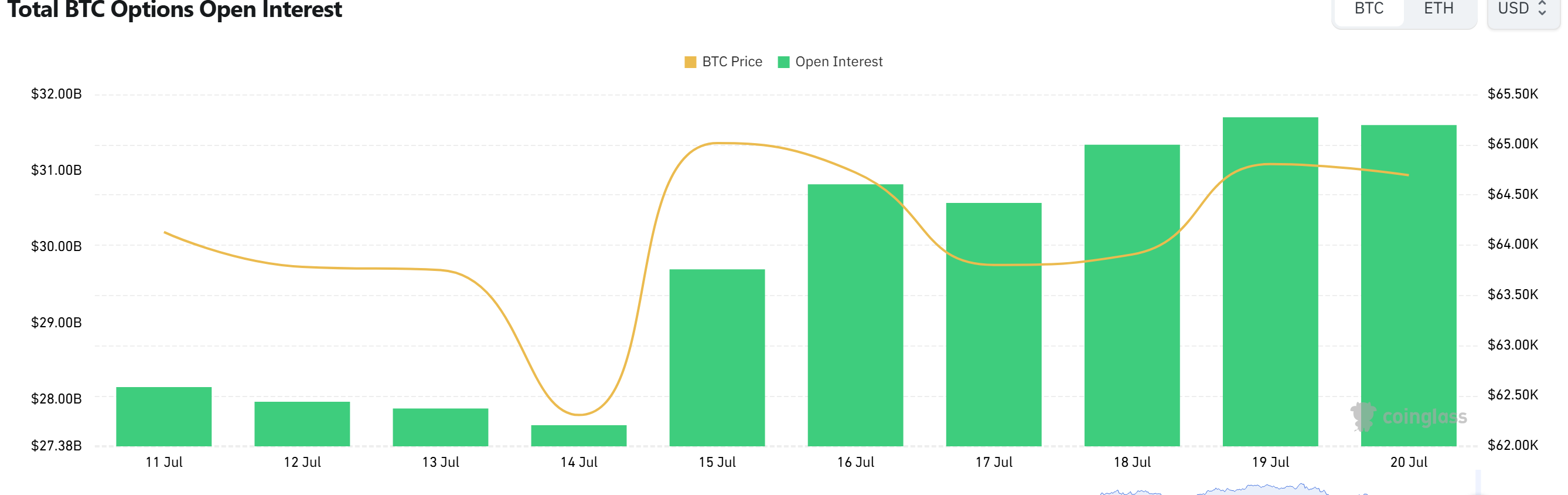
Bitcoin (BTC) options data on Sunday showed a market leaning bullish in its longer-dated positioning while turning noticeably more defensive in short-term trading—a split that suggests traders expect upside over the medium run but are actively hedging near-term volatility.
As of 9:40 a.m. in Seoul on July 20 (8:40 p.m. ET on July 19), CoinGlass data put total Bitcoin options 'open interest' (OI) at $31.0726 billion, up 0.11% from $31.0374 billion the day before. Reported 24-hour options volume was roughly $1.1223 billion.
The composition of outstanding positions remained skewed toward calls. Calls accounted for 65.18% of total OI, versus 34.82% for puts—typically a sign that medium-term positioning is tilted toward higher prices. However, the flow of activity over the past 24 hours told a different story: call volume represented 46.90% of trading, while put volume came in higher at 53.10%.
That divergence between positioning and flow is often interpreted as a market that is structurally optimistic but tactically cautious. A call-heavy OI profile can reflect accumulated 'upside exposure' and longer-dated bets on a rebound, while a surge in put-led volume can indicate demand for hedges against drawdowns, or short-term volatility trades as spot prices approach key levels.
On the OI leaderboard, the most crowded contracts were concentrated on Deribit and clustered at higher strikes, underscoring where traders have been building directional exposure. The top three by open interest were the $70,000 call expiring July 31, the $72,000 call expiring July 31, and the $80,000 call expiring Dec. 25.
In contrast, the most active contracts by 24-hour volume were primarily shorter-dated positions on Bybit and centered around the mid-$60,000 region—levels that can become focal points for hedging as expiry approaches. The most traded contracts were the $65,000 call expiring July 20, the $65,500 call expiring July 20, and the $64,500 put expiring July 20.
Options are widely used by crypto traders to express leveraged views on price direction or to hedge existing holdings. Calls generally represent 'bullish' exposure—giving the right, but not the obligation, to buy at a predetermined price—while puts function as 'downside protection' by granting the right to sell at a set price. OI measures how many contracts remain outstanding, offering a window into the accumulated size of positioning rather than just one day’s trading.
For the broader market, the latest figures highlight a familiar late-cycle dynamic: longer-horizon traders appear comfortable keeping upside structures in place, but near-term participants are paying up for protection as expiration-sensitive positioning clusters around widely watched strikes. If spot prices move sharply, those concentrations can amplify hedging flows and contribute to faster intraday swings—without necessarily overturning the market’s medium-term bias.
🔎 Market Interpretation
- Split sentiment: Bitcoin options positioning is structurally bullish (call-heavy open interest), while near-term trading is defensive (put-heavy 24h volume), implying upside expectations over the medium term but active hedging against short-term volatility.
- Open interest steady, activity meaningful: Total options OI is $31.0726B (+0.11% day/day) with $1.1223B in 24h volume—suggesting positioning is largely in place, but traders are actively adjusting short-dated risk.
- Positioning vs flow divergence: Calls are 65.18% of OI (puts 34.82%), yet 24h volume favors puts (53.10% puts vs 46.90% calls). This often signals hedging demand rather than a wholesale change in trend view.
- Where bullish bets cluster: Largest OI is concentrated at higher strikes on Deribit—especially $70K call (Jul 31), $72K call (Jul 31), and $80K call (Dec 25)—pointing to targeted upside levels traders are positioning around.
- Where hedging pressure may show up: Most active 24h contracts are short-dated and centered in the mid-$60K area on Bybit—$65K call (Jul 20), $65.5K call (Jul 20), $64.5K put (Jul 20)—a zone likely to attract hedging and gamma-related flows into expiry.
- Volatility mechanics into expiry: Concentrated strikes near spot can amplify dealer hedging flows, increasing intraday swings even if the broader medium-term bias remains bullish.
💡 Strategic Points
- Separate horizon views: Treat the market as bullish on longer-dated structures but risk-off into near expiries; strategies and leverage should reflect the time horizon mismatch.
- Watch key strike magnets: Monitor $64.5K–$65.5K (very short-dated activity cluster) for pinning/whipsaw risk and $70K–$72K (heavy OI) as potential breakout/target zones where flows can accelerate.
- Interpret put-led volume carefully: Elevated put volume can indicate protection buying (hedging spot/levered longs) or short-volatility positioning being adjusted; confirm with spot moves, funding, and implied volatility before concluding sentiment has flipped.
- Expect faster moves near expiry: As expiration approaches, concentrated strikes can increase sensitivity to small spot changes; consider tighter risk limits, smaller sizing, or defined-risk structures if trading intraday.
- Scenario framing:
- Upside continuation: If spot pushes higher, call-heavy OI at $70K+ may reinforce bullish momentum as hedges unwind or dealers adjust.
- Sharp downside/vol spike: Put demand and near-term hedges can intensify selling/hedging loops around the mid-$60K strikes, accelerating drawdowns before stabilizing.
📘 Glossary
- Options: Derivatives contracts giving the right (not obligation) to buy or sell an asset at a preset price by a certain date.
- Call option (Call): Right to buy at the strike price; generally benefits from price increases.
- Put option (Put): Right to sell at the strike price; commonly used for downside protection.
- Strike price: The predetermined price at which the option can be exercised (e.g., $65,000).
- Expiration (Expiry): The date after which the option contract ceases to exist (e.g., July 20, July 31, Dec. 25).
- Open Interest (OI): Total number/value of outstanding option contracts that remain open; indicates accumulated positioning, not just daily trading.
- Options volume: The amount of options traded over a period (here, 24 hours); reflects current activity and short-term positioning changes.
- Hedging: Taking positions (often puts) to reduce risk from adverse price moves in an existing holding.
- Deribit / Bybit: Crypto derivatives exchanges referenced as venues where contracts are most concentrated/most active.






















Comment 0