
 Add as a preferred source on Google
$15 Million Crypto Liquidations Hit as Volatility Triggers Long Wipeouts
Crypto derivatives markets saw $15 million in liquidations led by long positions as Bitcoin and Ethereum drove volatile, two-way price action.



Crypto derivatives markets saw a fresh wave of forced deleveraging over the past day, with liquidation data pointing to choppy, two-way price action rather than a clean trend. While the 24-hour total skewed heavily toward longs being washed out, the most recent four-hour window showed shorts taking the brunt—an oscillation that typically accompanies high intraday volatility.
Across major venues, combined liquidations totaled about $15.03 million over the last 24 hours, according to CoinGlass. Long liquidations accounted for roughly $10.64 million, versus $4.39 million in shorts—meaning around 70.8% of the damage was concentrated in bullish leveraged positions. The split suggests that, over the full day, traders positioned for continuation moves were repeatedly forced out as prices failed to hold breakouts.
Zooming into the latest four hours, liquidations accelerated to approximately $9.89 million, with notable differences by exchange. Binance led with about $6.72 million—roughly 67.9% of the total—where shorts made up 59.7% of liquidations, hinting at a short-covering push during a brief upward move. Bybit posted around $964,290 (about 9.8% share) with shorts representing 73.5%. OKX recorded about $743,610 (about 7.5%) with a near-even mix, though shorts were slightly higher at 50.7%. Bitget logged roughly $693,690 (about 7.0%), and stood out for an unusually high short share of 82.7%.
Other venues showed the opposite bias. Gate posted about $496,930 in liquidations with longs taking 53.1%, while HTX skewed more decisively toward long liquidations at 80.3%. Hyperliquid recorded about $101,310, with all of it attributed to shorts—an imprint often associated with a fast, localized price spike that pressures bearish leverage.
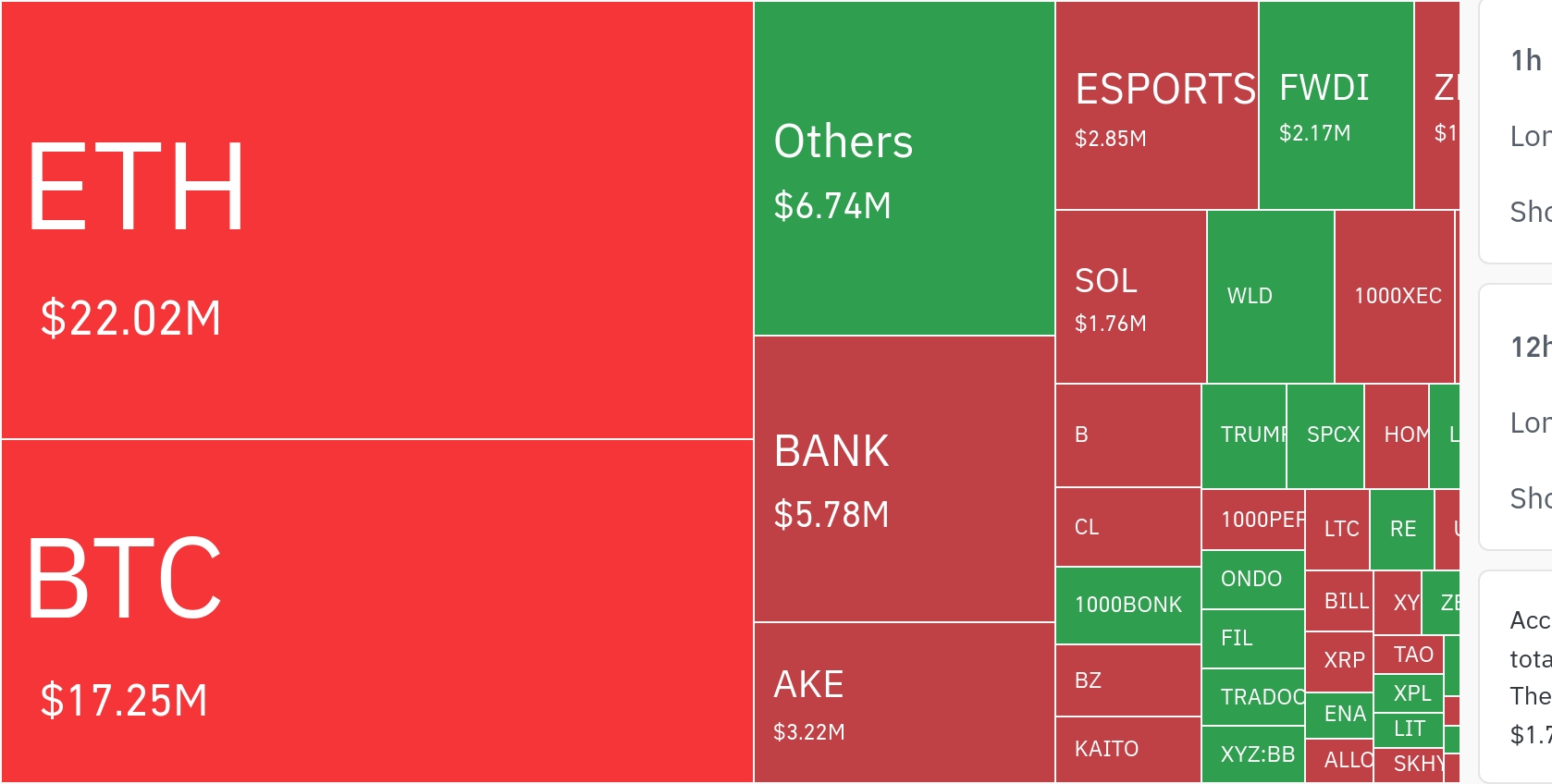
By asset, Ethereum (ETH) and Bitcoin (BTC) again dominated liquidation activity. CoinGlass’s 24-hour liquidation heatmap showed Ethereum at about $22.02 million in liquidations, followed by Bitcoin at about $17.25 million. A broader bucket of altcoins accounted for roughly $6.74 million. Among smaller or less-liquid names, several tokens saw outsized wipeouts, including BANK ($5.78 million), AKE ($3.22 million), ESPORTS ($2.85 million), and FWDI ($2.17 million), with Solana (SOL) also registering around $1.76 million.
In CoinGlass’s ticker-level table of 24-hour liquidations, Bitcoin led with approximately $555,600 in total forced closures (about $391,000 longs and $164,600 shorts). XRP followed at roughly $260,300, with Solana at about $217,600, Dogecoin (DOGE) at about $143,200, and BNB at about $118,300. While Ethereum did not appear in that specific ticker table, its top ranking on the heatmap underscores that the day’s core deleveraging impulse was centered on the two largest assets—ETH and BTC.
Price action over the same period reflected the lack of a settled direction. Bitcoin was reported around $71,700, down about 0.31% on the day. XRP was up roughly 0.31% even as short liquidations exceeded longs, consistent with a modest 'short squeeze' dynamic where short covering amplifies upward moves. Dogecoin showed a similar pattern—up about 0.31%—with short liquidations outweighing longs in the one-hour and four-hour windows, a setup frequently seen in meme-coin rebounds. TON, meanwhile, fell about 2.48%, the steepest decline among the cited majors, with liquidation flows suggesting a more straightforward selloff rather than an abrupt squeeze-driven move.
Market participants often view liquidation clusters as a window into where leverage has become overcrowded. The appearance of multi-million-dollar liquidations in lesser-followed tokens such as BANK, AKE, ESPORTS, and FWDI suggests that leverage may have been concentrated in theme-driven or 'low-liquidity' pockets, where relatively modest price swings can cascade into forced closes. At the same time, the mismatch between the near-term exchange data—where shorts dominated—and the 24-hour aggregate—where longs dominated—points to a market ping-ponging between brief rallies that punish shorts and subsequent pullbacks that unwind late longs.
Liquidations occur when leveraged traders can no longer meet margin requirements and positions are forcibly closed by exchanges. The latest readings indicate that crypto remains in a high-volatility regime, with Bitcoin and Ethereum at the center of the leverage reset even as sharp, idiosyncratic moves in smaller tokens add to instability. Until directional conviction improves, liquidation-driven swings are likely to remain a key feature of market structure.
Article Summary by TokenPost.ai
🔎 Market Interpretation
Volatility-led tape: Liquidations reflected two-way, choppy price action rather than a single sustained trend—typical of a high intraday volatility regime.
Timeframe divergence: The 24-hour picture was dominated by long liquidations (~$10.64M vs. $4.39M shorts; ~70.8% longs), but the latest 4-hour window flipped toward shorts being squeezed, signaling rapid sentiment reversals.
Exchange concentration: In the most recent 4 hours, Binance accounted for ~$6.72M (~67.9% share) with shorts making up ~59.7%—suggesting a brief upside move that forced short covering. Bybit and Bitget also showed elevated short-liquidation shares.
Core leverage reset centered on majors: Despite mixed ticker-table snapshots, broader heatmap data indicated ETH and BTC as the main liquidation hubs, implying the day’s leverage washout was anchored in the largest markets.
Tail-risk in smaller tokens: Multi-million liquidation spikes in lower-liquidity names (e.g., BANK, AKE, ESPORTS, FWDI) point to crowded leverage in theme-driven corners where modest moves can cascade.
💡 Strategic Points
Expect “ping-pong” conditions: With longs dominant over 24h but shorts dominant in the latest window, traders may face alternating mini-squeezes and pullbacks—risk is elevated for both sides.
Watch liquidation clusters as map markers: Areas with repeated forced closures often coincide with overcrowded positioning; these zones can act as near-term magnets for price and volatility.
Use position sizing and wider invalidation: In high-vol regimes, tighter stops are more likely to get clipped; consider smaller leverage, wider stop logic, or reduced exposure around major levels.
Exchange-specific flow matters: A large share of short liquidations on a dominant venue (e.g., Binance) can amplify brief upside impulses; confirmation across venues may help avoid chasing one-exchange noise.
Be cautious in low-liquidity alts: The outsized wipeouts in smaller tickers suggest higher gap risk, thinner order books, and faster liquidation cascades—especially during broader market swings led by BTC/ETH.
Interpret price/liq mismatches: Examples like XRP and DOGE rising while shorts liquidate align with short-squeeze dynamics; failing follow-through afterward can quickly flip into long unwinds.
📘 Glossary
Liquidation: Forced closure of a leveraged position when margin requirements are no longer met.
Long liquidation: A leveraged bullish position closed after price falls against it, often accelerating downside moves.
Short liquidation: A leveraged bearish position closed after price rises against it, often accelerating upside moves.
Forced deleveraging: Rapid reduction in market leverage via liquidations, typically increasing volatility and slippage.
Short squeeze: A sharp rise driven by short covering (buying back), which can compound upward momentum.
Liquidation cluster: A price zone with concentrated leveraged positions likely to be liquidated if reached.
Heatmap (liquidations): Visualization showing where liquidations are concentrated by asset and/or price levels over a period.
Margin: Collateral posted to support leveraged trading; declining equity can trigger liquidation.
High-volatility regime: Market condition with frequent, large intraday swings and rapid sentiment shifts.
Low liquidity: Thin order books where smaller trades can move price more, increasing cascade risk.