
 Add as a preferred source on Google
US Spot Ethereum ETFs See $28 Million Outflows, Extend 8-Day Streak
U.S. spot Ethereum ETFs recorded an eighth straight day of net outflows led by BlackRock’s ETHA, signaling cautious near-term institutional positioning despite steady trading activity.


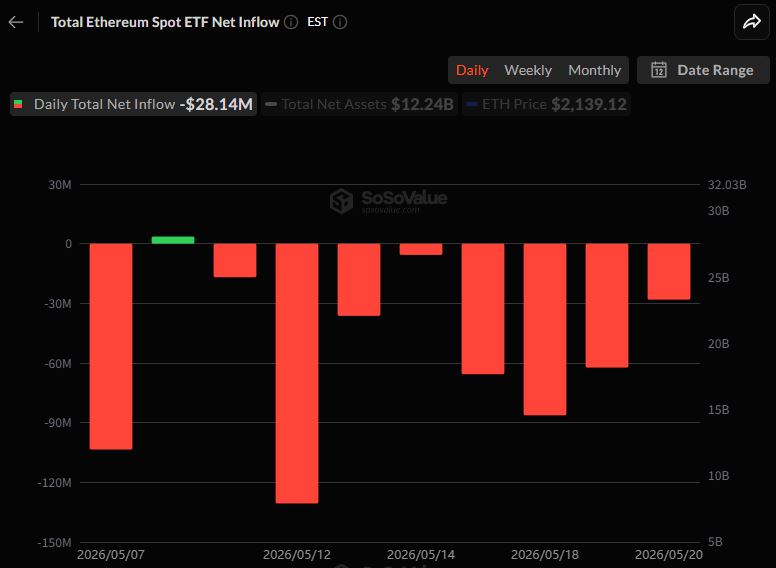
U.S. spot Ethereum (ETH) ETFs extended their losing streak on Tuesday ET, posting net outflows for an eighth consecutive trading day—a sign that demand has yet to decisively rebound even as trading activity remains relatively robust.
According to data compiled by SosoValue, the U.S. spot Ethereum ETF cohort recorded $28.14 million in net withdrawals on May 20 ET. The string of redemptions has persisted since May 11, marking eight straight sessions of net outflows. Despite the recent pressure, cumulative net inflows across the category stood at approximately $11.65 billion, underscoring that the broader adoption trend remains intact even as near-term positioning shifts.
Flows were concentrated in a small number of products. BlackRock’s iShares Ethereum Trust (ETHA) led the day’s outflows with $30.94 million exiting the fund, while Fidelity’s Fidelity Ethereum Fund (FETH) saw $1.6 million in net outflows. In contrast, BlackRock’s staking-focused Ethereum product (ETHB) registered $4.39 million in net inflows, partially offsetting withdrawals elsewhere. The remaining ETFs in the 10-fund group were flat on the day.
Trading volumes suggested that investors are still actively rotating exposure rather than abandoning the segment altogether. Total daily turnover across U.S. spot Ethereum ETFs reached about $350.4 million. BlackRock’s ETHA accounted for the bulk of activity at $246.17 million, followed by Grayscale’s Ethereum Mini Trust (ETH) at $30.71 million and Grayscale Ethereum Trust (ETHE) at $27.05 million.
In terms of assets, the combined net asset value of U.S. spot Ethereum ETFs was approximately $12.24 billion, representing about 4.75% of Ethereum’s total market capitalization. By size, BlackRock’s ETHA remained the largest with roughly $6.47 billion in net assets, followed by Grayscale’s ETH at $1.93 billion and Grayscale’s ETHE at $1.72 billion.
Market participants often read sustained ETF outflows as a proxy for cooling 'institutional demand' or reduced risk appetite, particularly when withdrawals are concentrated in the largest, most liquid products. At the same time, the modest inflow into the staking-oriented vehicle suggests some investors may be favoring frameworks that can potentially enhance returns via yield-like mechanics, even as the broader ETF category experiences net redemptions.
For now, the eighth straight day of net outflows highlights a cautious near-term tone around Ethereum ETF exposure in the U.S. market, with fund-level dispersion indicating that the shift may be more about product preference and positioning than a uniform reassessment of Ethereum itself.
Article Summary by TokenPost.ai
🔎 Market Interpretation
Persistent outflows signal cautious sentiment: U.S. spot Ethereum ETFs posted $28.14M net outflows on May 20 (ET), extending the streak to 8 consecutive sessions (since May 11), indicating demand has not clearly rebounded.
Concentration risk in flagship products: Outflows were dominated by BlackRock’s ETHA (-$30.94M), suggesting the most liquid, widely used vehicle is being reduced—often read as a proxy for softer institutional risk appetite.
Selective appetite remains: ETHB (+$4.39M) inflows imply some investors are rotating into products perceived to offer staking/yield-like benefits rather than exiting the Ethereum ETF theme entirely.
Active rotation, not abandonment: Despite net redemptions, total trading volume was strong at ~$350.4M, consistent with repositioning between issuers/structures rather than a broad shutdown of participation.
Zooming out remains constructive: Cumulative net inflows across the category still total ~$11.65B, implying the longer-term adoption trend is intact even as near-term flows turn defensive.
Meaningful footprint vs. ETH market: ETF category NAV is ~$12.24B, about 4.75% of Ethereum’s market cap—large enough for flows to influence market narrative and short-term positioning signals.
💡 Strategic Points
Watch the “ETHA tell”: Continued outflows from ETHA may indicate persistent de-risking among larger allocators; stabilization or inflows could be an early sign of sentiment repair.
Differentiate flow vs. volume: High turnover alongside outflows can mean investors are switching products (fees, structure, liquidity, staking exposure) rather than exiting ETH exposure outright.
Track dispersion across products: With most funds flat and flows concentrated, monitoring relative flows (ETHA vs. Grayscale products vs. staking-oriented vehicles) may reveal preference shifts and potential catalysts (fee competition, structure, anticipated yields).
Risk management framing: An 8-day outflow streak often coincides with tighter risk budgets; traders may treat it as a near-term headwind even if long-term inflows remain positive.
Focus on AUM leadership: ETHA remains largest at ~$6.47B NAV; changes in the biggest funds can disproportionately shape headlines, liquidity behavior, and perceived institutional stance.
📘 Glossary
Spot Ethereum ETF: An exchange-traded fund designed to track ETH price using spot ETH holdings (as opposed to futures-based exposure).
Net inflow/outflow: The day’s net creations (money entering) minus redemptions (money leaving) for an ETF.
Redemption: The process where authorized participants exchange ETF shares for underlying assets/cash, reducing fund assets (often reflected as outflows).
Net asset value (NAV): The total value of fund assets minus liabilities; closely related to the ETF’s underlying holdings value.
Turnover / trading volume: The dollar amount traded in a session; high volume can reflect active positioning even when net flows are negative.
Staking-focused product: A structure intended to incorporate or reference staking economics, aiming to enhance returns via yield-like mechanisms (implementation depends on product design and regulations).
Institutional demand proxy: A common interpretation that sustained inflows/outflows in large ETFs reflect changes in professional investors’ risk appetite.