

 News
News  Coin Information
  About us
  Customer Service


 Add as a preferred source on Google
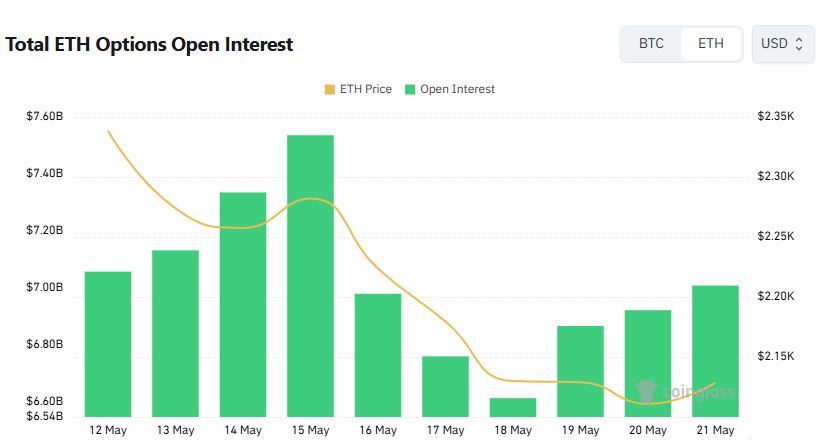
Ethereum (ETH) options markets continued to reflect a constructive bias, with call positions accounting for more than 60% of open interest as traders concentrated activity in near-dated upside strikes—most notably a $2,450 call on Bybit.
As of May 21 at 12:00 a.m. ET (4:00 a.m. UTC), CoinGlass data showed total Ethereum options open interest (OI) at roughly $7.01 billion, up about 1.3% from $6.92 billion the previous day. Calls represented 60.60% of total OI, while puts accounted for 39.40%, suggesting that ‘bullish positioning’ remains the dominant medium-term stance.
Aggregate Ethereum options trading volume over the period came in at approximately $839 million. By venue, Bybit led with about $386 million, followed by Binance at $189 million, Deribit at $157 million, OKX at $104 million, and CME at roughly $3 million. The distribution underscores how offshore crypto-native exchanges continue to drive most ETH options activity, while regulated venues such as CME represent a comparatively small share of turnover.
On a 24-hour volume basis, calls still led but with a narrower margin: calls made up 55.39% of traded volume versus 44.61% for puts. Market observers often read this split as a sign that, even amid a call-heavy outstanding positioning profile, some traders are simultaneously paying for ‘downside hedges’ or short-term volatility protection.
Looking at where positions are clustered, the largest open-interest concentrations were observed in the $2,100 put expiring May 29 on Deribit, the $3,200 call expiring Dec. 25 on Deribit, and the $2,500 call expiring June 26 on Deribit. The mix of a sizable near-term put alongside longer-dated and mid-year calls highlights a market balancing protection below key levels with upside exposure into later maturities.
Recent trading activity, however, skewed toward short-dated bullish bets on Bybit. The top contracts by 24-hour volume were the $2,450 call expiring May 22, the $2,500 call expiring May 22, and the $2,175 call expiring May 21—each pointing to heightened interest in immediate price moves around closely watched strike levels.
Options are derivatives that allow investors to express leveraged views on price direction or hedge existing exposure. A ‘call option’ gives the right to buy an asset at a predetermined price (typically used for upside positioning), while a ‘put option’ gives the right to sell (often used to position for declines or to hedge). OI reflects the total number of outstanding contracts, and changes in OI and volume can help distinguish between longer-horizon positioning and short-term tactical flows.
With OI rising alongside a call-dominant structure, the data points to fresh positioning rather than purely intraday churn. At the same time, the comparatively strong put share in realized volume suggests that demand for protection remains active—an important signal as traders navigate near-term volatility in ETH’s spot market.
🔎 Market Interpretation
- Options positioning remains bullish-leaning: Ethereum options open interest (OI) rose to ~$7.01B (+~1.3% day/day) with calls at 60.60% vs puts at 39.40%, indicating a constructive medium-term bias.
- But hedging demand persists: While calls dominate outstanding positioning, 24h volume was less skewed (calls 55.39% vs puts 44.61%), consistent with traders pairing upside exposure with near-term downside protection.
- Exchange mix shows offshore dominance: Most ETH options turnover is driven by crypto-native venues—Bybit led 24h volume (~$386M), followed by Binance (~$189M) and Deribit (~$157M); CME was minimal (~$3M), highlighting where liquidity and tactical flow are concentrated.
- Strikes signal both protection and upside targets: Large OI sits in a near-term $2,100 put (May 29, Deribit) alongside upside exposure like $3,200 call (Dec 25) and $2,500 call (Jun 26), implying a market hedging key downside levels while keeping upside optionality.
- Near-dated bullish speculation is hottest on Bybit: Top 24h contracts were short-dated calls (e.g., $2,450 call May 22, $2,500 call May 22), pointing to heightened focus on immediate spot moves around nearby strike levels.
💡 Strategic Points
- Read OI vs volume together: Rising OI with call dominance suggests new positions being added (not just intraday churn), while the relatively high put share of volume implies active hedging in the short horizon.
- Watch the $2,100 area as a downside reference: The largest near-term put OI at $2,100 (May 29) can act as a psychological level where hedging flows may intensify if spot weakens.
- Near-term “magnet” strikes: Heavy trading in $2,450–$2,500 calls into May 22 can amplify short-term volatility as dealers and traders adjust exposure around expiration.
- Curve positioning suggests a barbell: The combination of near-term puts + mid/long-dated calls resembles a barbell approach—protecting near-term downside while maintaining exposure to a later upside scenario.
- Venue matters for flow interpretation: With Bybit/Binance/Deribit dominating, sentiment and volatility signals may emerge first on offshore venues; CME’s low activity implies less incremental information from regulated flow in this snapshot.
📘 Glossary
- Option: A derivative contract giving the holder the right (not obligation) to buy or sell an asset at a preset price by a certain date.
- Call option: Right to buy at the strike price; typically used to express or hedge for upside.
- Put option: Right to sell at the strike price; often used for downside protection or bearish positioning.
- Strike price: The predetermined price at which the option can be exercised.
- Expiration: The date/time when the option contract expires and exercise rights end.
- Open interest (OI): Total number of outstanding (unclosed) option contracts; rising OI often indicates new capital/positions entering the market.
- Trading volume: Number (or notional) of contracts traded over a period; helps gauge current activity and short-term positioning.
- Downside hedge: Using instruments (often puts) to limit losses if the underlying price falls.




















Comment 0