
 Add as a preferred source on Google
USDC Sees $141 Million Outflow as USDT Leads Stablecoin Rotation
USDC recorded $141 million in net outflows while USDT led inflows, signaling short-term capital rotation across crypto markets.



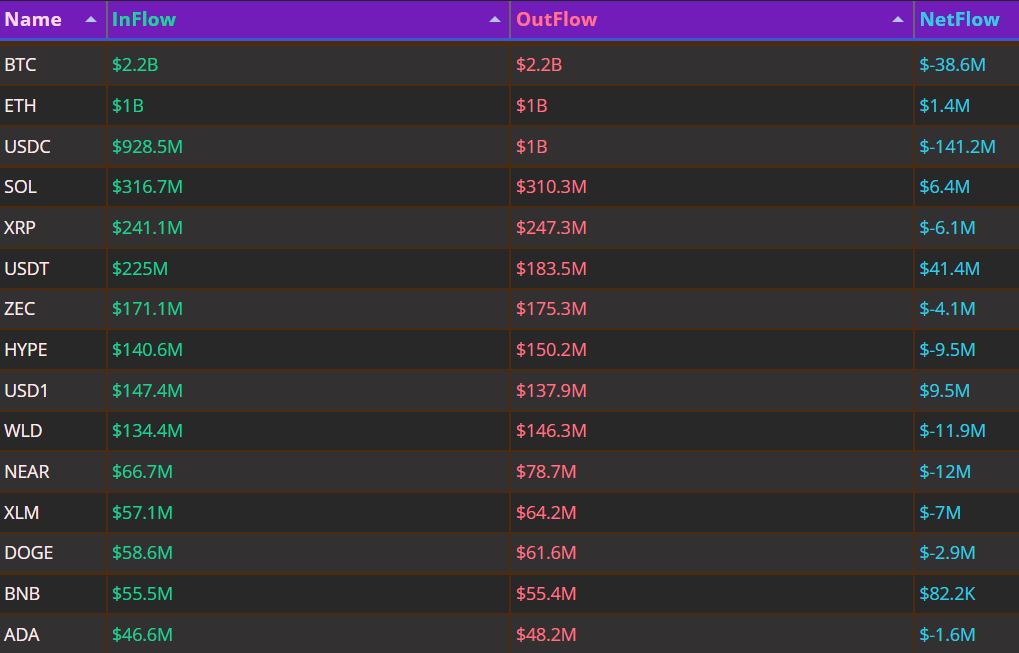
Crypto markets saw a notable shift in short-term capital allocation over the past 24 hours, with money rotating out of USD Coin (USDC) and, to a lesser extent, Bitcoin (BTC), while Tether (USDT) and several alternative assets attracted fresh inflows—an early signal that traders may be prioritizing 'liquidity' and tactical positioning rather than broad risk-on exposure.
According to data compiled by Cryptometer and published Wednesday ET, USDC posted the largest net outflow among major assets, recording approximately $928.5 million of inflows against $1.07 billion of outflows for a net exit of about $141.2 million. In contrast, USDT registered the strongest net inflow, with roughly $225.0 million entering and $183.5 million leaving—resulting in a net gain of around $41.4 million.
Bitcoin’s flow profile underscored heavy two-way activity. BTC saw roughly $2.2 billion in inflows and a similar $2.2 billion in outflows over the same window, translating into a comparatively small net outflow of about $38.6 million. Market watchers often interpret that kind of near-balanced churn as a sign of active repositioning around key levels rather than a decisive directional move.
Ethereum (ETH) appeared steadier by comparison, with about $1.0 billion in inflows and $1.0 billion in outflows, ending the period with a modest net inflow of roughly $1.4 million—effectively flat amid high turnover.
Outside the top two networks, a handful of tokens posted positive net flows. Solana (SOL) recorded a net inflow of about $6.4 million, while USD1 drew roughly $9.5 million in net inflows. Monero (XMR) stood out among non-stablecoin assets, attracting around $11.4 million, suggesting selective demand for assets perceived as offering differentiated utility.
Meanwhile, several widely traded altcoins recorded net outflows. XRP saw approximately $6.1 million leave on net, Zcash (ZEC) about $4.1 million, Hyperliquid (HYPE) about $9.5 million, Worldcoin (WLD) roughly $11.9 million, Near Protocol (NEAR) around $12.0 million, Stellar (XLM) about $7.0 million, Dogecoin (DOGE) about $2.9 million, and Cardano (ADA) roughly $1.6 million.
By ranking, the top five net inflows over the past 24 hours were led by Tether (USDT) at about $41.4 million, followed by Monero (XMR) at $11.4 million, USD1 at $9.5 million, Solana (SOL) at $6.4 million, and USDG at $5.1 million. The top five net outflows were USD Coin (USDC) at about $141.2 million, Bitcoin (BTC) at $38.6 million, GENIUS at $18.8 million, Near Protocol (NEAR) at $12.0 million, and Worldcoin (WLD) at $11.9 million.
While 24-hour flow data does not, on its own, confirm a lasting trend, the day’s standout divergence between USDT inflows and USDC outflows highlights a key near-term dynamic: traders appear to be reshuffling stablecoin exposure and deploying capital more selectively across large-cap networks and niche assets. If the pattern persists, it could influence short-term 'market depth' and execution conditions across major exchanges, particularly during periods of heightened volatility.
Article Summary by TokenPost.ai
🔎 Market Interpretation
Stablecoin rotation dominates: Over the last 24 hours, capital rotated out of USDC (largest net outflow) and into USDT (largest net inflow), signaling a preference for immediate liquidity and tactical flexibility rather than a broad risk-on shift.
BTC shows repositioning, not conviction: Bitcoin recorded heavy two-way flows with a small net outflow (near-balanced churn), typically read as active re-hedging/reallocation around key price levels instead of a clean directional bet.
ETH effectively flat despite high turnover: Ethereum ended near neutral net flow, implying stable posture while traders churn positions.
Selective alt demand: Positive net flows into XMR, SOL, USD1, USDG suggest targeted allocations to specific narratives/utilities rather than market-wide altcoin accumulation.
Broad altcoin leakage continues: Net outflows across several liquid names (e.g., NEAR, WLD, XRP, XLM, DOGE, ADA) point to risk being trimmed or consolidated into fewer instruments.
Microstructure implication: If USDT-in/USDC-out persists, it may affect exchange liquidity distribution, stablecoin pair depth, and execution quality during volatility.
💡 Strategic Points
Watch the USDT–USDC spread in flows: A sustained divergence can indicate where primary trading liquidity is concentrating (often influencing which quote currency gets better depth/slippage).
Interpret BTC “high gross / low net” as a range signal: Large inflows and outflows with minimal net change often align with range trading, positioning adjustments, or derivatives-driven hedging rather than spot-led trend formation.
Prefer confirmation across timeframes: Treat 24-hour flow spikes as tactical; look for multi-day persistence before assuming a regime change in stablecoin preference or risk appetite.
Liquidity-first playbook: The tilt toward USDT suggests traders may be preparing for fast redeployments (opportunistic dip buys, arbitrage, funding-rate shifts) rather than committing to long-duration exposure.
Altcoin selection matters: With many alts seeing net outflows, allocations may favor stronger relative demand names (e.g., SOL) or differentiated utility (e.g., XMR) rather than broad baskets.
Execution consideration for volatile sessions: If stablecoin liquidity concentrates in USDT pairs, expect potentially tighter spreads on USDT books and comparatively weaker depth on some USDC books until flows normalize.
📘 Glossary
Net Flow: Inflows minus outflows over a period; positive indicates net capital entering an asset, negative indicates net exiting.
Inflow / Outflow: Estimated movement of funds into/out of an asset across tracked venues or wallets; often used as a proxy for demand/supply pressure.
Two-way Activity (Churn): High inflows and outflows simultaneously; commonly reflects repositioning, arbitrage, hedging, or rotation rather than strong directional conviction.
Stablecoin Rotation: Shifting holdings between stablecoins (e.g., USDC → USDT) to optimize liquidity access, venue availability, perceived risk, or settlement convenience.
Market Depth: The amount of buy/sell liquidity in the order book near the current price; deeper markets usually mean lower slippage for large trades.
Execution Conditions: Practical trade quality factors such as spread, slippage, and fill probability—often sensitive to where liquidity concentrates.