

 News
News  Coin Information
  About us
  Customer Service


 Add as a preferred source on Google
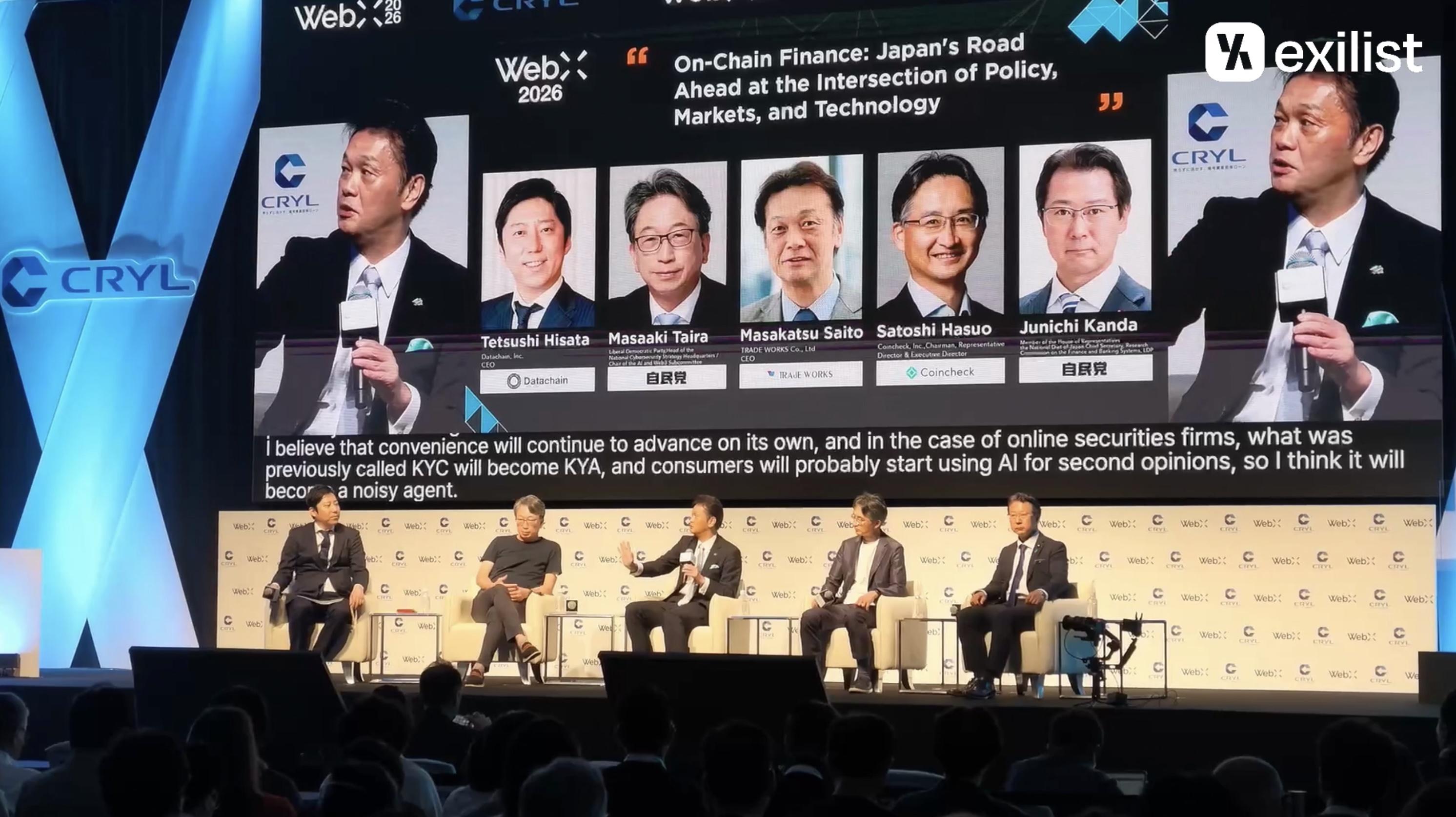
The next five years in crypto are unlikely to be decided by a single breakout theme. Instead, a growing body of industry research suggests the market’s center of gravity is shifting toward an integrated ‘onchain financial system’—one that combines stablecoins, real-world assets (RWA), AI-driven operations, privacy tooling, and compliance-ready regulatory infrastructure.
That was the core conclusion of a new analysis from Exilist, compiled from on-the-ground interviews conducted at WebX 2026 in Japan in mid-July. WebX—one of the country’s largest blockchain gatherings—featured a wide range of views on which segment will grow fastest. Yet despite different answers, executives and market operators repeatedly pointed to the same destination: a unified environment where cash-like instruments, tokenized financial products, trading and collateral, and automated control frameworks converge onchain.
In interviews with stakeholders including Startale Group, BitGo, bitFlyer, and SBI VC Trade, Exilist found that Japan’s ability to absorb meaningful ‘institutional capital’ hinges less on buzzworthy narratives and more on concrete building blocks—clear rules, custody standards, settlement rails, and a viable stablecoin foundation.
BitGo’s Asia lead Abel highlighted tokenized equities and stablecoins as the most important growth engines. In his view, stablecoins are increasingly being understood not merely as exchange settlement tools, but as assets designed to solve real-world financial frictions—pointing to potential expansion into payments, settlement, corporate treasury management, and cross-border remittances.
At bitFlyer, institutional representative Mengqi emphasized RWA and AI. With traditional equity markets constrained by fixed trading hours, tokenized representations of assets could reduce time and accessibility barriers, particularly for global participants. Startale Group business development lead Tatsu pointed to prediction markets and privacy as emerging opportunities, while SBI VC Trade’s Mio Yonenaga argued that ‘regulation’ and ‘compliance’—more than any single asset class—will ultimately determine how far the market can scale.
Exilist’s key interpretation is that these themes should not be read as competing fads. Stablecoins supply onchain cash. RWA and tokenized equities bring investable assets onchain. DeFi and derivatives connect them through collateral and liquidity. AI automates operations and risk management. Privacy and compliance mechanisms create the conditions required for institutions to participate at scale.
Stablecoins emerge as the most commercialized segment in Japan
Among all sectors discussed at WebX, stablecoins appeared to have the clearest near-term commercialization track in Japan, with experiments spanning both consumer payments and corporate settlement. SBI VC Trade announced a lending service tied to its trust-based yen stablecoin, JPYSC, on July 13, with applications opening July 16. The company holds a Japanese license that allows it to provide stablecoin distribution and trading services to retail customers.
Yonenaga said Japan’s familiarity with point-based payment systems and transit IC cards could make stablecoins a natural “first” everyday onchain product—provided the user experience hides blockchain complexity. If adoption is to move beyond crypto-native users, she argued, consumers should be able to pay without learning wallet addresses, gas fees, or other technical concepts.
Startale Group and SBI’s joint push behind JPYSC is also positioned as more than issuance. Initial use cases include cross-border remittances and peer-to-peer FX settlement. Rather than attempting to compete head-on with the market capitalizations of dollar stablecoins such as Tether (USDT) and Circle’s USD Coin (USDC), the strategy appears to prioritize connecting Japanese financial rails with global onchain markets—turning a yen stablecoin into a practical settlement asset for Asian capital flows, corporate accounting and reconciliation, and payments linked to Japanese financial products.
That direction also elevates the importance of institutional plumbing—custody, trading, tri-party collateral management, and issuance infrastructure—areas BitGo has repeatedly stressed. For institutions, the existence of a token is not sufficient. Reserve management, redemption mechanics, AML controls, and counterparty risk frameworks must work together. In that sense, Exilist suggests stablecoin competitiveness may increasingly be determined not by size alone, but by who issues, custodies, and settles the asset—and which regulated financial institutions participate in the process.
RWA and tokenized stocks: from access to ‘capital efficiency’
Exilist identified RWA and tokenized equities as the second structural pillar of onchain finance. While Japanese discussions often center on real estate and REIT-like products, tokenized stocks are quickly gaining visibility globally. According to RWA.xyz data cited in the report, as of July 21, 2026 (UTC), tokenized equities had an aggregate distributed issuance value of roughly $1.86 billion, monthly transfer volume near $8 billion, and about 670,000 holders. Ondo was highlighted as a leading platform, supplying approximately $850 million in tokenized equities.
While these figures remain small relative to traditional equity markets, Exilist argues the growth rate and structural advantages are increasingly difficult to ignore. Tokenized stocks can provide price exposure without a local brokerage account and can extend trading opportunities beyond standard market hours. But several speakers at WebX emphasized that the real breakthrough is not simply 24/7 trading—it is improved ‘collateral efficiency’ and onchain composability.
Ondo Finance CEO Ian De Bode said during a WebX session that the essential value proposition of tokenized stocks lies more in capital efficiency than in additional trading hours. In today’s onchain perpetual futures markets, stablecoins are typically the primary collateral. Even if a market maker hedges with real equities offchain—such as buying Tesla ($TSLA) shares through a brokerage—the onchain venue cannot verify that hedge, and still demands additional margin. De Bode argued this can drag effective capital efficiency for large funds and market makers down to the 30%–50% range.
If a tokenized Tesla position could be used as recognized collateral within the same platform, the system could verify the short position and the offsetting spot asset together—potentially reducing incremental margin requirements and allowing liquidity providers to deploy capital more efficiently. In that framing, tokenized stocks evolve from a traded product into collateral for lending, margin for derivatives, and building blocks for portfolio automation—where ‘composability’ becomes the core advantage.
Startale Group and SBI are also developing a Layer 1 blockchain named Strium, targeting this trajectory. The stated goal is to support 24-hour spot and derivatives trading and settlement for tokenized equities and RWA-linked products. The plan to support JPYSC as a native asset is particularly notable, signalling an attempt to place a yen stablecoin and tokenized financial products—potentially spanning Asian and U.S. markets—inside a single operational environment.
AI: less a token narrative, more an operating system for finance
AI was another major topic at WebX, though its role was framed less as a new token-driven story and more as a transformation in how financial firms operate. Mengqi said AI is already being used broadly for routine tasks such as drafting internal documents and organizing materials—workflows that can materially reduce compliance overhead in Japan, where costs tied to KYC, reporting, suspicious activity monitoring, and regulatory documentation are high.
Exilist also pointed to a “second phase” of AI: automated asset management. For AI agents to analyze market data, adjust portfolio weights, and manage positions in response to collateral changes, assets must be machine-readable and programmatically transferable. This is where stablecoins, tokenized assets, and onchain markets become natural counterparts—tokenization makes financial products programmable, while AI enables faster, rules-based execution.
However, multiple participants stressed that AI cannot simply be given unchecked authority. Guardrails such as risk limits, approval workflows, circuit breakers, accountability regimes, and verifiable execution logs would be essential. In this view, AI is not a tool to bypass regulation—if anything, it increases demand for more sophisticated control systems.
Privacy and ‘selective disclosure’ as institutions arrive
As institutional participation grows, privacy becomes less optional. Public blockchains are transparent by design, but that transparency can be commercially and legally problematic for corporations and financial institutions. Transaction counterparties, timing, payment amounts, and balance dynamics can be exposed to outsiders—an uncomfortable fit for firms bound by confidentiality and customer data-protection obligations.
Exilist suggests the likely solution is not full anonymity, but ‘selective disclosure’: structures in which approved parties and regulators can verify what they need, while unnecessary third parties cannot monitor commercially sensitive flows. At WebX, Datachain introduced enterprise Web3 wallet infrastructure alongside its onchain privacy stack, KuraPrivacy, arguing that policy, market structure, and technology must move together for stablecoins and tokenized deposits to reach broad adoption.
Prediction markets: limited domestically, informative globally
Prediction markets also drew attention, though Japan’s regulatory boundary between gambling and financial products may constrain near-term expansion. Still, from a global market perspective, prediction markets are increasingly valued for turning political, economic, and social developments into real-time price signals. The dynamic overlaps with onchain equity perps, where pricing can adjust on weekends and outside traditional market hours—reflecting information as it emerges, even when legacy venues are closed.
Japan’s decisive variable: regulation, not hype
Across interviews, Exilist found that Japan’s most important variable is regulation. WebX 2026 took place against the backdrop of visible government engagement. Japanese policymakers across finance, industry, and digital portfolios participated, reinforcing the perception that the country is moving from treating crypto as an experiment to integrating it within broader financial and industrial policy frameworks.
The most concrete signal came the day after the event began. On July 15 (UTC), Japan’s House of Councillors passed an amendment to bring crypto assets into the scope of the Financial Instruments and Exchange Act, shifting the regulatory approach from a payments-centered framework toward one that more closely resembles an investment-product regime. The amendment includes stronger disclosure expectations, insider trading restrictions, and tougher penalties for unregistered business activity. Exilist also noted that a path has been opened for taxes to move from progressive rates that can reach roughly 55% to a separate tax system near 20%, though implementation is widely expected to take time, with 2028 cited as a possible start.
Yonenaga said the direction could improve liquidity conditions and give investors a clearer environment in which to transact, even if compliance costs rise for operators. For institutions, clearer standards—covering asset classification, custody requirements, tax handling, and loss accounting—can reduce uncertainty that otherwise blocks large allocations.
Abel added that proof-of-concept efforts between crypto firms and traditional financial institutions are active in Japan. While that suggests commercialization is still in progress, it also indicates budgets and internal teams are already mobilizing—an important marker in a market often described as cautious. Exilist noted that Japan’s institutional adoption may be slower than in other regions, but once adopted, it can scale through established financial networks.
Infrastructure-first positioning in a softer market
Even amid weaker market conditions, several firms are focusing on building institutional-grade capabilities rather than cutting back. bitFlyer Holdings said it plans to launch ‘bitFlyer Prime’ in 2027, a prime brokerage service targeting institutions and corporates with offerings such as OTC execution, custody, and governance and control support. BitGo, meanwhile, is expanding beyond wallets and custody into trading, staking, tri-party collateral management, stablecoin issuance, and DeFi access services.
The underlying logic is that if institutional inflows become material, markets cannot function on an exchange-only model. Custody, market making, OTC desks, collateral management, and clearing systems form the ‘invisible infrastructure’ that determines real capacity. Those layers may attract less attention during bull markets, but they often decide how much capital can reliably operate onchain.
An onchain financial system, not a single winning coin
Exilist’s central takeaway is that the next market cycle’s winners are unlikely to be defined by a single token or isolated sector. Stablecoins are strong for payments and settlement but cannot alone supply the breadth of investment products. Tokenized equities expand the investable universe but require robust settlement assets and deep liquidity. AI can automate management, but only with trusted data and enforceable controls. Privacy can make institutions comfortable, but must preserve auditability and verification.
In practice, these components are both interdependent and competitive—pushing the market toward a race for the integration points where payment and custody, collateral and trading, and regulation and identity converge. Exilist suggests that the most durable revenues may accrue not to the loudest narratives, but to the platforms that control those junctions.
Japan may not be the fastest market to generate new crypto trends, the report concluded, but it has a demonstrated ability to embed technology into established systems through regulation, banking partnerships, and corporate distribution networks. What WebX 2026 ultimately highlighted was less Japan’s speed than its direction—and the next bull phase may be measured not by which theme goes viral, but by how many financial institutions launch real services, and how much capital and liquidity migrate onto the infrastructure now being built.




















Comment 0