

 News
News  Coin Information
  About us
  Customer Service


 Add as a preferred source on Google
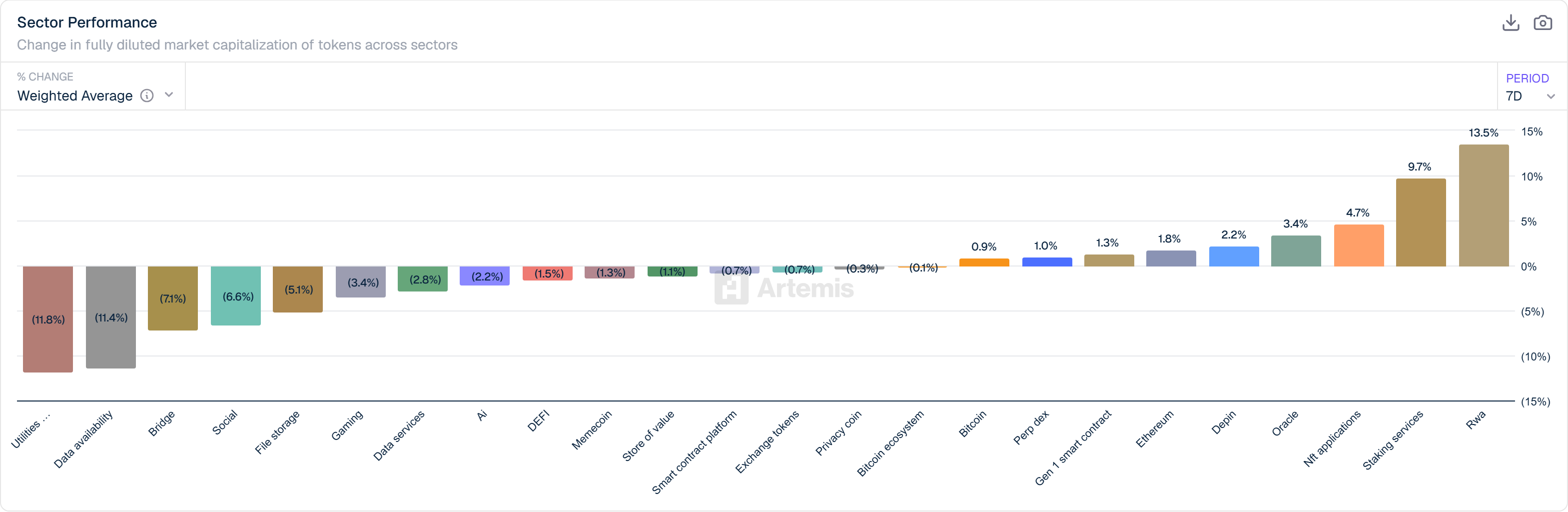
Token markets were broadly weaker over the past week, but a sharp divergence emerged as 'real-world asset tokenization' (RWA) and 'staking services' rallied strongly while infrastructure- and utility-linked segments sold off. The split underscores a market still searching for conviction, where flows are concentrating in a handful of narratives rather than lifting the entire crypto complex.
Artemis data for Tuesday, July 21 (UTC), using a weekly fully diluted valuation (FDV)-weighted average across 25 crypto sectors, showed 10 sectors posting gains versus 15 in decline. RWA led the table with a +13.5% advance, the strongest performance by a wide margin. Staking services followed with a +9.7% rise, standing out as one of the few areas approaching double-digit returns despite the broader risk-off tone.
Among other outperformers, NFT applications gained +4.7%, oracles rose +3.4%, and DePIN (decentralized physical infrastructure networks) added +2.2%. Several large-cap, market-defining buckets managed to stay in positive territory but with more modest moves: Ethereum (ETH) was up +1.8%, XRP (XRP) gained +1.7%, first-generation smart contract platforms rose +1.3%, derivatives DEXs increased +1.0%, and Bitcoin (BTC) edged higher by +0.9%.
Losses were comparatively mild in a small cluster of sectors near flat. The Bitcoin ecosystem category slipped -0.1%, privacy coins fell -0.3%, and exchange tokens declined -0.7%. Other widely followed themes weakened but did not capitulate—store-of-value plays dropped -1.1%, memecoins slid -1.3%, DeFi fell -1.5%, and smart contract platforms eased -1.7%—suggesting risk appetite failed to broaden meaningfully beyond a few bright spots.
Drawdowns intensified further down the leaderboard. AI-related tokens fell -2.2%, data services lost -2.8%, and gaming slipped -3.4%. File storage declined -5.1%, social tokens dropped -6.6%, and bridge-related assets fell -7.1%. The steepest losses came from data availability (-11.4%) and utility and services (-11.8%), both suffering double-digit weekly declines and anchoring the bottom of the sector performance table.
Market participants described the week’s action as less of a generalized rebound in risk assets and more of a selective rotation into themes perceived to have clearer near-term catalysts. RWA’s outperformance reflects renewed attention to tokenized finance—covering on-chain representations of assets such as Treasury bills, credit products, and other off-chain claims—while staking-related strength points to continued demand for yield and protocol-linked cash flows in a choppy environment.
The flip side of that trade was visible in the broad pressure on infrastructure, data, and utility segments, where investors appeared quicker to de-risk amid uncertain liquidity conditions and thinner bid support. With sector dispersion widening, the market is signaling that beta-driven rallies remain fragile, and that capital is likely to keep gravitating toward the most defensible narratives until macro and crypto-native catalysts align more decisively.
🔎 Market Interpretation
- Broad weakness with sharp dispersion: Weekly FDV-weighted sector performance split, with 10 sectors up and 15 down, indicating a market lacking unified risk-on conviction.
- Narrative-led rotation: Capital concentrated in a few themes rather than lifting the full crypto complex—suggesting a selective rotation, not a generalized rebound.
- Top leadership: RWA tokenization (+13.5%) and staking services (+9.7%) dominated gains, implying investors favored areas with clearer near-term catalysts and yield/cash-flow narratives.
- Large caps held up but didn’t drive a breakout: BTC (+0.9%), ETH (+1.8%), and XRP (+1.7%) stayed positive, but the moves were modest—consistent with a cautious market tone.
- Infrastructure and “building-block” sectors lagged: Deeper sell-offs in utility & services (-11.8%) and data availability (-11.4%) point to de-risking where liquidity is thinner and narratives are longer-duration.
- Risk appetite failed to broaden: Common high-beta themes (memecoins -1.3%, DeFi -1.5%, smart contract platforms -1.7%) drifted lower, signaling buyers were not chasing risk broadly.
💡 Strategic Points
- Track dispersion as the signal: Widening gaps between winners (RWA, staking) and losers (data availability, utilities) often indicate a late-rotation or cautious regime where positioning is more tactical than directional.
- RWA theme = “on-chain carry” narrative: Outperformance suggests renewed interest in tokenized Treasuries/credit and other off-chain claims—segments that can benefit from rates-driven yield and clearer fundamentals.
- Staking strength reflects yield preference: Investors appear to favor protocol-linked cash flows and yield-bearing exposure during choppy conditions, potentially treating staking as a defensive/quality tilt within crypto.
- Be cautious with longer-duration infrastructure bets: Weakness across data/utility/bridges implies markets are discounting uncertain liquidity and slower payoff timelines; positioning may require stricter risk controls and catalyst discipline.
- Watch for confirmation via breadth: A more durable rally would likely require improvement in mid-table sectors (DeFi, smart contract platforms, data services) and not just leadership from two narratives.
- Key levels are narrative catalysts, not just price: For RWAs and staking, monitor product launches, institutional adoption, TVL/issuance growth, and regulatory clarity; for laggards, watch funding conditions and network usage metrics.
📘 Glossary
- FDV (Fully Diluted Valuation): Market cap assuming all tokens are in circulation; used here to weight sector performance.
- RWA (Real-World Asset) Tokenization: Creating on-chain representations of off-chain assets (e.g., Treasury bills, credit, invoices) so they can be issued, traded, or used in DeFi.
- Staking Services: Infrastructure/providers enabling users to stake assets (often PoS tokens) to earn rewards; includes liquid staking and staking-as-a-service models.
- Sector Dispersion: The spread between best- and worst-performing sectors; higher dispersion implies selective, narrative-driven markets.
- DePIN: Decentralized Physical Infrastructure Networks—token-incentivized networks that coordinate real-world infrastructure (e.g., wireless, sensors, compute).
- Oracles: Systems that deliver off-chain data (prices, events) to smart contracts.
- Data Availability (DA): Infrastructure ensuring transaction data is published and accessible so networks/rollups can verify state; often treated as core scaling infrastructure.
- Bridge Assets: Tokens/protocols facilitating cross-chain transfers; often sensitive to security incidents and risk-off sentiment.
- Beta-driven rally: A broad market move where most assets rise mainly due to overall risk appetite rather than project-specific fundamentals.

















Comment 0