
 Add as a preferred source on Google
Crypto Liquidations Hit $762 Million as Short Squeeze Drives Market Rebound
Crypto derivatives markets saw $762 million in liquidations led by short positions as Bitcoin and major assets rebounded, triggering a broad short squeeze across exchanges.



Crypto derivatives traders were hit by a wave of forced liquidations over the past 24 hours, with roughly $762.15 million in leveraged positions wiped out across major tokens—an event that underscored how quickly sentiment can flip when prices rebound even modestly. The imbalance was striking: about $196.32 million in long liquidations versus $565.73 million in short liquidations, meaning roughly 74.2% of the total came from traders positioned for downside.
The data suggests the market’s latest move has been less about a broad-based “risk-off” selloff and more about an unexpectedly resilient tape that punished bearish positioning. In practical terms, a short-heavy liquidation profile typically points to either a sharp upward move or a grinding rebound that steadily erodes margin for over-leveraged bears—conditions often associated with a 'short squeeze' in parts of the market.
On a shorter time horizon, liquidation activity was concentrated on the largest venues. Over the last four hours, Binance led with $15.37 million in liquidations, accounting for 48.38% of the total across tracked exchanges. Shorts made up $9.45 million of that figure, or 61.51%. Bybit followed with $4.54 million in liquidations, with shorts comprising 56.37%.
Hyperliquid stood out for the intensity of the squeeze dynamics: $3.78 million was liquidated on the venue over the same four-hour window, and $3.37 million of that—89.02%—came from shorts. OKX, Bitget, and Gate also reported a majority of liquidations coming from short positions, reinforcing the broader picture of bearish leverage being unwound. HTX was the notable exception, where $1.30 million in liquidations skewed heavily toward longs (70.3%), suggesting a different positioning mix or client flow compared with other top exchanges.
Aggregated across exchanges, four-hour liquidations totaled $31.76 million, including $19.38 million in short liquidations (61.03%). While the absolute figure is smaller than the 24-hour total, the short-dominant split indicates that the squeeze pressure persisted into the latest session rather than being limited to a single abrupt move.
By asset, Bitcoin (BTC) remained the focal point of forced deleveraging. BTC traded around $100,848, down about 0.7% over 24 hours, yet still posted substantial liquidations across timeframes—evidence that positioning, rather than spot direction alone, has been driving liquidations. Reported BTC liquidations included roughly $82.9 million in longs and $83.6 million in shorts over one hour, $64.2 million in longs and $68.8 million in shorts over four hours, and $44.1 million in longs versus $94.2 million in shorts over 24 hours.
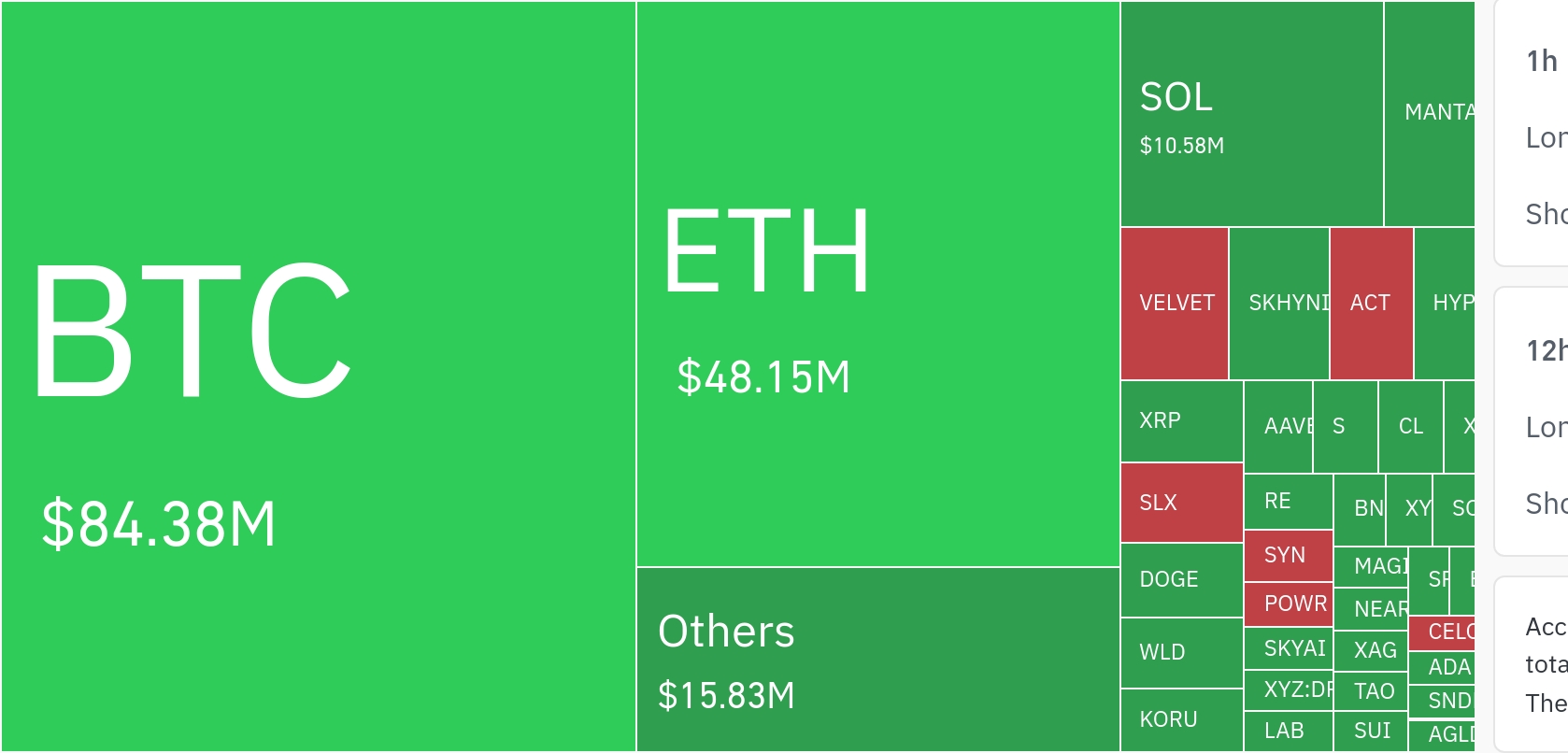
Ethereum (ETH) was not included in the detailed ticker table referenced in the dataset, but the 24-hour liquidation heatmap showed about $48.15 million in ETH liquidations—second only to BTC. The concentration in BTC and ETH highlights how 'liquidity' and leverage are still most heavily deployed in the two largest crypto assets, making them the primary transmitters of volatility into the broader market.
Solana (SOL) also saw outsized liquidation activity relative to its price move. SOL traded near $152.77, up about 0.8% on the day, yet liquidations reached approximately $159.4 million over one hour, $178.7 million over four hours, and $110.0 million over 24 hours, according to the provided figures. The scale suggests aggressive leverage and rapid repositioning, with derivatives flows amplifying intraday swings.
Among altcoins, Dogecoin (DOGE) illustrated how short positioning can unravel even when price action is not strongly positive. DOGE slipped about 0.4% to $0.1691, but still saw shorts liquidated in size—around $33.8 million over one hour, $18.0 million over four hours, and $28.4 million over 24 hours—signaling elevated short-term volatility and crowded bearish bets being forced out.
WIF posted a similar pattern. Despite a roughly 0.6% decline over 24 hours, WIF recorded short liquidations of about $30.1 million over one hour and $38.6 million over 24 hours, pointing to an overextended short base that was vulnerable to even modest bounces. BNX, by contrast, reflected the opposite positioning stress: with price up about 0.2%, BNX recorded about $12.0 million in long liquidations versus $4.5 million in short liquidations over 24 hours, showing that leverage was being cleared on both sides of the book depending on the token.
Sui (SUI) presented a more unusual footprint. While 24-hour liquidations amounted to roughly $8.8 million in longs and $10.9 million in shorts, the one-hour and four-hour totals were reportedly in the tens of thousands of dollars. That pattern suggests the day’s volatility was more cumulative than abrupt—a slow grind that still managed to trigger margin calls over a longer window rather than a single sharp spike.
Additional venue-level signals supported the view that parts of the derivatives market underestimated the rebound. Hyperliquid’s near-90% short liquidation share and BitMEX’s four-hour liquidation print being effectively all shorts pointed to pockets of traders caught leaning the wrong way as price action held firmer than expected.
In the 24-hour liquidation heatmap, forced closures were most concentrated in large-cap assets, led by Bitcoin (BTC) at about $84.38 million, Ethereum (ETH) at $48.15 million, and Solana (SOL) at $10.58 million. The lineup indicates that, despite periodic altcoin bursts, the largest coins continue to anchor leverage deployment and drive system-wide deleveraging episodes.
Liquidations occur when an exchange forcibly closes a leveraged position after a trader’s margin falls below required thresholds. This latest episode—dominated by short liquidations across major assets—suggests the market’s immediate stress point was not panic selling, but rather the rapid unwinding of bearish leverage amid an 'unexpected rebound' or downside resilience. How quickly traders rebuild leverage after this reset will be a key factor in determining whether volatility fades or returns in the next leg of price action.