
 Add as a preferred source on Google
Stablecoins vs Deposit Tokens: Policy Debate Sharpens Over Bank Disruption Risk
Policymakers in the U.S. and Korea are increasingly distinguishing stablecoins from bank-issued deposit tokens as concerns grow over deposit outflows, financial stability, and control of future digital payment systems.

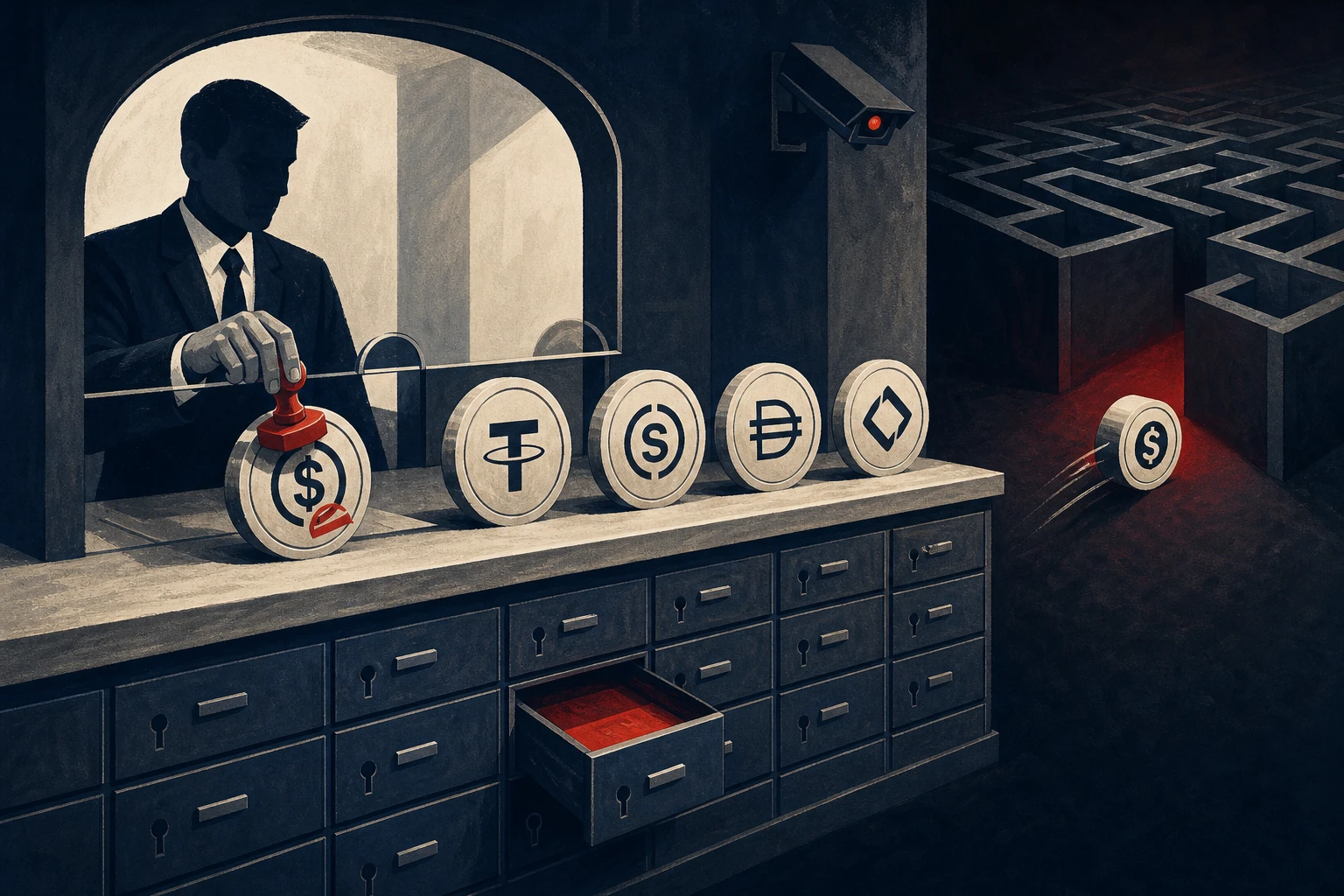
Stablecoins are often lumped together with other crypto assets as a generic “banking threat.” But in practice, the real disruption is more specific: money that is issued and circulates outside the banking system. A growing debate in Korea and the U.S. is now drawing a sharper line between two blockchain-based forms of digital cash that look similar on the surface—stablecoins and bank-issued deposit tokens—yet pull banks’ balance sheets and business models in opposite directions.
The distinction matters because it reframes the policy question. It is not whether “digital assets” threaten banks, but which digital instruments could drain deposits, weaken credit creation, and shift payments power away from regulated intermediaries.
At the center of the concern is stablecoins—digital assets pegged to fiat currencies like the U.S. dollar or the Korean won. While widely marketed as efficient payment tools, stablecoins can function as a direct alternative to bank deposits. When a customer moves money from a bank account into a stablecoin, that cash exits the bank’s balance sheet. Fewer deposits can translate into reduced lending capacity and, in turn, pressure the classic banking model of funding loans with deposits and earning the spread.
The risk becomes more politically charged when the issuer is a non-bank such as Circle or Tether. In that structure, deposits that previously sat within the banking system migrate to a private issuer’s reserve portfolio—typically concentrated in cash-like instruments and short-term government debt—allowing the stablecoin operator to capture yield and fees that banks historically benefited from. The banking sector’s unease is therefore not merely theoretical; it is tied to a potential redistribution of both funding and profit pools from regulated banks to non-bank digital money providers.
In the U.S., the American Bankers Association has repeatedly warned that, under extreme scenarios, stablecoins could attract trillions of dollars in deposits over time. The Federal Reserve has also noted that meaningful ‘deposit outflows’ could reduce banks’ ability to extend credit, even if widespread adoption is not imminent. For banks, the phrase ‘deposit flight’ carries psychological weight: bank runs tend to begin with confidence shocks before they show up in aggregate data.
That helps explain why U.S. banks have pressed for tight rules in stablecoin legislation—restrictions on interest payments, strict reserve requirements, and limits on who may issue. While the messaging is framed around consumer protection and financial stability, the underlying incentive is clear: a widely adopted stablecoin can compete with deposits more directly than many other crypto products.
Yet banks are not rejecting blockchain-based money outright. Large financial institutions have been investing heavily in tokenized settlement and blockchain payment rails—just not necessarily by embracing public stablecoins as the center of gravity. Instead, many are increasingly focused on ‘deposit tokens,’ a bank-issued, tokenized representation of existing deposits.
Deposit tokens mimic some of the functionality of stablecoins—programmable transfer and faster settlement—but with one crucial difference: the issuer is a regulated bank, and the liability remains a bank deposit. In other words, the deposit stays “inside” the banking system while gaining a new digital wrapper that can travel across modern settlement infrastructure. From a bank’s perspective, that means retaining funding stability and preserving lending capacity, while potentially unlocking new fee revenue in areas such as corporate treasury operations, institutional settlement, cross-border transfers, and securities settlement.
JPMorgan Chase ($JPM) is often cited as an early mover through its blockchain-based payments and settlement platform Kinexys, which has expanded processing volume in institutional workflows. Other major U.S. players—including Citigroup ($C), Bank of America ($BAC), Wells Fargo ($WFC), and The Bank of New York Mellon ($BK)—have also explored tokenized deposits or tokenized settlement models in various forms, reflecting a shared strategic logic: modernize the rails without surrendering the deposit base.
The debate, however, extends beyond bank profitability. The bigger contest is over control of the next-generation payments order—who sets the unit of account, who owns the rails, and whose liabilities become “default money” in digital commerce. Stablecoins have already become core settlement assets across crypto exchanges, onchain finance, and cross-border flows, functioning not only as a dollar-like instrument but as a foundational ‘accounting unit’ for digital markets.
That reality creates a geopolitical and monetary dimension: most global stablecoin liquidity is dollar-denominated. As dollar stablecoins become embedded as the default payment instrument across platforms—spanning gaming, content, e-commerce, and web3 applications—other currencies risk being pushed into secondary roles, used mainly at the on- and off-ramps. For Korea, this is not simply an industry argument; it is a question of where the won sits in the emerging digital payment stack.
These tensions are now playing out in Korea’s accelerating discussion around a won-based stablecoin, often linked to broader legislative efforts such as the Digital Asset Basic Act. Advocates argue that Korea needs a competitively regulated won stablecoin before dollar stablecoins harden into the global standard for digital settlement. Banks have reportedly explored trademarks and consortium structures, while fintech and big tech firms are watching closely for issuance pathways. The phrase “won stablecoin” has moved from industry slogan to policy agenda.
But the Bank of Korea’s caution remains central. If a privately issued won stablecoin scales quickly, policymakers worry about pressure on monetary policy transmission and potential financial stability risks—especially if stablecoin circulation draws deposits toward non-bank issuers. In that scenario, Korean banks could face the same ‘deposit outflow’ dynamics that concern U.S. lenders. This is one reason Korean authorities have shown relatively more openness to deposit-token models that keep the ultimate anchor of trust inside the bank-and-central-bank framework.
Korean commercial banks now face a strategic squeeze. Ignoring the won-stablecoin momentum could mean ceding payments influence to fintech and big tech firms. But leaning too heavily into stablecoins could weaken their own most valuable asset—the deposit base—if issuance and distribution migrate outside the banking perimeter. Deposit tokens offer a more comfortable route for banks: participate in blockchain payment innovation without losing deposits.
Even so, deposit tokens may not be sufficient on their own. If tokenized deposits remain confined to closed, institution-only networks, demand for open, programmable digital payments in the broader online economy may still gravitate toward stablecoins—particularly those already entrenched in global liquidity pools. This is partly why the choices of U.S. megabanks matter: they appear less interested in joining a retail stablecoin “arms race” than in strengthening institution-led tokenized settlement infrastructure that they can control.
The emerging consensus among policymakers and market participants is that the answer is not binary. Stablecoins and deposit tokens serve different use cases. Deposit tokens are structurally aligned with regulated finance—corporate payments, bank-to-bank settlement, securities clearing, and institutional cross-border transfers. Stablecoins, by contrast, are better suited to open digital ecosystems, global platforms, micro-payments, and programmable commerce beyond the traditional banking perimeter.
That is why the core policy challenge is design: determining how both instruments can coexist within a coherent regulatory framework, with clear rules on issuance eligibility, reserve composition, redemption rights, accounting treatment, consumer protection, and anti-money-laundering obligations. Just as importantly, the two systems cannot become isolated islands. Market trust depends on credible, par-value convertibility—confidence that one won today will reliably redeem as one won tomorrow. Without that anchor, even sophisticated blockchain infrastructure risks devolving into a closed-loop “points” system rather than functioning money.
Ultimately, the argument returns to first principles: digital money is not primarily a technology story but a trust story. Blockchain rails can make settlement faster and smarter, but if the final settlement anchor is unclear, finance struggles to build on top of it at scale. In most modern financial systems, the final backstop of trust still rests with central bank money.
The conclusion for Korea is therefore broader than whether stablecoins “harm” banks or deposit tokens “save” them. The real question is whether Korea can shape a sustainable ‘digital won order’—one that preserves monetary credibility while remaining competitive in a platform-driven global economy. If Korea fails to build interoperable rules for both stablecoins and deposit tokens, dollar stablecoins may increasingly dominate the rails of digital commerce, relegating the won to a peripheral, last-mile exchange currency rather than a native unit used across the digital economy.
For lawmakers debating the Digital Asset Basic Act and related frameworks, the stakes are structural. Regulation cannot become either a wall that blocks innovation or a license that favors a single constituency. It must function as an architecture that balances trust, competition, and interoperability—before the next payments order is set by networks built elsewhere.