

 News
News  Coin Information
  About us
  Customer Service


 Add as a preferred source on Google
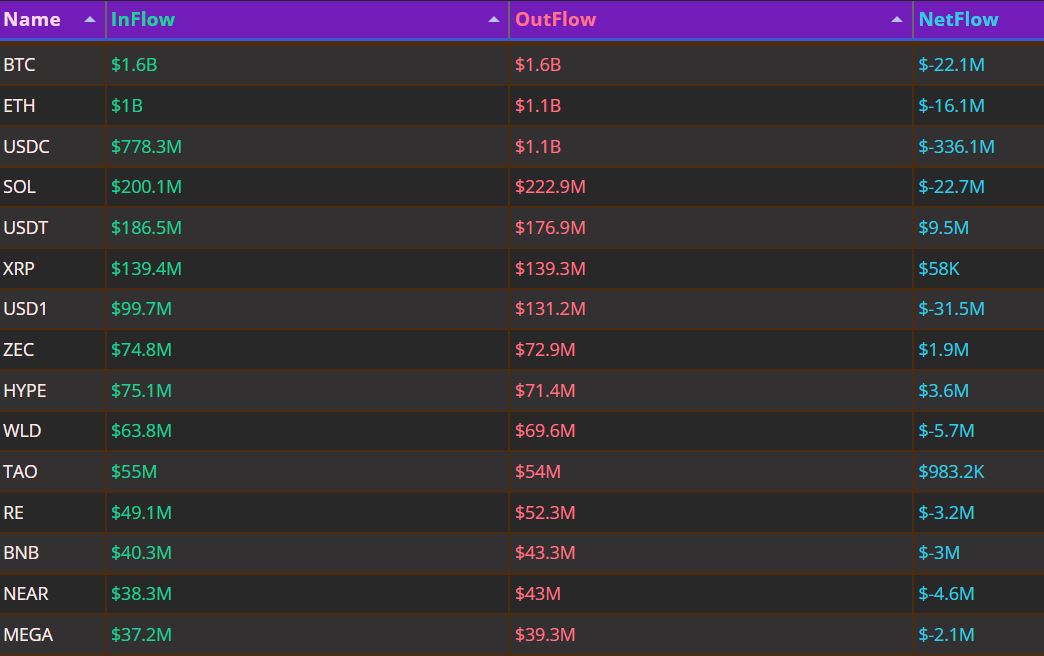
Capital flows across major crypto assets tilted toward selective inflows into USDG and Tron (TRX) over the past 24 hours, while USDC and USD1 saw sharp redemptions—an imbalance that underscores how quickly stablecoin liquidity can rotate even when broader market positioning looks relatively steady.
According to data compiled by Cryptometer as of June 23 UTC, Bitcoin (BTC) posted roughly $1.6 billion in inflows and $1.6 billion in outflows, resulting in a net outflow of about $22.1 million. Ethereum (ETH) showed a similar pattern, with approximately $1.0 billion entering and $1.1 billion leaving, for a net outflow of around $16.1 million.
Among stablecoins, Tether (USDT) recorded a modest net inflow of about $9.5 million, supported by roughly $186.5 million in inflows versus $176.9 million in outflows. In contrast, USD Coin (USDC) experienced the day’s largest net outflow: about $336.1 million, with approximately $778.3 million in inflows outweighed by roughly $1.1 billion in outflows. USD1 also saw meaningful net redemptions totaling about $31.5 million.
Outside the largest assets, Tron (TRX) led notable positive flows, posting a net inflow of about $14.7 million. USDG recorded the strongest net inflow overall at roughly $15.9 million, while Bitcoin Cash (BCH) added about $7.2 million and Monero (XMR) about $4.8 million in net inflows.
On the outflow side beyond stablecoins, Solana (SOL) registered a net outflow of about $22.7 million. Additional net outflows were observed in Worldcoin (WLD) at roughly $5.7 million, NEAR Protocol (NEAR) at about $4.6 million, RE at around $3.2 million, and BNB (BNB) at approximately $3.0 million.
Cryptometer’s ranking of the top net inflows over the past 24 hours placed USDG first ($15.9 million), followed by Tron (TRX) ($14.7 million), Tether (USDT) ($9.5 million), Bitcoin Cash (BCH) ($7.2 million), and Monero (XMR) ($4.8 million). The top net outflows were led by USDC (-$336.1 million), followed by USD1 (-$31.5 million), Solana (SOL) (-$22.7 million), Bitcoin (BTC) (-$22.1 million), and Ethereum (ETH) (-$16.1 million).
While one-day flow data can be noisy, the scale of USDC’s net outflow relative to other assets points to a clear 'liquidity rotation' rather than a broad-based risk-off move. With BTC and ETH showing near-balanced gross flows, the dominant story in this 24-hour window is the stablecoin reshuffle—an important signal for market depth, exchange funding conditions, and short-term positioning across spot and derivatives venues.
🔎 Market Interpretation
- Liquidity rotation dominates: The standout move is a sharp USDC net outflow (-$336.1M) alongside modest USDT net inflow (+$9.5M) and the strongest gains in USDG (+$15.9M), suggesting stablecoin liquidity is rapidly shifting rather than exiting crypto broadly.
- Majors are balanced, not risk-off: BTC (-$22.1M) and ETH (-$16.1M) show near-matched inflows/outflows (~$1B–$1.6B each side), indicating high churn and repositioning but no decisive directional capital trend in large-cap crypto.
- Selective alt preference: TRX (+$14.7M) leads non-stablecoin inflows, while SOL (-$22.7M) is the largest notable outflow outside stablecoins—pointing to a targeted rotation rather than uniform altcoin weakness.
- Market plumbing signal: A large stablecoin redemption/inflow gap typically reflects changes in exchange funding, venue preference, or settlement rails, which can affect near-term spreads and derivative basis even if prices appear stable.
💡 Strategic Points
- Watch stablecoin venue shifts: If USDC redemptions coincide with increased activity in other stablecoins (USDG/USDT), it may signal traders moving liquidity to specific exchanges, chains, or margin systems—often preceding changes in order-book depth and funding rates.
- Don’t overread BTC/ETH net flows: With gross flows nearly offsetting, treat the small net outflows as noise; instead monitor whether gross volumes stay elevated (continued churn) or begin trending one way (true accumulation/distribution).
- TRX inflows as a rails/use-case indicator: Increased TRX net inflow can relate to demand for Tron-based transfers/settlement; if persistent, it may align with broader stablecoin movement across Tron infrastructure.
- SOL outflow as short-term risk trim: SOL’s notable net outflow relative to peers can reflect reduced leveraged positioning or capital switching; confirmation would be a concurrent drop in SOL open interest or weakening spot premiums.
- Key follow-ups for the next 24–72h: (1) USDC supply changes and on-chain burn/mint data, (2) stablecoin exchange reserves, (3) derivatives funding/basis for BTC/ETH and SOL, (4) whether USDG inflows persist or mean-revert.
📘 Glossary
- Inflow / Outflow: Capital moving into or out of an asset across tracked venues over a period (here, 24 hours).
- Net Flow: Inflows minus outflows; a positive number indicates net buying/entry, negative indicates net selling/exit.
- Gross Flows: The total volume of inflows and outflows regardless of direction; high gross with low net often implies active repositioning.
- Redemption (Stablecoins): Conversion of stablecoins back into underlying collateral or fiat, often reflected as burns or withdrawals from circulation/venues.
- Liquidity Rotation: Rapid shifting of capital between assets (e.g., from USDC to USDT/USDG) without an overall market-wide move into or out of crypto.
- Market Depth: How much liquidity is available on order books; stablecoin availability can materially affect depth and spreads.
- Funding Conditions: The cost of holding leveraged positions in perpetual futures; influenced by liquidity and positioning.
- Spot vs. Derivatives Venues: Spot markets trade the underlying asset; derivatives markets trade contracts (perps/futures) whose pricing can react quickly to liquidity shifts.




















Comment 0