

 News
News  Coin Information
  About us
  Customer Service


 Add as a preferred source on Google
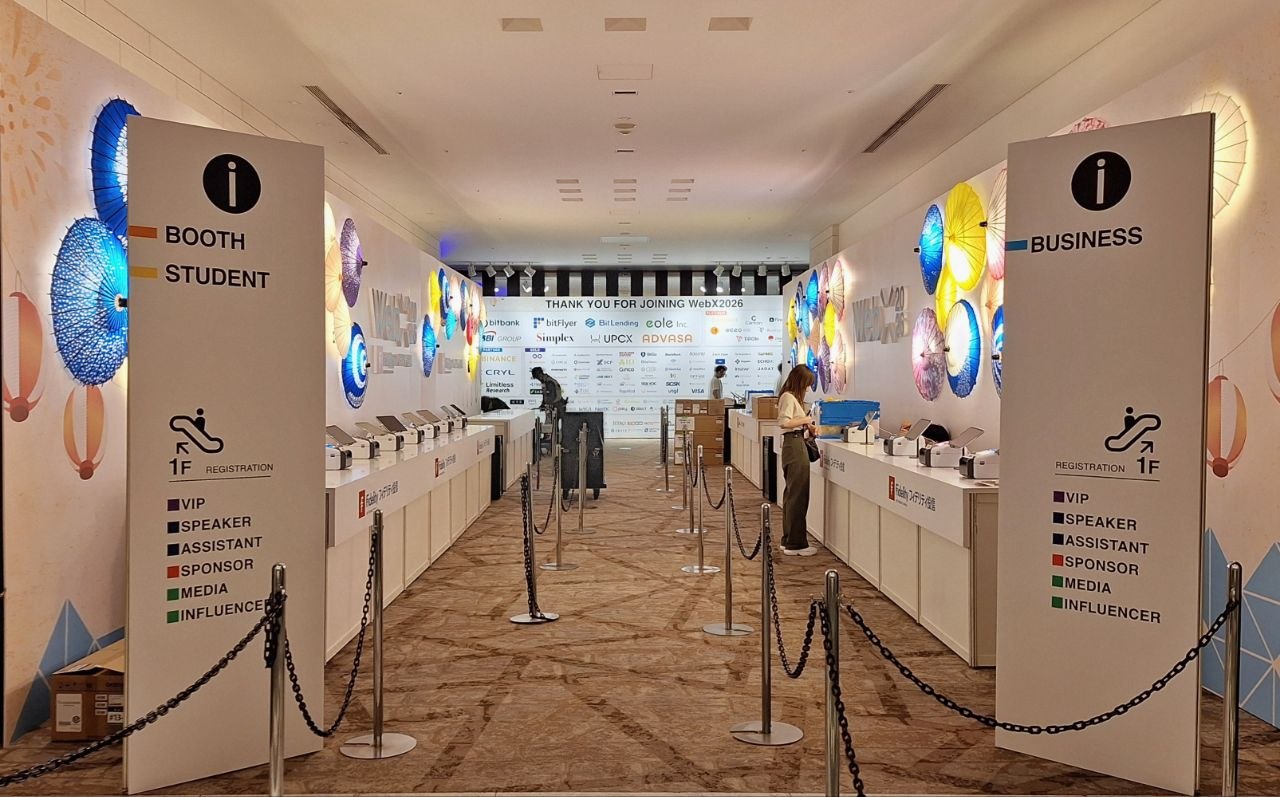
WebX 2026, billed as Asia’s largest Web3 conference, opened Sunday in Tokyo, underscoring how Japan has emerged as a regional hub for digital asset policy and institutional participation even as the global crypto industry continues to recalibrate in the post-FTX era.
The two-day event kicked off July 12 ET (July 13 in Japan) at The Prince Park Tower Tokyo, drawing government officials, banks, crypto-native firms, and large global brands for discussions centered on artificial intelligence (AI), stablecoins, real-world asset tokenization (RWA), digital finance, and Web3 infrastructure.
Launched in 2023 by Japan’s crypto media outlet CoinPost, WebX has expanded quickly alongside Tokyo’s push to foster a domestic Web3 ecosystem. What began as a crypto-focused gathering has evolved into a broader business platform where policymakers and traditional finance increasingly share the stage with exchanges, protocols, and venture investors.
Organizers said more than 230 speakers will participate this year, spanning major crypto and fintech names such as Uniswap, Coinbase, Pantera Capital, Ondo Finance, JPMorgan’s Kinexys, SBI Group, MUFG, and Mizuho. The lineup reflects a theme that has become difficult to ignore across global markets: the next phase of digital assets is being shaped less by retail speculation and more by 'institutional demand', compliance-driven product design, and payments integration.
On the exhibition floor, booths highlighted AI-enabled Web3 services, blockchain infrastructure, digital asset platforms, and analytics tools. Companies used the venue not only for product demos but also for investment discussions and cross-border partnership meetings—an indicator that, despite uneven token-market sentiment, builders and capital allocators are still chasing practical deployment opportunities.
One of the most visible signals of WebX’s institutional tilt was the sponsor presence inside the venue. A large sponsor wall featured logos including BlackRock, Visa, Binance, SBI Group, BitGo, and Circle, reinforcing how stablecoins, custody, and settlement rails are increasingly being treated as core financial infrastructure rather than niche crypto experiments.
AI was positioned as the conference’s dominant narrative. Panels and sessions are expected to focus on AI agents, automated onchain execution, and new consumer applications that blend identity, payments, and data—areas where crypto projects are racing to prove real utility. The emphasis illustrates a broader industry shift away from single-theme cycles toward convergence, where AI capabilities are packaged with tokenized incentives, programmable money, and compliant distribution.
Stablecoins and RWA are also set to take center stage, reflecting a market-wide pivot toward tokenized representations of cash-like instruments and traditional assets. For global institutions, these categories are increasingly viewed as the most straightforward path to measurable adoption, as they offer clearer use cases—such as cross-border settlement, collateral mobility, and yield-bearing token structures—while aligning more naturally with existing financial workflows.
WebX 2026 continues through Tuesday in Tokyo, with organizers and local media planning on-the-ground coverage of keynote addresses, major project announcements, and Japan’s evolving Web3 policy direction. The conference’s growth trajectory suggests that, while market cycles come and go, the industry’s center of gravity is steadily moving toward 'regulated rails', enterprise deployment, and the integration of digital assets into mainstream finance.
🔎 Market Interpretation
- Japan’s policy-led advantage: WebX 2026 highlights Japan’s rise as a regional hub where clearer digital-asset policy and active institutional participation are converging, even as global crypto continues to reset after FTX.
- Institutional market structure is taking over: The speaker and sponsor mix signals a shift from retail-driven token cycles to compliance-first offerings, enterprise adoption, and payments/settlement integration.
- Stablecoins + custody + settlement become “core rails”: Major brands (e.g., Visa, BlackRock, Circle, BitGo) appearing as sponsors reinforces the narrative that stablecoin issuance, custody, and onchain settlement are being treated as foundational financial infrastructure.
- Convergence cycle replaces single-theme hype: AI is positioned as the dominant storyline, but the article frames this as part of a broader convergence of AI + programmable money + identity + compliant distribution, rather than a standalone trend.
- RWA adoption path looks clearest: Tokenized cash-like instruments and traditional assets are portrayed as the most direct route to measurable adoption due to familiar workflows (settlement, collateral, yield) and better regulatory alignment.
💡 Strategic Points
- For builders: Prioritize products that meet institutional requirements—auditable flows, permissioning options, robust risk controls, and integrations with existing financial operations (treasury, settlement, custody).
- For investors: Track “usage-driven” segments highlighted at WebX—stablecoin rails, custody, compliance tooling, RWA platforms, and analytics—as they align with enterprise budgets and measurable KPIs.
- For enterprises and banks: Focus near-term pilots on cross-border settlement, collateral mobility, and tokenized yield, where benefits can be quantified and operationally mapped to existing processes.
- For policymakers: Japan’s positioning suggests that consistent rules around stablecoins, tokenized securities/claims, and licensed intermediaries can attract global participation without relying on speculative inflows.
- For partnerships: The conference floor activity indicates continued momentum for cross-border deals; practical collaboration areas include identity/payment UX, AI-driven automation for onchain operations, and regulated distribution channels.
📘 Glossary
- Web3: Internet services built around blockchain networks, enabling tokenized ownership, decentralized applications, and programmable transactions.
- Post-FTX era: The period after FTX’s collapse, marked by heightened regulatory scrutiny, demand for transparency, and preference for risk-managed infrastructure.
- Stablecoin: A blockchain-based token designed to maintain a stable value, typically pegged to a fiat currency (e.g., USD), often used for payments and settlement.
- RWA (Real-World Assets): Tokenized representations of traditional assets (e.g., bonds, funds, commodities) on blockchain rails to improve transferability and settlement.
- Tokenization: Converting rights to an asset or cash flow into a digital token that can be issued, transferred, and settled onchain.
- Onchain execution: Actions (trades, transfers, contract calls) that occur directly on a blockchain and are recorded on the ledger.
- AI agents: Software systems that can autonomously plan and execute tasks; in Web3, often linked to automated trading, payments, and contract interactions.
- Custody: Secure holding and management of digital assets, typically via regulated custodians or institutional-grade wallet infrastructure.
- Settlement rails: The underlying network/process used to finalize payments or asset transfers—here, increasingly referring to blockchain-based settlement.
- Regulated rails: Digital-asset infrastructure built to comply with financial regulations (licensing, KYC/AML, reporting), enabling institutional participation.



















Comment 0