

 News
News  Coin Information
  About us
  Customer Service


 Add as a preferred source on Google
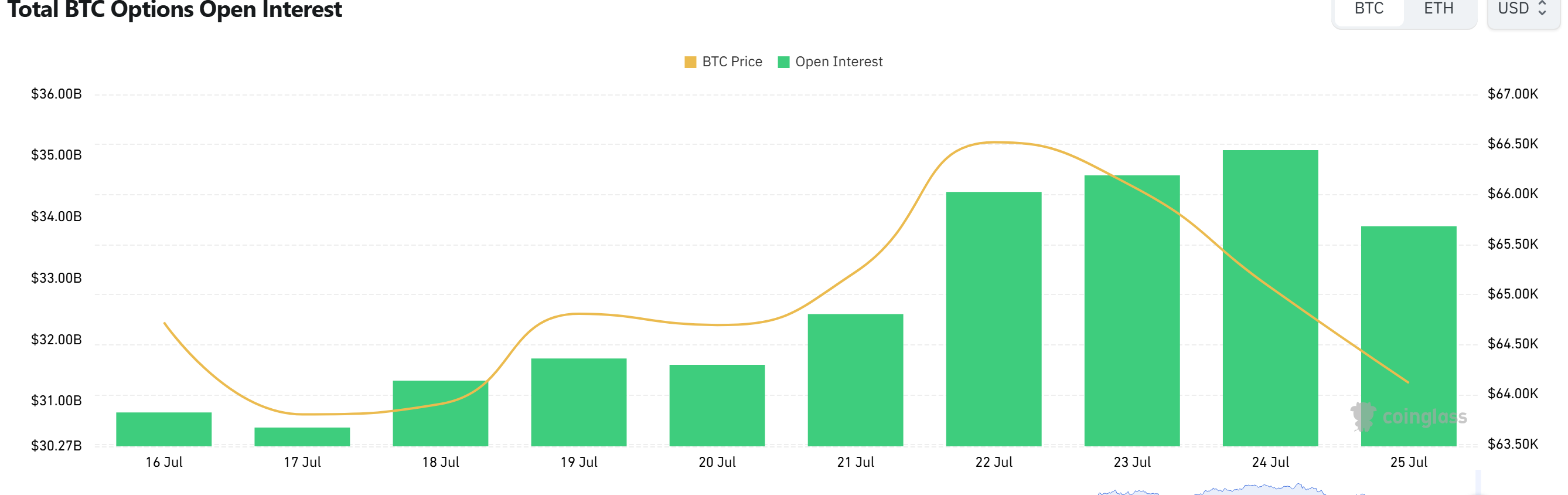
Bitcoin (BTC) options markets continued to show a clear 'bullish tilt' in positioning on Friday, even as overall exposure eased. Data indicate traders are still leaning toward upside scenarios, with call options dominating both outstanding contracts and near-term flow despite a pullback in total open interest.
As of 13:40 UTC on July 25, CoinGlass data put total Bitcoin options open interest (OI) at $33.20 billion, down 3.14% from $34.28 billion a day earlier. Reported 24-hour options trading volume stood at roughly $3.05 billion, suggesting activity remained steady even as some longer-dated positions were reduced.
The composition of OI underscored the market’s directional bias: calls accounted for 66.24% of outstanding contracts, compared with 33.76% for puts. In the past 24 hours, calls also led trading volume at 55.51%, versus 44.49% for puts—an indication that 'risk appetite' has not fully rolled over and that traders are still paying for upside exposure.
In options markets, rising OI often points to fresh positioning, while falling OI can reflect profit-taking, exposure trimming, or position roll-offs ahead of expiry. The latest decline in OI, paired with call-heavy activity, suggests traders may be reducing overall leverage while still maintaining a constructive view on BTC’s medium-term direction.
On Deribit, the largest concentrations of open interest were clustered around near-term and year-end upside strikes. The top OI contracts were the $72,000 call expiring July 31, followed by the $70,000 call also expiring July 31, and the $80,000 call expiring Dec. 25. These crowded strikes are often watched as potential 'magnet levels' into expiration, although actual spot action can vary depending on hedging flows and volatility conditions.
By 24-hour turnover, the most actively traded contract was the $75,000 call expiring Aug. 7, followed by the $68,000 call expiring July 31. The third most-traded was a $58,000 put expiring Dec. 25, hinting that some participants are also maintaining downside hedges or positioning for volatility later in the year even while near-term flow remains call-led.
More broadly, the split between call-dominant OI and a comparatively higher share of put volume can sometimes signal a two-track market: investors holding longer-dated upside exposure while using shorter-dated puts for protection against drawdowns. Friday’s figures, however, still point to a market where upside demand is leading, with defensive positioning present but not overwhelming.
The coming week’s July 31 expiries are likely to draw increased attention from traders monitoring volatility, dealer hedging, and positioning shifts around key strikes. While the data do not predict spot direction on their own, the persistence of call-heavy exposure suggests the options market is still pricing in meaningful probability of a rebound or further gains in Bitcoin (BTC) rather than a decisive turn toward risk-off positioning.



















Comment 0