

 News
News  Coin Information
  About us
  Customer Service


 Add as a preferred source on Google
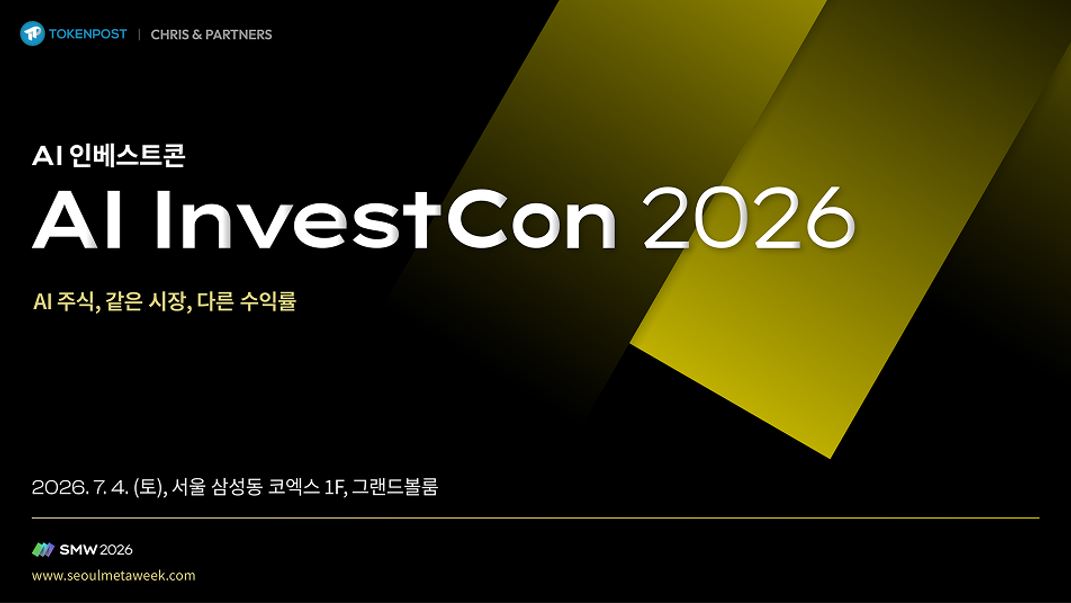
As artificial intelligence continues to reshape global equity markets—from semiconductor demand to software monetization—South Korea is set to host a retail-investor-focused conference aimed at narrowing the knowledge gap that has increasingly defined returns in AI-linked stocks.
Organizers said AI InvestCon 2026 will take place on July 4, 2026 at COEX Grand Ballroom Stage B in Seoul. The event will be held as the Day 2 investment track of Seoul Meta Week (SMW) 2026, under the theme: ‘AI stocks: returns differ between those who understand and those who don’t’. The program is designed for individual investors seeking to build an actionable framework for decision-making rather than simply collecting stock tips.
The conference arrives at a moment when AI has moved from a niche theme to a market-defining narrative. Across major indices, AI exposure is increasingly expressed through the full ‘AI value chain’—from advanced chips and memory to cloud infrastructure, robotics, and emerging ‘AI agent’ applications that automate workflows and customer interactions. In Korea, the AI trade has also become closely intertwined with broader questions about export momentum, corporate profitability, and how quickly domestic firms can convert capex and R&D spending into sustainable earnings.
According to the agenda, InvestCon will center on practical lenses such as ‘investment decision frameworks’, the distinction between ‘theme stocks vs. fundamentals’, and ‘risk management’ for volatility-heavy sectors. The focus reflects a common challenge for retail investors: AI narratives can drive sharp repricing ahead of earnings delivery, creating a gulf between momentum-led rallies and companies with demonstrable revenue and margin expansion.
The day’s first session begins at 1:00 a.m. ET (10:00 a.m. local time in Seoul) with Hong Chun-wook, CEO of Prism Investment Advisory, presenting on the potential vulnerabilities facing the Korean economy as it rides the AI boom. Organizers said his talk will examine how AI-led industrial expansion filters into financial markets—and where investors may be underestimating macro or market-structure risks.
At 2:05 a.m. ET, Yeom Seung-hwan, a director at LS Securities, will deliver a session on how Korea positions itself in the AI era and how retail investors can approach the theme with more discipline. Yeom—widely known among Korean retail investors by the nickname ‘Yeom블리’—has spent roughly two decades engaging with individuals across media, including YouTube and major broadcasters, and has authored investment education books on retail FAQs and ETFs. His presentation is expected to connect global Big Tech investment trends with domestic earnings trajectories and the evolving dynamics of Korea’s stock market.
From 3:55 a.m. ET, Kim Nam-ho, head of ETF management at Timefolio Asset Management, will discuss AI investing through the lens of active ETFs, using chart-based analysis to trace how AI-related trades have evolved and what may matter after 2026. The session is positioned around how fund managers interpret AI as both a long-cycle growth story and a sequence of shorter, liquidity-driven rotations across subsectors.
At 5:00 a.m. ET, Oh Gun-young, head at Shinhan Bank, will provide macro analysis focused on how AI intersects with the global economic environment. With AI capex influencing everything from commodity demand and supply chains to interest-rate sensitivity in growth equities, macro conditions have become a critical variable for investors attempting to time entries and manage drawdowns in AI-heavy portfolios.
The final session, starting 6:05 a.m. ET, features Ham Seo-kyung, CEO of European, speaking on where wealth-building opportunities may emerge as AI disrupts industries. Her talk is expected to emphasize portfolio construction and asset management considerations—an acknowledgment that AI exposure is increasingly treated as a core allocation question, not just a single-stock trade.
Organizers said tickets and full session details are available via the official Seoul Meta Week website. As AI expands beyond chips and cloud into consumer and enterprise automation, events like InvestCon underscore a broader shift in retail participation: investors are seeking repeatable ‘decision rules’ to separate durable adopters from speculative proxies, in a market where storytelling can move prices faster than fundamentals.
🔎 Market Interpretation
- AI has become a market-wide pricing engine: The article frames AI not as a niche theme but as a “market-defining narrative,” impacting valuations across semiconductors, cloud, robotics, and emerging AI-agent software.
- Retail-investor returns are increasingly knowledge-differentiated: As AI-linked stocks reprice quickly on expectations, investors who can separate story-driven momentum from earnings delivery may capture more durable returns.
- Korea’s AI exposure ties into macro and export cycles: The local AI trade is depicted as intertwined with export momentum, corporate profitability, and how effectively Korean firms convert capex/R&D into sustainable earnings.
- Volatility risk is structural, not occasional: AI sectors are described as “volatility-heavy,” where sharp repricing can occur ahead of fundamentals, increasing drawdown risk for undisciplined positioning.
- Market breadth across the AI value chain matters: Exposure is no longer limited to chips/memory—allocation decisions increasingly span infrastructure and application layers, creating rotation risk across subsectors.
💡 Strategic Points
- Build a repeatable investment decision framework: The conference emphasizes decision rules and process (thesis → catalyst → valuation → risk sizing) rather than collecting “stock tips.”
- Separate “theme stocks” from fundamentals: Prioritize companies with measurable revenue growth, margin expansion, and customer adoption signals over proxies that only track sentiment.
- Time horizon matching: Treat AI as both (1) a long-cycle transformation and (2) a series of shorter liquidity-driven rotations—position sizes and holding periods should reflect which regime you are trading.
- Risk management as a core edge: Use explicit rules for volatility (entry scaling, stop/invalidations, diversification across value-chain layers) because AI narratives can reprice faster than earnings.
- Macro overlays for AI portfolios: Monitor rates, capex intensity, supply-chain constraints, and commodity sensitivity—macro conditions can amplify or compress AI equity multiples independent of product progress.
- ETF implementation considerations: Active ETFs can express AI themes while managing rotations; however, investors should review factor tilts (growth, momentum), concentration, and rebalancing behavior.
- Portfolio construction mindset: The article highlights a shift from single-stock speculation to core allocation planning, suggesting AI is becoming a strategic portfolio sleeve rather than a one-off trade.
- Event-driven learning path: Sessions cover macro risk (economy riding AI boom), positioning Korea in the AI era, chart-based evolution of AI trades, and wealth-building opportunities via asset allocation.
📘 Glossary
- AI value chain: The linked set of industries enabling AI—from chips and memory to data centers, cloud platforms, robotics, and application software.
- AI agents: Software systems that autonomously execute tasks (e.g., workflow automation, customer interaction) using models and tools, often positioned as a next wave of monetization.
- Capex: Capital expenditures—spending on physical and digital infrastructure (e.g., fabrication, data centers) that can pressure near-term profits but support long-term growth.
- R&D: Research and development spending; a key input for AI competitiveness, but it must translate into products and earnings to justify valuation.
- Theme stocks: Stocks that rise mainly due to association with a popular narrative (e.g., “AI”) rather than proven business performance.
- Fundamentals: Underlying business performance indicators such as revenue, earnings, cash flow, margins, and balance-sheet strength.
- Repricing: Rapid valuation change as markets update expectations—common in AI when sentiment shifts ahead of earnings confirmation.
- Drawdown: The peak-to-trough decline in portfolio or asset value; higher in sectors driven by momentum and valuation sensitivity.
- Active ETF: An exchange-traded fund managed with discretionary security selection (not purely index-tracking), often used to navigate sector rotations.
- Liquidity-driven rotation: Short-term capital flows that rotate leadership between subsectors (chips → software → robotics), sometimes independent of fundamentals.


















Comment 0