

 News
News  Coin Information
  About us
  Customer Service


 Add as a preferred source on Google

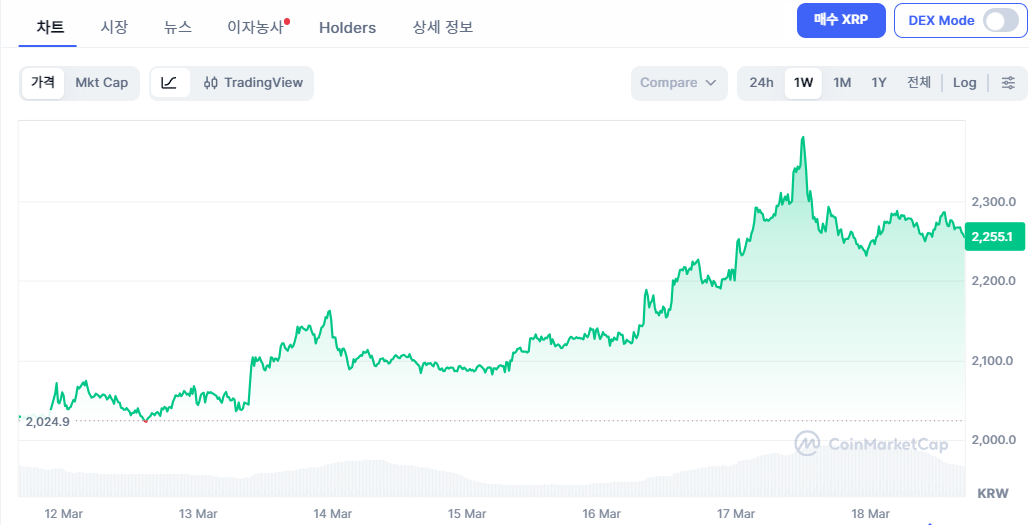
XRP (XRP) retreated after failing to punch through the closely watched $1.60 level, sliding roughly 3.3% to around $1.53—an abrupt pullback that traders framed as a rejection at the top of a multi-week range.
The move unfolded between March 17 and March 18 UTC, when XRP briefly tagged $1.60—its highest print since mid-February—before rolling over and extending losses the next day. Technical traders highlighted a bearish 'pin bar' formation near the highs, a reversal-style candlestick that often signals waning momentum after an attempted breakout.
At roughly $1.53, XRP is back inside the consolidation zone that has contained price action for weeks, reinforcing the view that the market treated $1.60 as overhead supply rather than a springboard. In practical terms, the rejection suggests the rally needed fresh 'liquidity inflow' to sustain a breakout, but instead met profit-taking and short-term de-risking.
Zooming out, chart-focused analysts continue to debate XRP’s long-running compression structure, with some describing the token as trading within a multi-year tightening pattern. In that framework, a decisive breakout is argued to open upside scenarios spanning the mid-single digits to higher targets, while a breakdown risk case points to a deeper retracement toward prior cycle support levels.
Analyst EGRAG CRYPTO pointed to the XRP/Bitcoin (XRP/BTC) pair maintaining what was described as a bullish rectangle formation, arguing that a confirmed move through the relevant boundary could tilt probabilities toward an upward trend shift. Such relative-strength setups matter because they can signal whether XRP is outperforming the broader market anchor—Bitcoin (BTC)—rather than merely rising with overall risk sentiment.
Beyond the charts, Ripple’s expanding role in payments remained a key narrative catalyst after the company joined Mastercard’s crypto partner program alongside dozens of other firms. Mastercard, which advertises annual network volume in the trillions of dollars, represents a high-visibility distribution channel, and proponents see the integration pathway as supportive of broader 'payments adoption' over time.
Ripple has also been emphasizing ecosystem-building around the XRP Ledger rather than positioning itself solely as a direct replacement for legacy payment rails. The strategy includes supporting DeFi-oriented applications, payment solutions, digital wallets, developer tooling, and liquidity providers—an approach designed to widen use cases and strengthen network effects.
Longer-horizon forecasts circulating among market commentators remain widely dispersed, with conservative wave-based projections citing mid-single-digit targets for 2026 and optimistic scenarios extending significantly higher. More extreme community claims of four-figure prices continue to be treated as low-probability outliers, reflecting sentiment more than defensible modeling.
With short-term technicals flashing a cooldown but partnerships and ecosystem development pointing to improving fundamentals, XRP is entering a period where confirmation—either through a sustained breakout above resistance or a deeper test of support—may shape market positioning into the next leg of the cycle.
🔎 Market Interpretation
{
"price_action_snapshot": [
{
"event": "Rejection at key resistance",
"details": "XRP briefly touched ~$1.60 (highest since mid-February) and reversed, falling ~3.3% to ~$1.53, signaling sellers defended the top of a multi-week range."
},
{
"technical_signal": "Bearish pin bar near the highs",
"details": "A reversal-style candlestick formed around $1.60, often interpreted as failed breakout momentum and a potential near-term cooldown."
},
{
"range_context": "Return to consolidation",
"details": "Price moved back into the weeks-long consolidation zone, implying $1.60 acted as overhead supply rather than a breakout launch point."
},
{
"market_mechanics": "Liquidity and positioning",
"details": "The move suggests the rally lacked fresh liquidity inflow to sustain continuation; profit-taking and short-term de-risking dominated after the spike."
},
{
"higher_timeframe_read": "Compression structure debate",
"details": "Analysts frame XRP as being in a multi-year tightening pattern, where a decisive breakout could expand volatility upward, while failure could invite a deeper retracement toward prior-cycle supports."
},
{
"relative_strength_angle": "XRP/BTC rectangle",
"details": "Commentary highlights XRP/BTC holding a bullish rectangle; a confirmed boundary break would suggest XRP is strengthening versus BTC, not just rising with broad risk-on sentiment."
}
],
"key_levels_to_watch": {
"resistance": [
{
"level": "$1.60",
"meaning": "Primary overhead supply/failed breakout point; reclaiming and holding above it would be a key confirmation signal."
}
],
"support_zone": [
{
"level": "~$1.53 and the broader recent consolidation range",
"meaning": "Area to monitor for stabilization; losing the range increases odds of a deeper pullback toward historical supports."
}
]
}
}
💡 Strategic Points
{
"trade_and_risk_takeaways": [
{
"theme": "Confirmation matters more than the first breakout attempt",
"insight": "After a rejection, many traders look for either (1) a clean reclaim of resistance with follow-through volume, or (2) a controlled retest/hold of range support before re-risking."
},
{
"theme": "Separate absolute gains from relative strength",
"insight": "Monitoring XRP/BTC can help identify whether XRP is outperforming BTC (a stronger bullish signal) versus merely moving with overall market beta."
},
{
"theme": "Narrative vs. price timing",
"insight": "Partnership headlines (e.g., Mastercard’s crypto partner program) can support long-term adoption narratives, but short-term price still responds primarily to liquidity, positioning, and technical supply zones."
},
{
"theme": "Expect wide forecast dispersion",
"insight": "The article notes projections range from mid-single digits by 2026 (more conservative) to much higher optimistic scenarios; four-figure targets are framed as sentiment-driven outliers rather than model-backed expectations."
},
{
"theme": "Ecosystem breadth as a fundamental lever",
"insight": "Ripple’s emphasis on XRP Ledger ecosystem building (DeFi apps, wallets, tooling, liquidity providers) aims to strengthen network effects, which can improve resilience if adoption translates into sustained on-chain and payment activity."
}
],
"scenario_map": {
"bull_case": {
"trigger": "Sustained breakout and acceptance above $1.60",
"what_it_implies": "Buyers absorb overhead supply; momentum can re-accelerate and validate the multi-year compression breakout thesis for some analysts."
},
"base_case": {
"trigger": "Continued range trading",
"what_it_implies": "Market remains in consolidation; traders may focus on mean-reversion setups and wait for a catalyst + liquidity to force a directional move."
},
"bear_case": {
"trigger": "Breakdown from the established consolidation zone",
"what_it_implies": "Increases probability of a deeper retracement toward prior cycle support levels as referenced by chart-focused analysts."
}
}
}
📘 Glossary
{
"terms": [
{
"term": "Resistance",
"definition": "A price level where selling pressure has historically been strong enough to stop or reverse an advance (e.g., XRP near $1.60)."
},
{
"term": "Overhead supply",
"definition": "Previously bought positions that may sell into rallies to exit at break-even or profit, creating selling pressure above current price."
},
{
"term": "Consolidation zone / Trading range",
"definition": "A period where price oscillates between support and resistance without establishing a sustained trend."
},
{
"term": "Pin bar (bearish pin bar)",
"definition": "A candlestick with a long upper wick and a close below the highs, often interpreted as rejection of higher prices and weakening bullish momentum."
},
{
"term": "Liquidity inflow",
"definition": "New buying power entering the market (spot demand, leveraged positions, or broader inflows) needed to absorb sellers and sustain a breakout."
},
{
"term": "De-risking",
"definition": "Reducing exposure (selling or hedging) to limit downside after a move appears overextended or uncertain."
},
{
"term": "Compression / Tightening pattern",
"definition": "A long period of declining volatility where price range narrows; breaks from compression can lead to larger directional moves."
},
{
"term": "XRP/BTC (relative strength pair)",
"definition": "The price of XRP measured in Bitcoin; used to evaluate XRP’s performance relative to BTC rather than in USD terms."
},
{
"term": "Bullish rectangle",
"definition": "A chart pattern where price moves sideways between parallel support/resistance; an upside break is often treated as continuation or trend shift confirmation."
},
{
"term": "Network effects",
"definition": "When a network becomes more valuable as more users, developers, and liquidity providers participate—potentially improving adoption and utility over time."
},
{
"term": "XRPL (XRP Ledger)",
"definition": "The blockchain network associated with XRP, used for transfers and increasingly positioned for broader ecosystem applications (payments, DeFi, wallets, tooling)."
}
]
}
















Comment 0