

 News
News  Coin Information
  About us
  Customer Service


 Add as a preferred source on Google

XRP (XRP) slid back after failing to clear the closely watched $1.60 level this week, reinforcing a near-term bearish technical setup even as investors debate whether looming U.S. spot ETF decisions and Ripple’s corporate moves could reset sentiment.
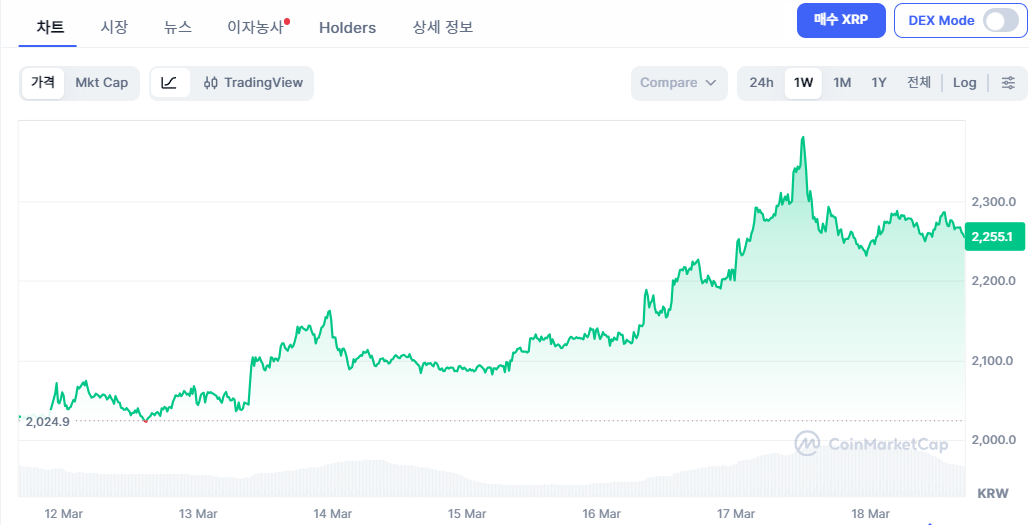
On Monday UTC (March 17), XRP rallied to around $1.60 but stalled at resistance and reversed. The token then fell 1.6% on the day and extended losses on Tuesday UTC (March 18) with an additional 3.3% drop, carving out what technicians often describe as a bearish 'pin bar'—a candle pattern that can signal rejection at higher prices. XRP was last trading near $1.51 in the move described, leaving it roughly 62% below its 2025 high of $3.66 and about 59% under its all-time peak.
Despite the pullback, retail positioning remains conflicted rather than capitulatory. Sentiment readings cited from Stocktwits continued to lean bullish, highlighting a recurring dynamic in XRP: price weakness in the chart can coexist with optimistic social indicators, often contributing to sharper volatility when catalysts hit.
Separately, Ripple’s decision to repurchase about $750 million of its own shares has reignited debate over how the company’s capital allocation intersects with the token’s market narrative. Supporters frame the buyback as a standard corporate action aimed at strengthening valuation, while critics argue it underscores management priorities and revives long-running complaints that corporate growth is being pursued alongside token sales. Ripple CTO David Schwartz pushed back, calling the move part of a previously disclosed plan and arguing it could leave token holders with a window to accumulate at lower prices.
Ripple has also pointed to infrastructure and regulatory initiatives as evidence of continued execution. The company said it integrated Ripple Prime into the DTCC’s NSCC clearing framework on March 2 UTC, positioning the XRP Ledger (XRPL) closer to legacy market rails. In Australia, Ripple is pursuing an Australian Financial Services License via BC Payments, a step that observers interpret as consistent with a broader global expansion strategy and renewed chatter about a potential IPO.
The dominant near-term variable, traders say, is the U.S. regulatory calendar—particularly the prospect of a spot XRP ETF. The U.S. Securities and Exchange Commission is reviewing final filings, with a decision deadline cited for March 27. Some market watchers peg approval odds above 90% and project that a green light could attract as much as $8 billion in demand from retirement channels such as pensions and IRA-linked allocations, though such forecasts remain highly sensitive to fee structures, distribution, and broader risk appetite.
Regulatory tone is another swing factor for altcoins. Following the conclusion of the SEC’s Ripple case on March 17 UTC, the agency released fresh guidance addressing when crypto assets may be treated as securities, a move that market participants read as a step toward clearer rulemaking. For XRP, the key question is whether improved clarity translates into incremental 'institutional demand' rather than short-lived speculative flows.
Meanwhile, a public dispute with Chainlink has added fuel to the ecosystem debate. Chainlink executive Zac Rynes criticized XRPL as an “outdated ghost chain,” citing claims that its shares of real-world asset tokenization and stablecoin activity are below 1% and 0.01%, respectively. Ripple executives and community members countered by pointing to XRP’s roughly $91 billion market capitalization versus Chainlink’s about $7 billion, arguing that market value and brand recognition contradict the “ghost chain” label.
Technically, analysts continue to frame $1.60 as a pivotal inflection point: reclaiming it could help confirm a momentum turn, while a breakdown below the $1.40 support zone would raise the odds of deeper downside in a risk-off scenario. Longer-range projections remain widely dispersed—from Elliott Wave-based paths that envision a run toward $5 followed by a pullback near $0.78 and a later surge toward $27, to far more aggressive community targets that many professional observers view as speculative.
For now, the market’s next major cues appear tied to the March 27 ETF deadline and the trajectory of the CLARITY Act, both of which could reshape expectations for U.S. digital-asset oversight. A supportive regulatory backdrop paired with ETF-driven 'liquidity inflow' could help XRP exit its current range and rebuild upside momentum; any delay, rejection, or legislative setback, however, may amplify short-term swings and keep pressure on prices.
Article Summary by TokenPost.ai
🔎 Market Interpretation
- Failed breakout reinforces bearish bias: XRP’s rejection at the heavily watched $1.60 resistance and the formation of a bearish pin bar suggest sellers are defending higher levels, keeping near-term momentum cautious.
- Pullback still within a broader drawdown: Price near $1.51 leaves XRP about 62% below its 2025 high (~$3.66) and roughly 59% under its all-time peak, underscoring the gap between current trading range and prior cycle extremes.
- Sentiment/price divergence raises volatility risk: Stocktwits sentiment remains bullish despite weakness on the chart—often a setup for sharper moves when a headline catalyst hits (squeeze/flush dynamics).
- Corporate actions complicate the narrative: Ripple’s $750M share repurchase is read in two ways—either a confidence signal for corporate valuation or evidence that management priorities may not directly align with token-holder outcomes.
- Macro catalyst concentration: The near-term market is effectively “binary” around U.S. regulatory/ETF decisions—approval could re-rate expectations; delay or rejection could intensify risk-off pressure.
- Ecosystem debate adds noise: Public criticism from Chainlink about XRPL usage may not be the primary driver of price, but it can influence narrative momentum and retail conviction at key technical levels.
💡 Strategic Points
- Key levels to monitor:
- $1.60: A reclaim/close above can signal a momentum shift and reduce the immediate bearish setup.
- $1.40: A breakdown raises probability of deeper downside, especially if broader crypto turns risk-off.
- Catalyst calendar focus:
- March 27: Deadline cited for the SEC spot XRP ETF decision—likely the dominant near-term volatility trigger.
- Post-lawsuit guidance: New SEC guidance on when crypto assets may be securities could affect whether flows are institutional and durable vs. short-term speculative.
- CLARITY Act trajectory: Legislative progress (or setbacks) can reset expectations for U.S. digital-asset oversight and consequently risk appetite.
- ETF scenario framing (risk-based):
- Approval: Could improve liquidity narrative and broaden access (including retirement channels). Forecasts of multi-billion demand are highly sensitive to fees, distribution strength, and overall market conditions.
- Delay/denial: May renew range trading or accelerate downside tests (notably toward/through $1.40) as positioning is unwound.
- Interpreting Ripple’s buyback: Investors may treat it as a corporate confidence signal, but token impact is indirect; watch whether it coincides with improved on-chain/market liquidity conditions or merely shifts narrative sentiment.
- Fundamental execution watchlist:
- DTCC/NSCC integration (Ripple Prime): If it translates into measurable usage, it strengthens the “legacy-rails” institutional story.
- Australia licensing: Pursuit of an AFSL via BC Payments supports global compliance positioning and revives IPO chatter, which can influence longer-term perception.
- Manage expectations on long-range targets: Wide projections (e.g., Elliott Wave paths to $5 / $27) reflect scenario speculation; near-term price is more likely to be dictated by levels + regulatory outcomes.
📘 Glossary
- Resistance (e.g., $1.60): A price area where selling pressure historically limits upside progress.
- Support (e.g., $1.40): A price area where buying interest historically limits downside declines.
- Pin bar (bearish): A candlestick with a long upper wick and a close near/under the open, often interpreted as rejection of higher prices.
- Spot ETF: An exchange-traded fund that holds the underlying asset (here, XRP) rather than derivatives, potentially expanding access for traditional investors.
- Institutional demand: Participation from funds, advisors, pensions, and other large allocators—often viewed as more durable than retail-driven flows.
- Liquidity inflow: New net buying capacity entering the market (e.g., via ETF creations), which can tighten supply and amplify upside moves.
- Share repurchase (buyback): A company buying back its own shares, typically to return capital, support valuation, or consolidate ownership—distinct from token economics.
- XRPL (XRP Ledger): The blockchain network associated with XRP, used for payments and tokenization-related activity.
- RWA tokenization: Issuing blockchain-based representations of real-world assets (e.g., bonds, funds, treasuries).
- Risk-off: A market environment where investors reduce exposure to volatile assets, often pressuring altcoins more than large-cap benchmarks.


















Comment 0