

 News
News  Coin Information
  About us
  Customer Service


 Add as a preferred source on Google
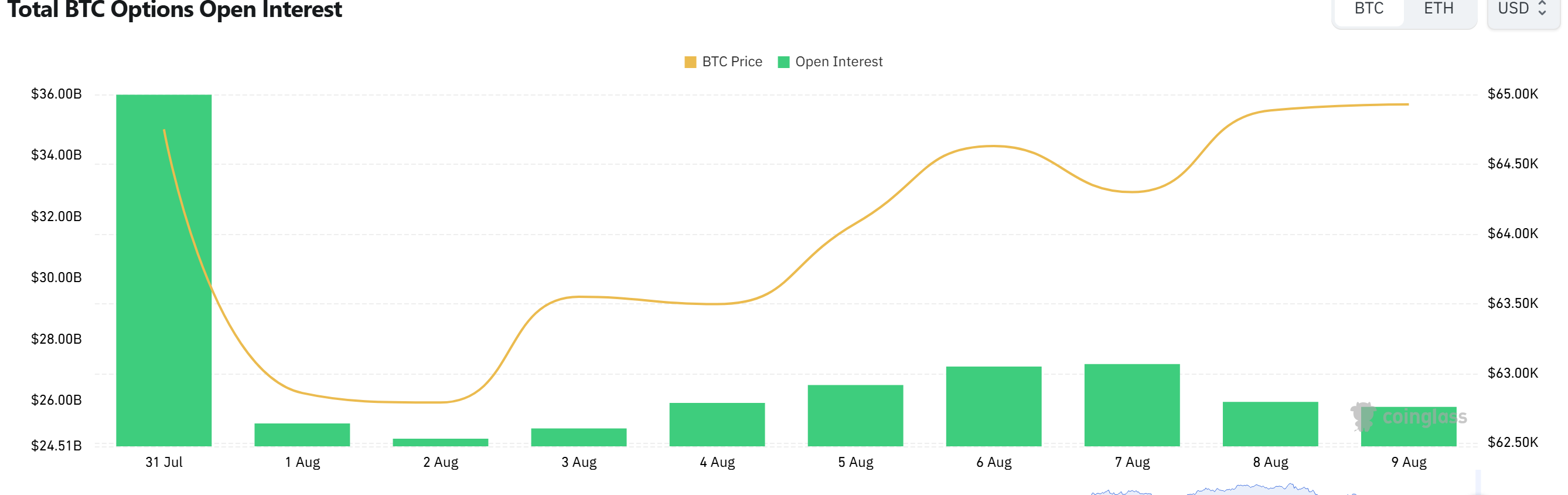
Bitcoin (BTC) options data on Saturday pointed to a market split between medium-term optimism and short-term caution, with positioning still skewed toward upside exposure even as near-term trading leaned defensive. The divergence suggests traders are keeping a bullish core view while actively hedging against near-term volatility.
As of 1:41 a.m. ET on Aug. 9, data compiled by Coinglass showed total Bitcoin options 'open interest' (OI) at $25.34075 billion, down 0.63% from the prior day’s $25.5012 billion. Total options volume over the period was approximately $775.91 million.
The composition of outstanding positions continued to favor calls, with call options accounting for 60.35% of OI versus 39.65% for puts. However, the picture flipped in recent activity: over the past 24 hours, calls represented 47.66% of traded volume while puts made up 52.34%.
That combination—calls dominating OI while puts lead in volume—typically reflects a market where longer-dated positioning remains geared toward higher prices, but short-dated flows are more focused on protection. In practice, traders may be maintaining upside exposure while buying puts to hedge spot holdings, protect leveraged long positions, or brace for sharp swings around macro headlines and liquidity shifts.
By contract, the largest concentrations of OI were seen in Deribit listings, led by an $80,000 call expiring Dec. 25, followed by a $60,000 put expiring Dec. 25, and a $70,000 call expiring Sept. 25. The clustering around large round-number strikes highlights where market participants have collectively placed the most significant longer-dated bets—both for upside targets and downside insurance.
Short-dated activity was more tightly centered on Bybit’s Aug. 9 expiries, where the most actively traded contracts were a $65,000 call, a $65,000 put, and a $64,750 put. The prominence of near-expiry strikes around the same price area often signals a market preparing for fast price action, as traders adjust hedges and gamma exposure into the close of the trading window.
Options are derivatives that allow investors to gain 'leveraged' exposure to price moves or manage risk. Calls are generally used for bullish positioning, while puts are commonly used to express downside views or hedge. OI measures the total number of outstanding contracts and is often tracked as a gauge of how much positioning has accumulated beyond short-term churn.
For now, the data suggests Bitcoin’s medium-term positioning remains tilted toward upside scenarios, even as the balance of recent trading underscores a cautious stance into the near term—an alignment consistent with a market that expects higher prices over time but is unwilling to ignore the risk of short-term pullbacks.
🔎 Market Interpretation
- Medium-term bullish bias remains intact: Total BTC options open interest (OI) is still call-heavy (calls 60.35% vs puts 39.65%), implying positioning is broadly skewed toward upside scenarios over longer horizons.
- Near-term risk-off behavior is rising: The last 24 hours’ trading volume flipped bearish/defensive (puts 52.34% vs calls 47.66%), consistent with traders paying for short-dated protection.
- Hedged bullish stance: The OI/volume divergence suggests traders are keeping core long exposure (or upside bets) while actively layering hedges against a pullback or volatility spike.
- Positioning slightly cooled, not reversed: Total OI dipped to $25.34B (−0.63% day/day), indicating modest de-risking or expiry/roll effects rather than a wholesale shift in market view.
- Key strike “magnets” define expectations: Large clustering at round-number strikes (e.g., $70k/$80k calls and $60k put) highlights where upside targets and downside insurance are most concentrated.
- Event/expiry sensitivity near spot: Bybit’s Aug. 9 activity around $65,000 (both call and put) and $64,750 put signals tight hedging and potential elevated sensitivity into expiry (gamma effects).
💡 Strategic Points
- Read OI vs volume together: Call-dominant OI points to longer-dated optimism, while put-led volume flags short-term caution—useful for separating “structural” views from tactical hedging.
- Likely hedge motivations: Put buying can reflect (1) hedging spot BTC holdings, (2) protecting leveraged longs, or (3) preparing for macro/liquidity-driven swings.
- Watch the Dec. 25 strike cluster: Heavy OI in Deribit’s $80k call and $60k put suggests the market is framing a wide year-end distribution—upside ambition with defined downside guardrails.
- Expiry-day dynamics: Concentrated near-expiry strikes around $65k can amplify intraday moves as traders adjust hedges, potentially increasing volatility into and around settlement.
- Sentiment baseline: The market message is “higher over time, but protect the near term.” Traders may consider combining directional exposure with defined-risk hedges if volatility remains elevated.
📘 Glossary
- Options: Derivative contracts giving the right (not obligation) to buy or sell an asset at a set price by a certain date.
- Call option: Typically benefits if BTC rises; often used for bullish exposure.
- Put option: Typically benefits if BTC falls; often used for bearish bets or portfolio hedging.
- Open Interest (OI): Total number (or notional) of outstanding option contracts; a proxy for accumulated positioning, not just daily trading.
- Options Volume: Contracts traded during a period; reflects recent flow/activity and short-term sentiment.
- Strike price: The price at which the option can be exercised (e.g., $65,000).
- Expiry (expiration): The date the option contract ends (e.g., Aug. 9, Sept. 25, Dec. 25).
- Hedging: Using instruments (often puts) to reduce downside risk of an existing exposure.
- Gamma exposure (Gamma): Measures how quickly an option’s delta changes; near expiry, large strike positioning can make price action more sensitive as dealers/traders rebalance hedges.
















Comment 0