

 News
News  Coin Information
  About us
  Customer Service


 Add as a preferred source on Google
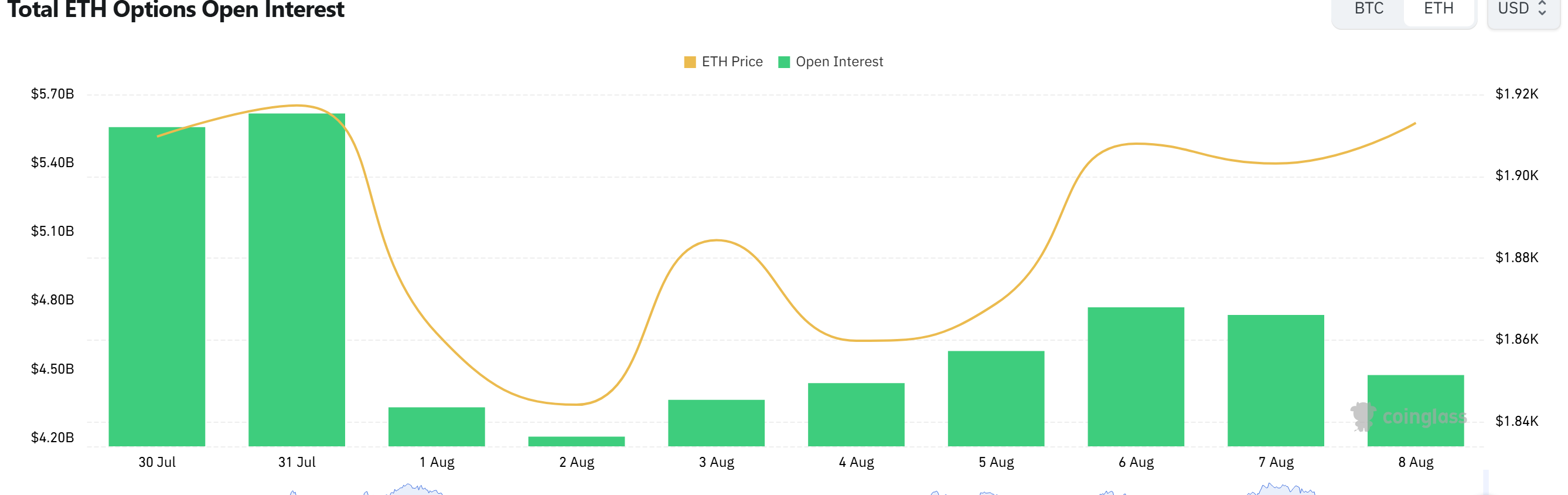
Ethereum (ETH) options traders continued to show a clear preference for upside exposure, even as overall positioning cooled and open interest slipped—an early sign that bullish conviction is being tempered by caution rather than expanding aggressively.
As of 12:50 a.m. ET on Friday, Aug. 8, data compiled by CoinGlass showed total Ethereum options 'open interest' (OI) at $4.3325 billion, down 5.64% from $4.5917 billion a day earlier. Options trading volume over the past 24 hours totaled roughly $847.3 million.
The composition of outstanding positions remained tilted toward calls. Call options accounted for 61.75% of total OI, while puts made up 38.25%. In 24-hour trading activity, calls represented 56.03% of volume versus 43.97% for puts.
The gap between call-heavy OI and the smaller—but still call-led—volume split suggests the market’s baseline stance remains constructive over the medium term, with more capital parked in 'bullish' structures. However, the decline in headline OI points to some position unwinds and a more wait-and-see posture, potentially reflecting traders taking profit, reducing leverage, or reassessing risk around near-term volatility.
On Deribit, the largest concentrations of OI were clustered in longer-dated, higher-strike call contracts: the $3,200 call expiring Dec. 25 led the list, followed by the $2,200 call expiring Dec. 25 and the $3,000 call expiring Sept. 25. The positioning indicates that a portion of the market is still maintaining exposure to higher-price scenarios into late 2026, even as aggregate participation has eased.
Shorter-dated flow was more active around strikes closer to current spot levels. By 24-hour volume, the most-traded contract was the $1,950 call expiring Aug. 14 on Deribit, followed by the $1,940 call expiring Aug. 8 on Deribit. The third-most active contract was the $1,875 put expiring Aug. 8 on Bybit, highlighting that hedging demand remains present alongside directional call buying.
Options are widely used in crypto markets to express leveraged views or manage downside risk. A 'call option' gives the holder the right to buy an asset at a set price by a future date, typically reflecting a bullish outlook, while a 'put option' provides the right to sell, often used to position for declines or hedge spot exposure. OI tracks the total number of outstanding contracts and is often read as a proxy for how much money is committed to medium-term positioning, while volume captures near-term trading intensity.
For Ethereum, the latest snapshot portrays a market still biased toward upside, but with decreasing overall exposure—an alignment that often accompanies consolidation phases, where traders keep directional preference yet reduce aggregate risk until a clearer catalyst emerges.
🔎 Market Interpretation
- Upside bias remains intact: Ethereum options positioning is still call-heavy (calls 61.75% of open interest; 56.03% of 24h volume), signaling the market’s default stance is constructive.
- Risk is being reduced, not flipped bearish: Total options open interest fell to $4.3325B (down 5.64% day-over-day), suggesting unwinds/profit-taking and a more cautious posture rather than a broad rotation into puts.
- Medium-term conviction vs near-term caution: Call-heavy OI paired with a less-extreme call share of volume implies existing bullish structures are being maintained, while incremental new activity is more balanced and selective.
- Long-dated optimism persists: The largest OI concentrations on Deribit are in higher-strike calls (notably $3,200 Dec. 25, $2,200 Dec. 25, and $3,000 Sept. 25), indicating some traders are still positioned for higher ETH price scenarios further out.
- Near-term trading focused around spot: The most active 24h contracts clustered near current levels (e.g., $1,950 Aug. 14 call, $1,940 Aug. 8 call), consistent with tactical positioning around short-term moves and event risk.
- Hedging demand remains present: Meaningful put activity (e.g., $1,875 Aug. 8 put on Bybit) shows downside protection is still being bought alongside call exposure—typical of markets expecting volatility but not fully committing to a bearish trend.
- Overall regime read: A bullish-leaning consolidation—directional preference stays tilted upward, but aggregate exposure/leveraging is being dialed down until a clearer catalyst emerges.
💡 Strategic Points
- Interpret OI decline as de-risking: Falling OI with a persistent call skew often reflects reduced leverage and trimmed positions; it can dampen momentum in the short run even if sentiment remains positive.
- Watch call/put split for confirmation: If call OI stays dominant while volume shifts increasingly toward puts, it may indicate rising hedging pressure or a change in near-term expectations.
- Track key strike magnets: Heavy interest in $3,200 and $3,000 calls can become reference levels for sentiment; growing OI there may reinforce bullish narratives, while rapid unwinds may signal fading conviction.
- Short-dated activity hints at tactical trading: Concentration in weekly expiries near spot suggests traders are positioning around immediate volatility windows; spikes in volume without rising OI can imply fast in-and-out trades rather than new commitments.
- Use hedging cues: Continued put demand alongside call buying can indicate investors want upside participation but are paying to cap downside—often seen during uncertain macro/crypto-specific news cycles.
- Volatility and catalyst monitoring: The described “wait-and-see” stance typically breaks when a catalyst appears (macro data, ETF/regulated product flows, major protocol news); watch whether OI rebuilds into such events.
📘 Glossary
- Options Open Interest (OI): The total number of outstanding options contracts that have not been closed or exercised; a proxy for capital committed to positions.
- Options Volume: The number (or notional) of contracts traded over a period (e.g., 24 hours); reflects near-term activity and churn.
- Call Option: A contract giving the right (not obligation) to buy the underlying asset at a predetermined price before/at expiry; typically used for bullish exposure.
- Put Option: A contract giving the right (not obligation) to sell at a predetermined price before/at expiry; used for bearish positioning or hedging spot holdings.
- Strike Price: The predetermined price at which the option can be exercised (e.g., $1,950, $3,200).
- Expiration (Expiry): The date when an options contract ends and can be exercised/settled (e.g., Aug. 8, Aug. 14, Dec. 25).
- Deribit / Bybit: Crypto derivatives venues where options are traded; Deribit is a major hub for BTC/ETH options liquidity.
- Hedging: Using derivatives (often puts) to reduce losses from adverse price moves in an underlying spot or futures position.


















Comment 0