

 News
News  Coin Information
  About us
  Customer Service


 Add as a preferred source on Google
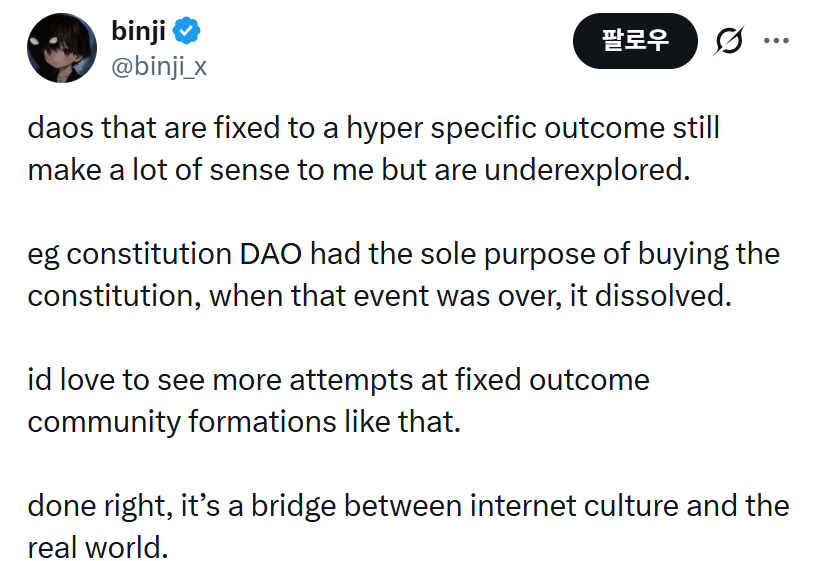
Goal-driven DAOs—decentralized autonomous organizations formed around a single, clearly defined outcome—are regaining attention as builders and commentators revisit how online communities can coordinate in the real world.
On Tuesday ET, crypto community influencer binji wrote on X that DAOs “fixed on a particular result” still matter, but remain “not explored enough,” arguing that the format offers a distinct organizational blueprint compared with always-on governance collectives.
Binji pointed to ConstitutionDAO, the 2021 effort that rapidly mobilized capital and participants in an attempt to purchase an original copy of the U.S. Constitution at auction. While the group ultimately failed to secure the winning bid, its structure—organize fast around one mission, then unwind once the attempt concludes—has continued to resonate as a template for ‘goal-based, one-off organizations’ rather than perpetual communities.
Unlike many DAOs that justify their existence through continuous development, treasury management, and long-term governance, goal-driven DAOs tend to optimize for speed, clarity, and social momentum. That focus can reduce the ambiguity that often plagues open-ended collectives, but it also raises hard operational questions around accountability, refund mechanics, legal exposure, and what—if anything—should persist after the objective is met or fails.
Binji suggested the model could serve as a bridge between internet culture and tangible outcomes, turning collective online energy into bids on real assets, coordinated events, or other forms of social action. The broader implication is that DAOs may be less about running “on-chain governments” and more about enabling high-conviction, time-boxed coordination—an angle that could expand how the industry thinks about community formation beyond token-centric ecosystems.
He added that he hopes to see more experiments in fixed-goal community coordination, an idea arriving as crypto continues to search for practical use cases that translate on-chain activity into verifiable real-world impact without relying on indefinite organizational lifecycles.

















Comment 0