
 Add as a preferred source on Google
AI Tokens Lead Crypto Sector Rebound With 24% FDV Surge
AI-related tokens led a broad crypto market rebound with a 24% weekly FDV surge as multiple sectors posted synchronized gains, signaling renewed risk appetite.



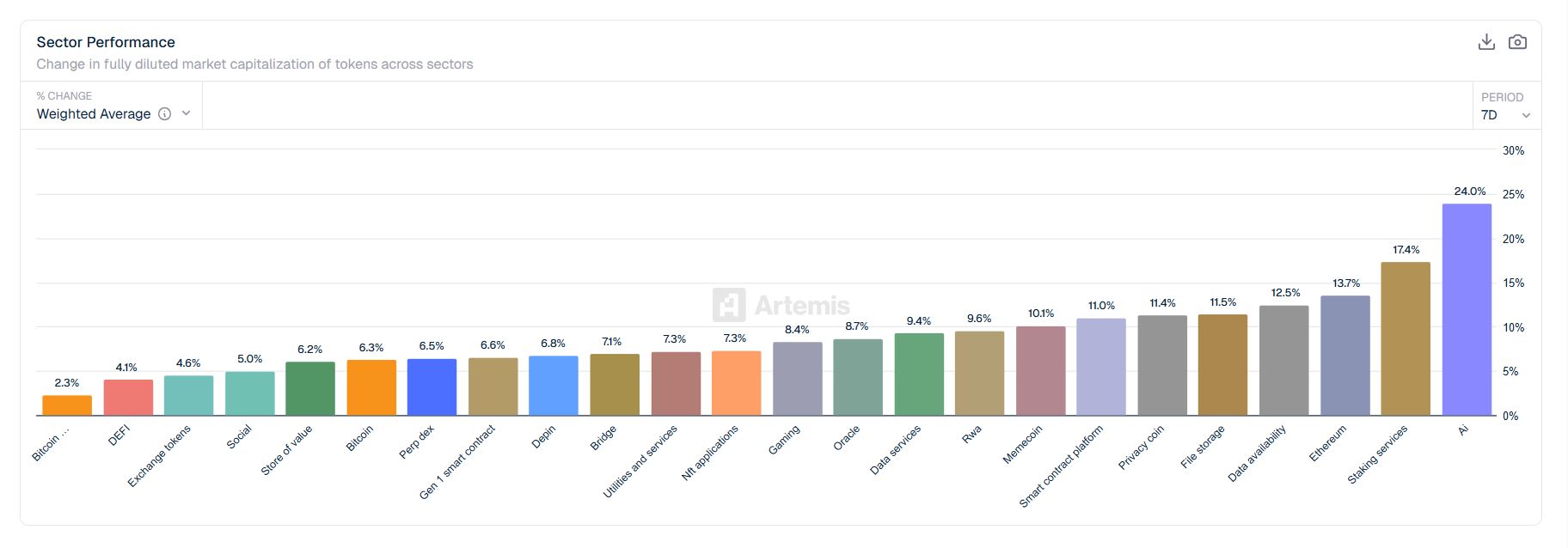
Crypto markets posted a broad-based rebound over the past week, with sector-level 'fully diluted valuation' (FDV) metrics turning higher across most categories—an indication that risk appetite is returning after last week’s softer tone.
Data compiled by Artemis as of Monday UTC (March 17) showed the AI segment leading the move, surging 24.0% in weekly FDV performance. The jump put AI-related tokens at the top of the leaderboard, marking the strongest momentum among tracked crypto sectors.
The rally was not confined to one theme. Several groups that had underperformed in the prior week—such as real-world assets (RWA), file storage, gaming, and staking services—snapped back sharply, suggesting investors rotated into previously discounted narratives rather than concentrating solely in majors.
Staking services recorded a 17.4% weekly FDV gain, while the Ethereum (ETH) sector rose 13.7%. Other double-digit movers included data availability (+12.5%), file storage (+11.5%), privacy coins (+11.4%), smart-contract platforms (+11.0%), and memecoins (+10.1%), underscoring the breadth of the upswing.
Mid-tier advances were also widespread. RWA climbed 9.6%, followed by data services (+9.4%), oracles (+8.7%), gaming (+8.4%), NFT applications (+7.3%), and utilities and services (+7.3%), a pattern consistent with early-stage rebounds where beta-heavy categories often recover in tandem.
Not every segment accelerated at the same pace. The bridge category, which had risen 9.4% the previous week, still added 7.1% but showed signs of cooling versus its earlier burst of strength.
Elsewhere, DePIN gained 6.8%, first-generation smart-contract networks added 6.6%, pump-focused DEX themes rose 6.5%, Bitcoin (BTC) climbed 6.3%, and store-of-value groupings increased 6.2%. Social tokens advanced 5.0%, exchange tokens rose 4.6%, and DeFi added 4.1%, keeping the overall tape constructive.
Bitcoin-related subsectors, however, lagged with a comparatively modest 2.3% increase—an underperformance that may signal traders are leaning into higher-beta themes as sentiment improves, while keeping core BTC exposure steadier.
Overall, the synchronized rise in FDV across categories points to a market-wide repricing rather than a single isolated catalyst, a setup that often precedes sharper differentiation as investors begin to focus on revenue, token unlock schedules, and real usage metrics in the weeks ahead.
Article Summary by TokenPost.ai
🔎 Market Interpretation
Broad risk-on rebound: Sector-wide FDV gains signal improving sentiment after a softer prior week, implying buyers returned across the board rather than only to large caps.
AI led the surge: The AI sector topped weekly FDV performance at +24.0%, indicating the strongest momentum and likely the highest beta appetite in the current leg.
Rotation into discounted themes: Strong rebounds in previously weaker categories (e.g., RWA, file storage, gaming, staking) suggest investors rotated into laggards, a common pattern in early rebound phases.
Breadth confirms repricing: Multiple double-digit sector moves (staking services, ETH, data availability, file storage, privacy, smart-contract platforms, memecoins) point to a market-wide repricing rather than a single narrative-driven spike.
Cooling in bridges: Bridges still advanced (+7.1%) but slowed versus the prior week’s pace, hinting that the “catch-up trade” may be moderating in that niche.
BTC steadier; higher beta favored: BTC rose +6.3%, but Bitcoin-related subsectors lagged at +2.3%, consistent with traders seeking more upside sensitivity in thematic segments while keeping core exposure stable.
Next phase may differentiate winners: After synchronized rebounds, attention often shifts to fundamentals—revenue traction, token unlock/vesting pressure, and real usage—which can drive dispersion among sectors and tokens.
💡 Strategic Points
Use breadth as a regime signal: When many sectors rise together, it often reflects improving liquidity and sentiment—use it to frame whether markets are in “risk-on rebound” vs. “selective rally” mode.
Momentum vs. mean reversion:
Momentum focus: AI’s leadership (+24.0%) may attract trend-following flows, but can also become crowded quickly.
Mean-reversion focus: Laggard-to-leader snaps (RWA, gaming, storage) can offer rebound trades, but require confirmation if the move fades.
Watch for “beta compression” turning to dispersion: Early rebounds lift most categories; later, performance typically diverges as investors prioritize tokens with clearer catalysts and stronger fundamentals.
Key checkpoints for the weeks ahead:
Token unlock schedules: Larger near-term unlocks can cap upside despite strong sector momentum.
Revenue/fees and usage: Favor sectors/tokens showing improving on-chain activity, fee capture, or sustained demand beyond speculative flows.
Narrative durability: Identify which themes have structural tailwinds (e.g., data availability, staking) vs. purely reflexive moves.
Risk management implication: With higher-beta themes outperforming (and BTC-subsectors lagging), volatility can rise—position sizing and liquidity considerations become more important during rotation-heavy weeks.
📘 Glossary
FDV (Fully Diluted Valuation): A token’s market value assuming the maximum supply is in circulation (price × total/max supply). Often used for sector-level comparisons but can overstate near-term value if supply is not yet unlocked.
Sector-level FDV performance: Weekly percentage change in aggregate FDV for a group of related tokens (e.g., AI, DeFi, RWA).
Risk appetite / Risk-on: Investor willingness to buy higher-volatility assets, typically expressed through outperformance of smaller caps and high-beta narratives.
High beta: Assets/sectors that tend to move more than the broader market; can outperform in rallies and underperform in pullbacks.
RWA (Real-World Assets): Tokenized representations of off-chain assets (e.g., treasuries, credit, commodities, real estate) or protocols enabling such exposure.
Data availability (DA): Infrastructure ensuring transaction data is published and accessible so networks/rollups can verify state and security.
DePIN: Decentralized Physical Infrastructure Networks—crypto networks coordinating real-world infrastructure (compute, wireless, sensors, energy) via tokens.
Bridge: Protocol enabling assets/data to move between blockchains; often sensitive to security perceptions and cross-chain activity.
DEX: Decentralized exchange, a non-custodial venue for trading tokens on-chain.
Token unlock: Release of previously locked tokens (team, investors, incentives) into circulation, which can increase sell pressure.