

 News
News  Coin Information
  About us
  Customer Service


Solana (SOL) held firm around the mid-$75 level on Saturday, supported by a steady bid from institutional narratives in Asia and a growing list of real-world payment use cases. The token’s resilience comes as market participants weigh near-term technical levels against longer-term adoption signals tied to regulated finance, tokenized assets, and consumer-facing crypto commerce.
As of Saturday 6:00 a.m. UTC, SOL traded at $75.98, up 1.25% over the past 24 hours. Solana’s market capitalization stood at roughly $44.2 billion, ranking it seventh among cryptocurrencies, while 24-hour trading volume totaled about $1.03 billion, according to figures cited in the original report.
A key catalyst highlighted by traders is SBI Holdings, Japan’s largest financial group, selecting Solana as the underlying blockchain for a tokenization initiative and a yen-denominated stablecoin lending platform. The choice is being read as a meaningful endorsement in a region where regulatory clarity and institutional standards often dictate which networks gain traction for production-grade deployments.
SBI Holdings has introduced a Solana-based yen stablecoin lending product targeting an annual yield of around 3%. Market watchers say the move reinforces Solana’s positioning as an institutional-capable chain, particularly for applications that require high throughput and predictable execution—attributes frequently cited by firms exploring decentralized finance (DeFi) and real-world asset (RWA) tokenization.
Analysts noted that an established financial conglomerate embracing Solana in a tightly supervised market could have second-order effects, potentially nudging other institutions to evaluate the network for stablecoin settlement, collateral workflows, and tokenized instruments. In that sense, SBI’s decision is viewed less as a one-off product launch and more as a signal that Solana is becoming part of the region’s broader ‘regulated on-chain’ roadmap.
Solana is also expanding beyond finance into entertainment-linked payments. During the 2026 World Series of Poker (WSOP) season, the network served as an official presenting sponsor and processed approximately $22.89 million in crypto buy-ins, the report said. While Solana-based payments represented about 2.5% of 6,176 recorded entries, they accounted for 5.3% of total buy-in value—implying that users who paid via Solana tended to transact in larger ticket sizes.
Buy-ins could be completed without fees using SOL, USD Coin (USDC), and Tether (USDT), underscoring Solana’s push to be a practical settlement layer rather than purely a speculative venue. Observers say high-profile, high-volume events provide an important stress test for consumer payments—especially for chains that claim low-cost execution and fast finality.
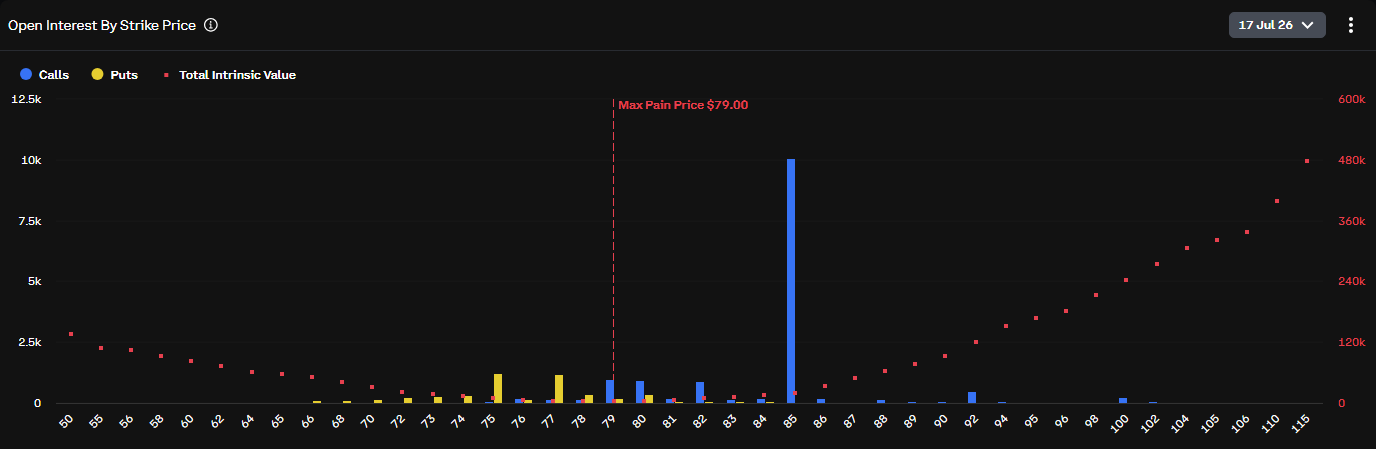
From a technical perspective, short-term price action remains tightly contested. Support levels cited in the report cluster around $73.81, $72.55, and $71.59, while immediate resistance sits near $76.03, $76.98, and $78.24. Bitget analysis referenced in the article suggested that losing the $73.56 area could open a move toward $70, whereas a clean break above resistance could set up a push into the low $80s, with $81–$83 and $93 flagged as potential upside zones.
Medium-term momentum has been more mixed. The report pointed to SOL struggling to sustain a recovery below the $88 resistance area, with profit-taking limiting follow-through. Even so, some institution-oriented outlooks continue to circulate longer-range scenarios in which Solana benefits from tokenized stock trading and RWA rails—arguments that, if realized, could underpin a return toward $250 sometime between 2026 and 2030. Such projections remain speculative and contingent on sustained adoption and favorable market structure.
On-chain signals add nuance to the bullish institutional narrative. Data cited from RSI Hunter and analyst Ali Martinez indicated that the number of Solana ‘whale’ wallets has declined by about 3.6% since May. A reduction in large-holder concentration can be interpreted in different ways—either as distribution that broadens ownership or as large players trimming exposure—but traders often focus on the market-structure implications, including shifts in liquidity distribution and how price reacts around liquidation clusters.
Despite relatively range-bound price action, a recent market briefing highlighted that Solana has reclaimed an important support zone near $77 and that decentralized exchange activity remains lively. For participants tracking chain health, persistent DEX volume is often framed as a sign of durable on-chain liquidity, even when the spot price is consolidating.
Cross-chain risk also resurfaced after Across Protocol temporarily paused Solana deposits amid a security issue tied to bridge infrastructure. According to the report, all in-flight transfers were completed or refunded with no user losses, as the relayer network absorbed the hit. The episode was described as a bridge-specific incident—not a vulnerability in Solana itself—and was cited as evidence that incident response across the sector is maturing, even as cross-chain attack surfaces remain a structural risk.
Retail-driven activity, meanwhile, continues to animate parts of the Solana ecosystem. CryptoRank data referenced in the report showed the Solana-based memecoin ‘Jimothy The Raccoon’ surging 186% after a “Seattle raccoon” meme spread on social media. While memecoin rallies do not typically alter core protocol development, they can amplify network usage, test throughput under bursts of demand, and lift trading activity for Solana-based DEX venues.
Fan tokens and prediction-market activity have also shown sensitivity to real-world events. The report cited a case in which Solana ecosystem fan tokens and related prediction activity spiked following Bukayo Saka being named man of the match in a World Cup game involving England. Analysts said the episode illustrates how quickly sports-driven attention can translate into on-chain flows, reinforcing Solana’s role in fan engagement and event-linked markets.
Overall, Solana is navigating a dual-track environment: a near-term technical battle around the $73–$76 region, and a longer-term story centered on ‘institutional adoption’ and practical usage—from yen stablecoin lending to large-scale event payments. Market participants will be watching whether key support levels hold, while looking for signs that more major financial groups follow SBI Holdings onto Solana in regulated, high-compliance contexts.
🔎 Market Interpretation
- Price holding a key band: SOL is consolidating around $73–$76 with spot near $75.98, reflecting a balance between short-term technical caution and longer-term adoption optimism.
- Institutional validation narrative (Asia-led): SBI Holdings selecting Solana for tokenization initiatives and a yen stablecoin lending product (~3% yield) is being treated as a “regulated-market endorsement,” potentially influencing other institutions evaluating on-chain settlement and tokenized instruments.
- Payments traction as proof-of-utility: Solana’s role in WSOP 2026 processing about $22.89M in crypto buy-ins suggests real-world throughput and consumer payment viability; Solana payments were 2.5% of entries but 5.3% of buy-in value, implying larger average ticket sizes among SOL rails users.
- Mixed medium-term structure: Despite adoption catalysts, SOL reportedly struggled to regain/hold levels below $88 resistance, indicating profit-taking and a still-fragile recovery trend.
- On-chain signals complicate the bull case: A reported 3.6% decline in whale wallets since May can read as either healthier distribution or reduced large-buyer support—important for liquidity and liquidation dynamics.
- Risk contained but present in bridging: Across Protocol’s temporary pause of Solana deposits was described as bridge-infrastructure-specific (no user losses), highlighting improving incident response while keeping cross-chain risk on the radar.
💡 Strategic Points
- Key levels to monitor (tactical):
- Supports: $73.81, $72.55, $71.59 (loss of ~$73.56 flagged as risk for a move toward $70).
- Resistances: $76.03, $76.98, $78.24 (break could target $81–$83 and potentially $93).
- Institutional adoption watchlist (thesis): Track whether SBI’s deployment triggers follow-on participation from other regulated entities for stablecoin settlement, collateral workflows, and tokenized RWAs—the “second-order effect” the market is pricing as optionality.
- Payments as a network stress test: High-volume events like WSOP serve as practical validation for fast finality/low cost claims. Continued event integration can strengthen Solana’s “commerce rail” positioning beyond DeFi.
- Health indicators beyond price: Persistent DEX activity and reclaimed support areas (report mentions ~$77) are framed as durability signals during consolidation; traders may pair this with liquidity/volatility metrics to gauge breakout credibility.
- Positioning around whale trend shifts: If whale-wallet count continues declining, expect heightened sensitivity around liquidation clusters; if distribution is broadening, volatility may compress but rallies could require stronger spot demand.
- Speculation boundary (risk management): Long-range targets like $250 (2026–2030) hinge on successful RWA/tokenized equities rails and favorable market structure—treat as scenario analysis, not baseline.
- Ecosystem volatility catalysts: Memecoin bursts (e.g., “Jimothy The Raccoon” +186%) and sports/fan-token spikes can temporarily lift on-chain volume and fees, but may also introduce short-lived liquidity whipsaws.
📘 Glossary
- Tokenization: Representing real-world or financial assets (e.g., stocks, bonds) as tokens on a blockchain for transfer/settlement.
- Stablecoin: A crypto asset designed to maintain a stable value, typically pegged to a fiat currency (e.g., yen, USD).
- RWA (Real-World Assets): Off-chain assets (treasuries, credit, equities, commodities) brought on-chain as tokenized instruments.
- DeFi (Decentralized Finance): On-chain financial services such as lending, trading, and derivatives without traditional intermediaries.
- DEX (Decentralized Exchange): An on-chain venue for swapping tokens via smart contracts rather than centralized order books.
- RSI (Relative Strength Index): A momentum indicator often used to assess overbought/oversold conditions (the article references an RSI-focused data source).
- Whale wallet: An address holding a large amount of a token; changes in whale counts can affect liquidity and market impact.
- Support/Resistance: Price areas where buying (support) or selling (resistance) historically increases, often shaping short-term trading decisions.
- Bridge / Cross-chain: Infrastructure enabling asset transfers between blockchains; often a higher-risk surface due to complex custody and messaging.
- Relayer network: A set of entities/services that facilitate cross-chain message or transfer execution; can absorb losses in some incident scenarios.









Comment 0