

 News
News  Coin Information
  About us
  Customer Service


 Add as a preferred source on Google

Crypto markets turned cautious on Friday ET as a fresh wave of regulatory filings and institutional positioning data underscored how rapidly the U.S. spot ETF trade is evolving—just as risk appetite softened and derivatives liquidations spiked.
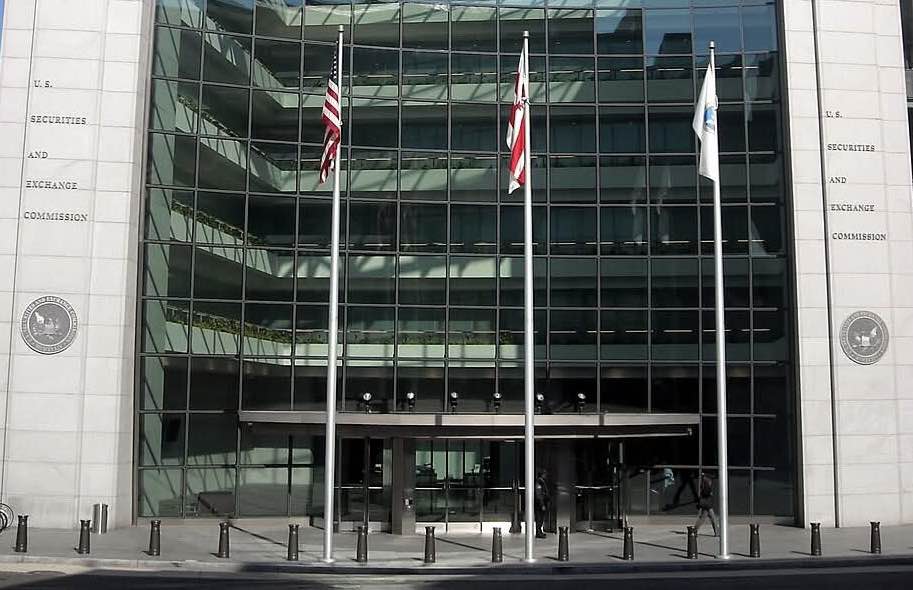
The U.S. Securities and Exchange Commission (SEC) has acknowledged updated filings from VanEck and Grayscale tied to proposed exchange-traded funds tracking BNB (BNB), developments that observers say could signal incremental progress toward a new line of U.S.-listed crypto products beyond Bitcoin (BTC) and Ethereum (ETH). Separately, new 13F filings for the first quarter of 2026 revealed that Abu Dhabi’s sovereign wealth investor Mubadala increased its stake in BlackRock’s iShares Bitcoin Trust (IBIT), while Harvard University’s endowment exited its position in BlackRock’s spot Ethereum ETF and reduced its IBIT exposure.
According to reporting that cited The Block, VanEck submitted its fifth amended registration statement for a BNB ETF on May 15, while Grayscale filed a second amended prospectus for a Grayscale BNB ETF the same day. Bloomberg Intelligence ETF analyst James Seyffart interpreted the synchronized updates as a response to SEC feedback, calling it a sign that issuers are moving closer to launch readiness. He added that BNB could become the next major crypto asset to clear the SEC review process for a U.S. listing, though timing remains uncertain and dependent on the regulator’s ongoing dialogue with applicants.
In a separate filing track, Canary Capital also submitted an amendment related to its proposed Tron (TRX) staking ETF, an approach designed to incorporate ‘staking yield’—rewards earned by locking tokens to help secure a blockchain—inside an SEC-compliant structure. The mechanics and risk disclosures around staking, including slashing and custody considerations, have become a focal point for regulators and product designers as the market pushes for yield-bearing crypto ETFs.
Institutional allocation data added another layer to the narrative. 13F reports for Q1 2026 indicated that Mubadala increased its IBIT holdings to 14,721,917 shares from 12,702,323, valuing the position at roughly $660 million at the reporting date. The Abu Dhabi Investment Authority (ADIA), which operates under the Mubadala umbrella in the report, maintained its IBIT position of 8,218,712 shares, worth about $315.8 million.
Harvard’s endowment disclosed a 3,044,612-share IBIT stake—about $117 million—down roughly 43% from approximately 5.35 million shares at the end of last year. The filing also showed Harvard fully sold a prior position in BlackRock’s spot Ethereum ETF worth about $86.8 million, removing IBIT from its largest reported holdings. The endowment had already cut its IBIT exposure in the prior quarter, suggesting a deliberate de-risking rather than a one-off rebalance.
Other U.S. educational institutions appeared to be rotating rather than retreating. Dartmouth College maintained 201,531 shares of IBIT and shifted exposure within Ethereum products, moving from the Grayscale Ethereum Mini Trust to the Grayscale Ethereum Staking ETF. Dartmouth also initiated a new position in the Bitwise Solana Staking ETF, reporting 304,803 shares. Brown University held steady at 212,500 IBIT shares, while Emory University trimmed IBIT but increased holdings in the Grayscale Bitcoin Mini Trust.
Bank disclosures reflected more nuanced positioning, pairing outright exposure with derivatives overlays. Royal Bank of Canada expanded direct IBIT holdings and related options hedges, while Scotiabank increased IBIT after closing out positions in Bitcoin-linked equities associated with President Trump. Barclays also reported both spot IBIT holdings and options exposure, highlighting how large institutions are increasingly treating Bitcoin ETFs as liquid tools for tactical exposure, hedging, and balance-sheet management.
In Asia, brokerage distribution could broaden retail access if regulations align. Japan’s SBI Securities and Rakuten Securities are exploring the sale of crypto investment trust products, according to Nikkei. SBI Securities plans to offer ETFs and investment trusts developed by its subsidiary SBI Global Asset Management and tied to high-liquidity assets such as Bitcoin and Ethereum. Rakuten Securities, meanwhile, is preparing to develop in-house crypto investment trust products with group affiliates, with distribution expected via its smartphone trading app. Nikkei’s survey of 18 major Japanese securities firms found that 11 are considering similar offerings once a clearer regulatory framework is finalized, with firms including Nomura signaling openness to launching comparable products after rules are clarified.
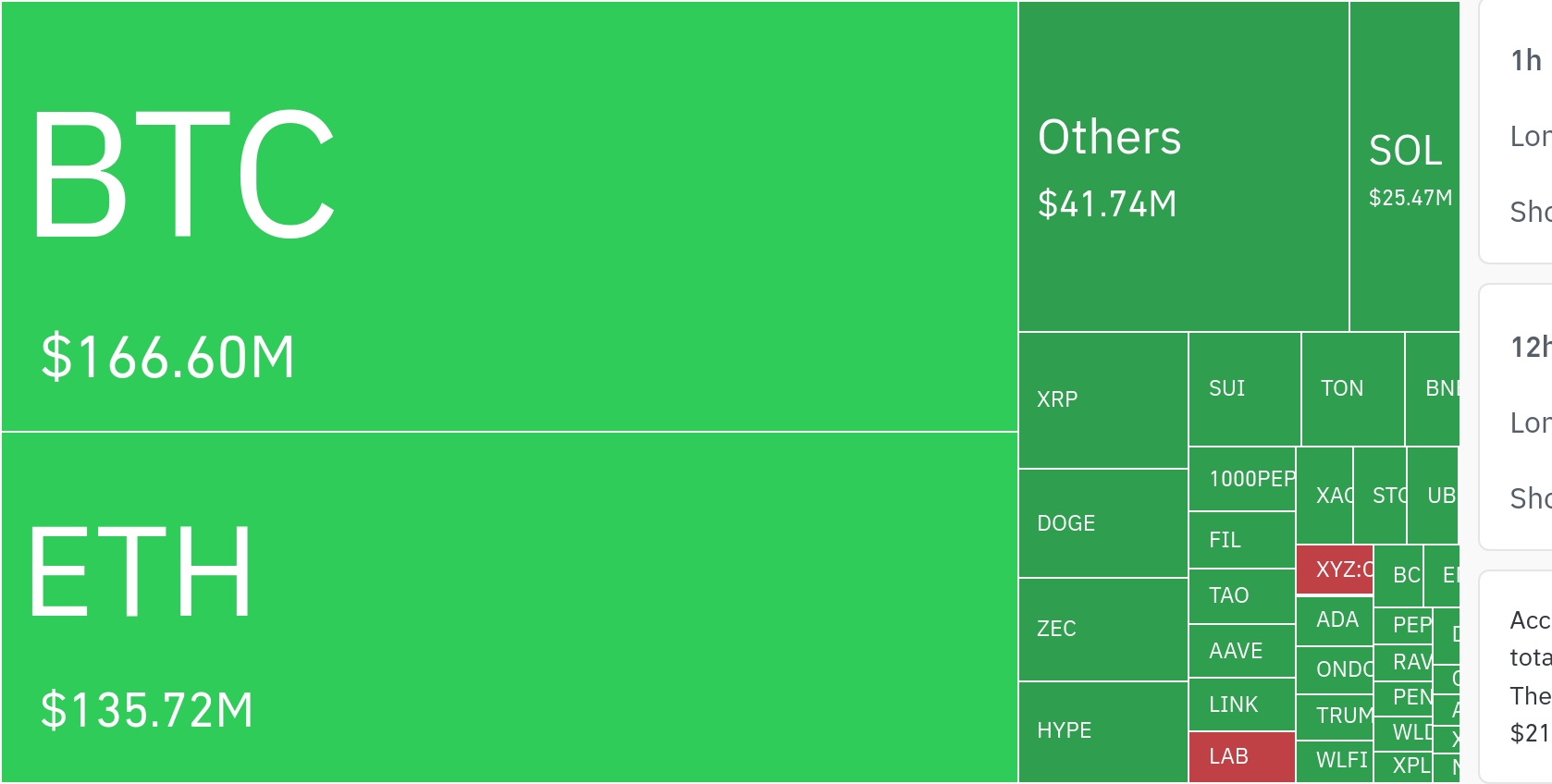
Market conditions, however, were less constructive. CoinAnk data cited by PANews showed $368 million in crypto futures liquidations over the past 24 hours, heavily skewed toward long positions at roughly $345 million, versus about $23.25 million in shorts. Bitcoin liquidations totaled approximately $123 million, while Ethereum saw about $94.74 million. Forced unwinds—triggered when positions fail to meet margin requirements—tend to accelerate volatility, particularly during downside moves.
Bitcoin briefly slipped below $78,000, according to OKX pricing cited by PANews, down about 0.32% intraday. On the derivatives side, on-chain analyst Eugene said a trader on Hyperliquid holding a 114,000 ETH long position swung from about $13 million in unrealized profit to roughly $10 million in losses after building the position in late April around an average entry near $2,268 per ETH.
Large stablecoin flows also drew attention. Whale Alert tracked a transfer of about 138.22 million USDC between an anonymous wallet and Aave, followed by a return transfer of roughly 138.19 million USDC back to an anonymous wallet on Ethereum. While the intent—deposit, borrowing, or strategy execution—was not confirmed, such movements are routinely monitored as potential signals of changing ‘on-chain liquidity’ and leverage behavior.
Regulatory enforcement activity outside the U.S. remained active as well. In China, Ningbo customs authorities disrupted multiple mining-machine smuggling rings and seized more than 400 devices, including models such as Antminer L9 and Glacier KS3, according to reporting that cited Zhejiang Daily. Investigators said the group imported disassembled miners disguised as ordinary goods through Ningbo and Guangzhou ports via international express shipping, then reassembled the equipment for domestic resale or deployment to illegal mining facilities in regions including Xinjiang and Hunan. Authorities also alleged the use of crypto such as USDT for cross-border settlement to avoid traditional financial surveillance.
Tokenized Treasury products continued to scale, reflecting demand for on-chain dollar yield instruments. TokenTerminal data put the total value of tokenized government bonds at around $13.7 billion, led by USYC at $3.0 billion, BlackRock’s BUIDL at $2.7 billion, and IBENJI at $1.5 billion. TokenTerminal argued that tokenized Treasuries are becoming core infrastructure for stablecoin issuers, and projected that by the end of 2030 the stablecoin market could expand roughly tenfold—potentially adding about $2.7 trillion in on-chain dollar supply.
Finally, political expectations are showing up in prediction markets. Odds on Kalshi implying the likelihood of a U.S. ban on a central bank digital currency (CBDC) rose to roughly 75%, according to a post shared by the Bitcoin Historian account. A CBDC ban would limit the federal government’s ability to introduce a state-backed digital dollar—an issue often framed by Bitcoin advocates as a question of privacy, financial surveillance, and competition between public and private digital money.
Across these threads—ETF filings, institutional reallocations, leverage flushes, and the growth of tokenized cash-like instruments—the common theme is market maturation. The next phase, traders say, will hinge less on whether crypto can attract capital and more on how quickly regulatory pathways and product structures can keep up with demand for ‘liquid, compliant exposure’ to an expanding set of digital assets.
🔎 Market Interpretation
- Regulatory product pipeline is widening: The SEC’s acknowledgment of amended BNB ETF filings (VanEck, Grayscale) suggests iterative progress via regulator feedback cycles—potentially positioning BNB as a next-in-line U.S. spot-style product beyond BTC/ETH.
- Institutions are diverging, not moving in unison: Mubadala increased IBIT exposure while Harvard reduced IBIT and fully exited a spot ETH ETF—signaling mixed risk budgets and different mandates rather than a single “institutional trend.”
- Yield is the new design battleground: Proposed staking-based ETF structures (e.g., TRX staking ETF amendment) highlight the market’s push to package on-chain yield in compliant wrappers, where disclosure, custody, and slashing risk are central constraints.
- Risk-off tape clashed with bullish product headlines: Despite ETF momentum, derivatives liquidations ($368M, mostly longs) and BTC dipping below $78K reflect fragile positioning and leverage sensitivity.
- Liquidity signals are increasingly on-chain: Large USDC movements involving Aave were watched as potential leverage/liquidity repositioning—illustrating how DeFi flows now inform macro crypto sentiment.
- Tokenized Treasuries are becoming “crypto’s cash layer”: With ~$13.7B in tokenized government bonds, on-chain T-bill yield products are scaling as core infrastructure for stablecoins and collateral systems.
- Global regulatory and political vectors remain material: China’s enforcement against mining-machine smuggling and prediction-market odds of a U.S. CBDC ban show policy risk/opportunity continues to shape capital flows and narratives.
💡 Strategic Points
- Expect an “amendment cadence” playbook: Multiple synchronized ETF amendments often indicate active SEC dialogue; traders should watch for filing frequency, language changes (custody, valuation, surveillance-sharing), and comment-response patterns as leading indicators.
- BNB/alt ETF optionality is rising—but timing risk is high: Treat BNB ETF progress as a probability-weighted catalyst rather than a dated event; delays can be meaningful if the SEC focuses on market integrity, offshore venue concentration, or issuer disclosures.
- Staking ETFs introduce new risk premia: Products that embed staking yield must price operational risks (slashing, validator performance, lockups), legal uncertainties (what counts as “yield” vs. “security-like distribution”), and custody complexity.
- Institutional 13F reads require nuance: 13F data is backward-looking and can reflect hedged books; combine it with options disclosures and ETF flow data to infer net directional conviction.
- Leverage flush is a volatility accelerant: Liquidation skews toward longs suggest crowded bullish positioning; in similar setups, downside can overshoot before mean reversion once forced sellers exhaust.
- Use ETF + options as a “tactical sleeve” signal: Banks reporting both spot IBIT and options overlays indicates growing use of ETFs for hedging, inventory management, and short-term exposures—less “buy-and-hold,” more balance-sheet tooling.
- Track tokenized T-bills as systemic collateral: Growth in BUIDL/USYC-like instruments can tighten crypto credit spreads (better collateral) but may also link crypto liquidity conditions more directly to U.S. rates.
- Watch Japan distribution channels: If SBI/Rakuten and peers gain regulatory clarity, retail distribution via broker apps could become a structural demand driver for compliant crypto-linked products in Asia.
- Policy tails: CBDC-ban expectations can benefit private rails: Higher odds of a CBDC ban may strengthen narratives around stablecoins and tokenized cash products as the default “digital dollar” pathway.
📘 Glossary
- SEC acknowledgment: Confirmation the SEC has received a filing; not an approval, but often the start/continuation of formal review.
- Spot ETF: An exchange-traded fund intended to hold the underlying asset (e.g., bitcoin) rather than only futures contracts.
- 13F filing: Quarterly U.S. disclosure of certain institutional investment holdings; reported with a time lag and may not show hedges fully.
- IBIT: BlackRock’s iShares Bitcoin Trust, a U.S.-listed spot Bitcoin ETF.
- Prospectus / registration statement amendments: Updated disclosures to address regulator comments, structural changes, or risk language.
- Staking / staking yield: Earning rewards by locking tokens to help secure a proof-of-stake network; yields can vary and may involve lockups and penalties.
- Slashing: A penalty mechanism in proof-of-stake networks where misbehavior or operational failure can cause loss of staked assets.
- Derivatives liquidation: Forced closure of leveraged positions when margin is insufficient, often amplifying price moves.
- Options hedge / overlay: Using options to manage downside risk or adjust exposure while holding the underlying ETF/asset.
- On-chain liquidity: The availability and movement of funds within blockchain-based venues (DEXs, lending protocols, bridges), often used to infer leverage and risk appetite.
- Aave: A major DeFi lending/borrowing protocol where large stablecoin deposits/withdrawals can reflect leverage and collateral shifts.
- Tokenized Treasuries: Blockchain tokens representing claims on U.S. government bond exposure, often used for on-chain yield and collateral.
- Stablecoin: A cryptocurrency designed to maintain a stable value (typically pegged to USD), widely used for trading and settlement.
- CBDC: Central bank digital currency; a government-issued digital form of national currency.
- Prediction market odds (Kalshi): Market-implied probabilities derived from trading on future outcomes/policies.




















Comment 0