

 News
News  Coin Information
  About us
  Customer Service


 Add as a preferred source on Google
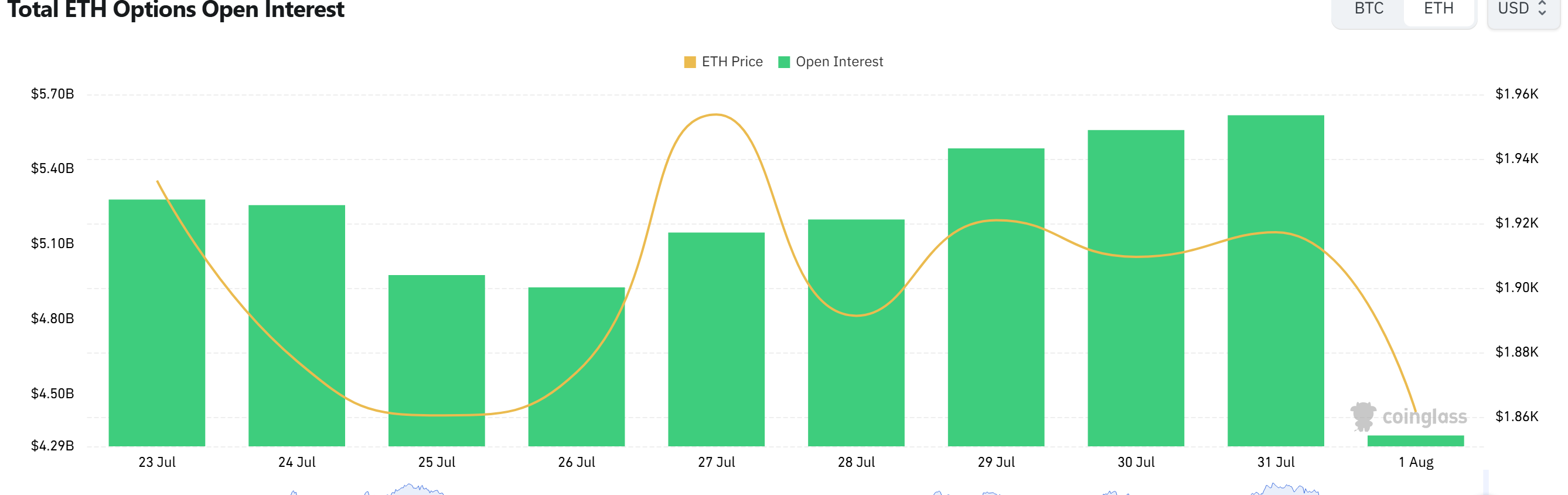
Ethereum (ETH) options positioning tilted modestly bullish even as overall exposure shrank, suggesting traders are reducing risk while keeping upside bets in place. Call options continued to dominate open interest, and near-dated flow leaned slightly toward calls—an indication of cautious optimism rather than an outright risk-on stance.
As of Friday 1 August at 00:50 UTC, data compiled by CoinGlass showed total Ethereum options open interest (OI) at $4.168 billion, down 23% from $5.436 billion a day earlier. Options trading volume over the period was about $829.95 million, underscoring active short-term repositioning despite the decline in outstanding contracts.
The OI mix remained skewed toward calls, with call options accounting for 61.43% versus 38.57% for puts. By contrast, the 24-hour volume split was nearly even—50.35% calls and 49.65% puts—signaling that while longer-dated positioning still favors an upside scenario, traders are also actively transacting downside protection and volatility hedges in the short term.
Market participants often read this combination—call-heavy OI with a near-balanced volume profile—as a sign that ‘medium-term upside targeting’ persists, but ‘near-term caution’ has not disappeared. A drop in aggregate OI typically points to position closures, reduced leverage, or profit-taking, rather than fresh conviction entering the market.
By concentration of outstanding contracts, the largest OI clusters were in Deribit’s 25 December expiries, led by the $3,200 call, followed by the $2,200 call. The next most crowded contract was Deribit’s 7 August $2,000 call, indicating traders remain focused on round-number strikes across both short-dated and year-end time horizons.
In terms of trading activity over the last 24 hours, Bybit’s 1 August expiries dominated: the $1,925 call recorded the highest volume, followed by the $1,900 call and the $1,950 call. The grouping around these strikes points to heavy engagement near spot-adjacent levels, consistent with short-term traders leaning into upside exposure while simultaneously keeping hedges close at hand.
Options are derivatives that can be used either to express leveraged views on price direction or to hedge existing holdings. Calls generally reflect bullish positioning, while puts are typically associated with downside expectations or protective strategies. With Ethereum’s options market showing shrinking OI but persistent call dominance, the latest data suggests a market that is de-risking—yet still reluctant to abandon its ‘upside bias’ entirely.
🔎 Market Interpretation
- Positioning remains mildly bullish, but risk is coming off: Ethereum options open interest fell to $4.168B (down 23% day-over-day), implying traders are closing/downsizing positions rather than adding fresh leverage.
- Structural upside bias persists: Calls continue to dominate outstanding positioning with a 61.43% call vs 38.57% put OI split—suggesting medium-term participants are still skewed toward upside scenarios.
- Near-term caution shows up in flow: 24h volume is nearly balanced (50.35% calls vs 49.65% puts), consistent with traders actively buying protection/hedges even while maintaining call-heavy longer-dated exposure.
- Active repositioning despite lower OI: Options volume of roughly $829.95M indicates meaningful short-term trading activity—likely rolling expiries, trimming risk, and re-hedging rather than a quiet market.
- Strike clustering highlights key reference levels: Crowding in round-number strikes (e.g., $2,000, $2,200, $3,200) suggests traders are anchoring strategies around psychologically important price points and liquidity-rich strikes.
💡 Strategic Points
- Interpretation of “calls-heavy OI + balanced volume”: The market appears to be maintaining upside structures (calls held) while using short-dated trades (puts/hedges) to manage near-term uncertainty.
- Deleveraging signal from falling OI: A sharp OI decline often reflects profit-taking, reduced leverage, and/or position closures—generally a more defensive posture than aggressive risk-on accumulation.
- Watch the most crowded expiries for “pin”/gamma effects:
- Deribit Dec 25 concentration led by the $3,200 call and $2,200 call can matter for year-end positioning and dealer hedging flows.
- Deribit Aug 7 $2,000 call highlights a near-term focal point where price sensitivity may increase as expiry approaches.
- Near-expiry Bybit activity suggests spot-adjacent trading: Heavy volume in Aug 1 calls at $1,900–$1,950 (top: $1,925 call) points to short-term traders targeting small upside moves while keeping hedges close.
- Practical read for traders/investors:
- If call dominance holds while OI stabilizes or rises, it may indicate renewed conviction in upside.
- If put volume grows and call OI declines further, it may indicate increasing hedging demand and a shift toward defensive positioning.
- Round-number strikes (e.g., $2,000) may act as short-term liquidity magnets into expiries due to concentrated positioning.
📘 Glossary
- Options Open Interest (OI): The total number (or notional value) of outstanding option contracts that remain open; rising OI often suggests new positions being added, while falling OI suggests closing/downsizing.
- Call Option: A derivative contract giving the buyer the right (not obligation) to buy the underlying asset at a set price (strike) by a certain date; typically used to express or hedge upside.
- Put Option: A contract giving the buyer the right to sell the underlying at a set strike by a certain date; often used for downside protection or bearish views.
- Volume (Options Volume): The value or number of contracts traded over a period (here, 24h); indicates activity/turnover rather than outstanding exposure.
- Expiry (Expiration Date): The date when an option contract ceases to exist; positioning can become more price-sensitive as expiry approaches.
- Strike Price: The price at which the option can be exercised (bought/sold); round-number strikes often attract liquidity and heavy positioning.
- Deribit / Bybit: Crypto derivatives exchanges where options are listed and traded; different venues can show different flow/positioning patterns.
- Hedge: A position intended to offset risk (e.g., buying puts to protect spot ETH holdings) rather than purely to speculate.


















Comment 0