

 News
News  Coin Information
  About us
  Customer Service


 Add as a preferred source on Google
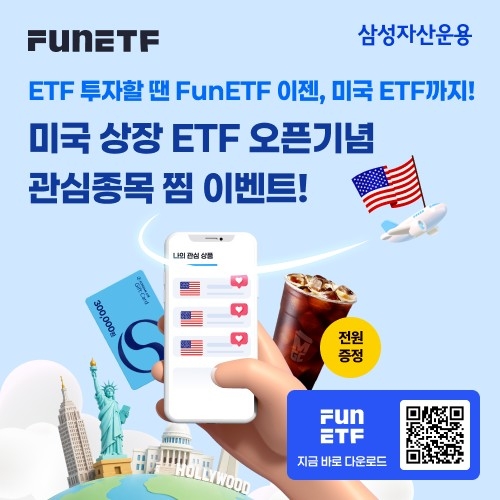
Samsung Asset Management said it has expanded U.S. exchange-traded fund (ETF) search and comparison tools on its proprietary platform, FunETF, aiming to improve information access for Korean investors increasingly allocating capital overseas.
The company said Monday ET (July 27) that a service overhaul now allows users to view detailed data on roughly 1,140 ETFs listed in Korea alongside more than 5,500 U.S.-listed ETFs in a single interface. ETFs are funds designed to track indices, sectors, or asset-price movements and trade like stocks—an investment structure that has seen rapid adoption among retail investors seeking exposure to international markets.
The centerpiece of the update is a strengthened comparison function. Investors can place up to five ETFs on one screen, including products listed in both Korea and the U.S., and compare key metrics such as management approach, fees, portfolio holdings, and performance history. The tool targets a common pain point for cross-border ETF buyers: products tracking the same benchmark can still diverge meaningfully due to differences in replication methods, costs, rebalancing policies, and underlying composition.
FunETF also added a U.S. ETF ‘theme’ service that provides daily market updates and highlights popular themes that drew attention in the prior New York trading session. The company positioned the feature as a way to help investors monitor issues—such as the U.S. rate path, artificial intelligence, semiconductors, and big tech—that increasingly shape decision-making for Korean retail flows into overseas markets.
Samsung Asset Management said the expansion reflects rising demand for global ETF information and analysis. The move also underscores a broader shift in South Korea’s asset management industry, where competition is extending beyond product launches into ‘information infrastructure’—including screening, comparison, and analytics—designed to capture and retain self-directed investors navigating a growing menu of international ETF options.
With cross-border investing becoming more mainstream, enhanced data and comparison tools are likely to intensify competition among platforms offering overseas investment information, while raising the baseline for how investors evaluate fees, exposures, and risk profiles before selecting ETFs.
🔎 Market Interpretation
- Samsung Asset Management is competing on “information infrastructure,” not just products: By expanding FunETF’s screening and comparison capabilities, the firm is aiming to become the default research hub for Korean investors buying overseas ETFs.
- Retail-led globalization of portfolios is accelerating: The upgrade targets a clear behavioral shift—more Korean self-directed investors allocating to U.S. markets and needing localized, consolidated data.
- Platform differentiation is moving toward analytics and usability: A single interface for ~1,140 Korea-listed and 5,500+ U.S.-listed ETFs raises expectations for competitors and may intensify the “platform war” for investor attention and retention.
- Comparability reduces friction and can reshape flows: Easier side-by-side comparisons can increase switching between similar ETFs and push more fee- and exposure-sensitive allocation decisions.
- Theme-based market updates reinforce “narrative investing”: Daily U.S. theme highlights (AI, semiconductors, big tech, rate path) align with how many retail investors discover and track ETF ideas, potentially magnifying thematic flow cycles.
💡 Strategic Points
- Use the 5-ETF comparison to check true differences behind the same benchmark: Even if two ETFs track the same index, outcomes can diverge due to replication method, rebalancing, holdings mix, securities lending, and fee drag.
- Prioritize “total cost,” not just headline expense ratio: Compare fees alongside tracking difference, spreads/liquidity, and turnover-related costs to understand what investors actually pay over time.
- Validate holdings overlap and concentration risk: For themes like AI/semis/big tech, holdings can be highly concentrated—confirm top positions and sector weights rather than relying on the label.
- Cross-listing choices require an extra checklist: When picking Korea-listed vs U.S.-listed ETFs, investors should consider currency exposure (KRW/USD), trading hours, liquidity, tax treatment, and hedged vs unhedged share classes (where available).
- Theme updates are a starting signal, not a thesis: Use daily “popular themes” to identify what moved markets, then confirm valuation, earnings sensitivity, and macro drivers (e.g., rate expectations) before entering trades.
- Expect rising platform standards: Better tools may normalize more disciplined ETF selection (fees, exposures, risk profile), pressuring platforms to expand data depth, education, and portfolio analytics.
📘 Glossary
- ETF (Exchange-Traded Fund): A fund that trades on an exchange like a stock and typically aims to track an index, sector, or strategy.
- Benchmark / Index: The reference index an ETF seeks to track (e.g., S&P 500, Nasdaq-100, sector indices).
- Replication Method: How an ETF tracks its benchmark—full replication (buying most/all constituents), sampling (holding a subset), or synthetic (using derivatives/swaps) depending on market and rules.
- Expense Ratio / Management Fee: Annual operating cost charged by the ETF, expressed as a percentage of assets.
- Tracking Difference: The performance gap between the ETF and its benchmark over time, influenced by fees, trading costs, and portfolio construction.
- Rebalancing Policy: The schedule/rules for adjusting index or ETF holdings to match target weights; different rebalance frequencies can change exposures.
- Holdings / Portfolio Composition: The securities inside the ETF; determines actual exposures, concentration, and risk.
- Thematic ETF: An ETF built around a market narrative (e.g., AI, semiconductors); may carry higher concentration and factor risks than broad-market funds.
- Liquidity / Bid-Ask Spread: How easily an ETF trades without price slippage; tighter spreads generally reduce transaction costs.
- Currency Exposure (FX Risk): Performance impact from exchange-rate movements (KRW vs USD) when investing in overseas assets.


















Comment 0