

 News
News  Coin Information
  About us
  Customer Service


 Add as a preferred source on Google

XRP (XRP) traded near a pivotal technical level on Thursday UTC as investors weighed short-term price pressure against a string of regulatory and product developments around Ripple’s payments business in Europe and enterprise markets.
According to CoinMarketCap data, XRP was changing hands at $1.0887 as of 4:41 p.m. UTC on July 24, down 1.86% over 24 hours. Despite the daily pullback, the token remained slightly higher on the week (+0.41%) and up 2.55% over the past 30 days, underscoring a market that is stabilizing in the near term even as longer-horizon holders remain under pressure.
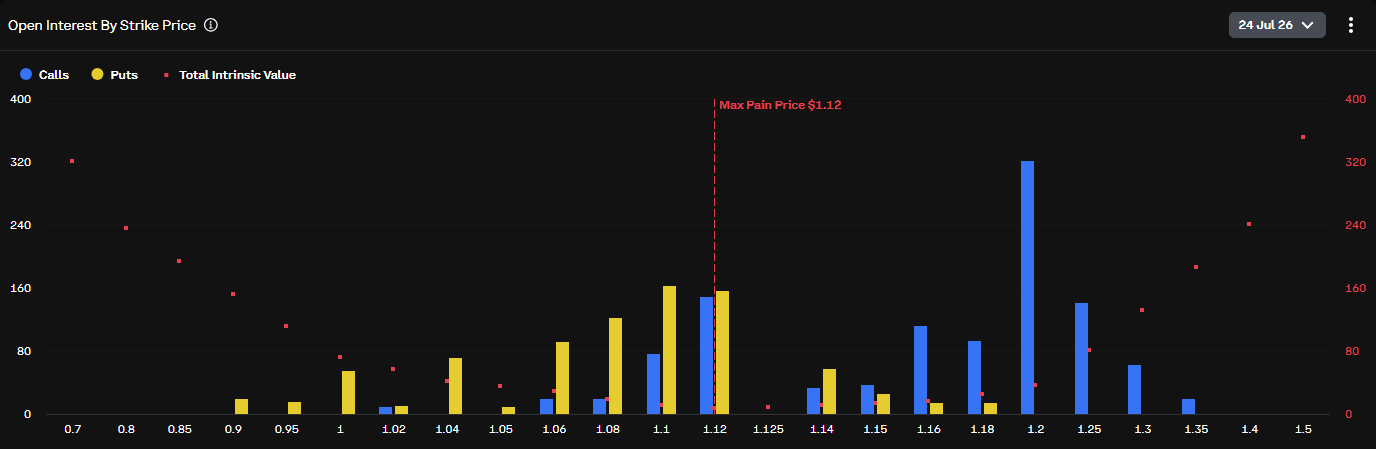
Technical analysts continue to frame $1.10 as the immediate battleground. FXLeaders identified a resistance zone spanning roughly $1.10 to $1.14, arguing that a weekly close above that band could open a path toward $1.20. Coinpedia similarly highlighted $1.10 as key support and flagged $1.22 as a potential upside target. At the same time, XRP’s 60-day and 90-day returns were still sharply negative at –19.84% and –23.53%, respectively—figures that typically translate into overhead supply as underwater investors sell into rallies.
Markets are also digesting Ripple’s push to deepen its compliance and enterprise rails. SpendNode reported that Ripple made a strategic investment in Notabene, a fintech focused on ‘travel rule’ compliance requirements for virtual asset transfers. The investment amount was not disclosed. Notabene provides tooling used by exchanges, banks, and payments companies to comply with standards linked to the Financial Action Task Force (FATF), including originator-and-beneficiary information sharing for certain crypto transactions.
Ripple’s rationale, according to the report, is tied to integrating its U.S. dollar-pegged stablecoin RLUSD into Notabene’s enterprise transaction network—an approach that signals focus on ‘regulated distribution’ and corporate settlement use cases rather than changes to the XRP Ledger’s core code. Industry observers view the move as a bid to make RLUSD more palatable to institutions by embedding compliance features close to the flow of funds, while also strengthening Ripple’s posture with regulators and counterparties.
On the regulatory front, Ripple is also being linked to a significant milestone in Europe. CoinStats AI reported that Ripple obtained a full CASP (crypto-asset service provider) authorization under the EU’s MiCA framework from Luxembourg’s financial regulator, the CSSF. If confirmed, the authorization would effectively grant Ripple ‘passporting’ rights across the European Economic Area, allowing services to be offered across 27 EEA jurisdictions without applying for separate national licenses.
MiCA, the European Union’s sweeping digital asset rulebook that fully took effect at the end of 2024, has become a central gatekeeper for global crypto firms seeking legal and scalable access to the EU market. Market participants generally interpret a MiCA-aligned authorization as more than a procedural step: it can clarify compliance expectations for banks and corporates that might otherwise hesitate to adopt crypto-based settlement tools.
Adding to the narrative of institutional traction, TheStreet reported that XRP exchange-traded funds have recorded more than $200 million in net inflows so far in 2026. The figure, however, could not be independently verified from primary fund filings in the source material and should be treated as an indicative datapoint rather than a definitive tally. Still, even the discussion of sustained inflows reflects a broader theme: investors are increasingly looking beyond Bitcoin (BTC) and Ethereum (ETH) for regulated exposure as product menus expand.
TheStreet also pointed to XRP Ledger activity that suggests the network is moving past a payments-only identity. The report said ‘agentic transactions’—on-chain actions executed autonomously by AI agents—surpassed 1 million, and that an XRPL lending protocol was officially launched this month. While definitions and measurement methodologies vary across platforms, the broader implication is that XRPL is attracting experimentation in DeFi and AI-integrated transaction automation, areas that can deepen network utility if adoption proves durable.
For traders, the immediate focus remains the $1.10 level. A failure to hold that support could bring the $1.00–$1.06 region into view, particularly given the weight of recent multi-month drawdowns that can amplify selling into any bounce. For longer-horizon investors, the opposing forces are clear: short-term technical fragility on one side, and a list of ecosystem catalysts—European regulatory access, enterprise-oriented compliance integrations for RLUSD, ETF-driven narratives around institutional participation, and expanding on-chain use cases—on the other.
How XRP’s next phase unfolds may hinge on whether Ripple can translate regulatory permissions and compliance-first integrations into measurable enterprise payment volume, while XRPL’s emerging DeFi and AI-driven activity matures beyond early experimentation. For now, the market is left navigating a familiar tension between near-term price structure and longer-term fundamentals.
















Comment 0