

 News
News  Coin Information
  About us
  Customer Service


 Add as a preferred source on Google
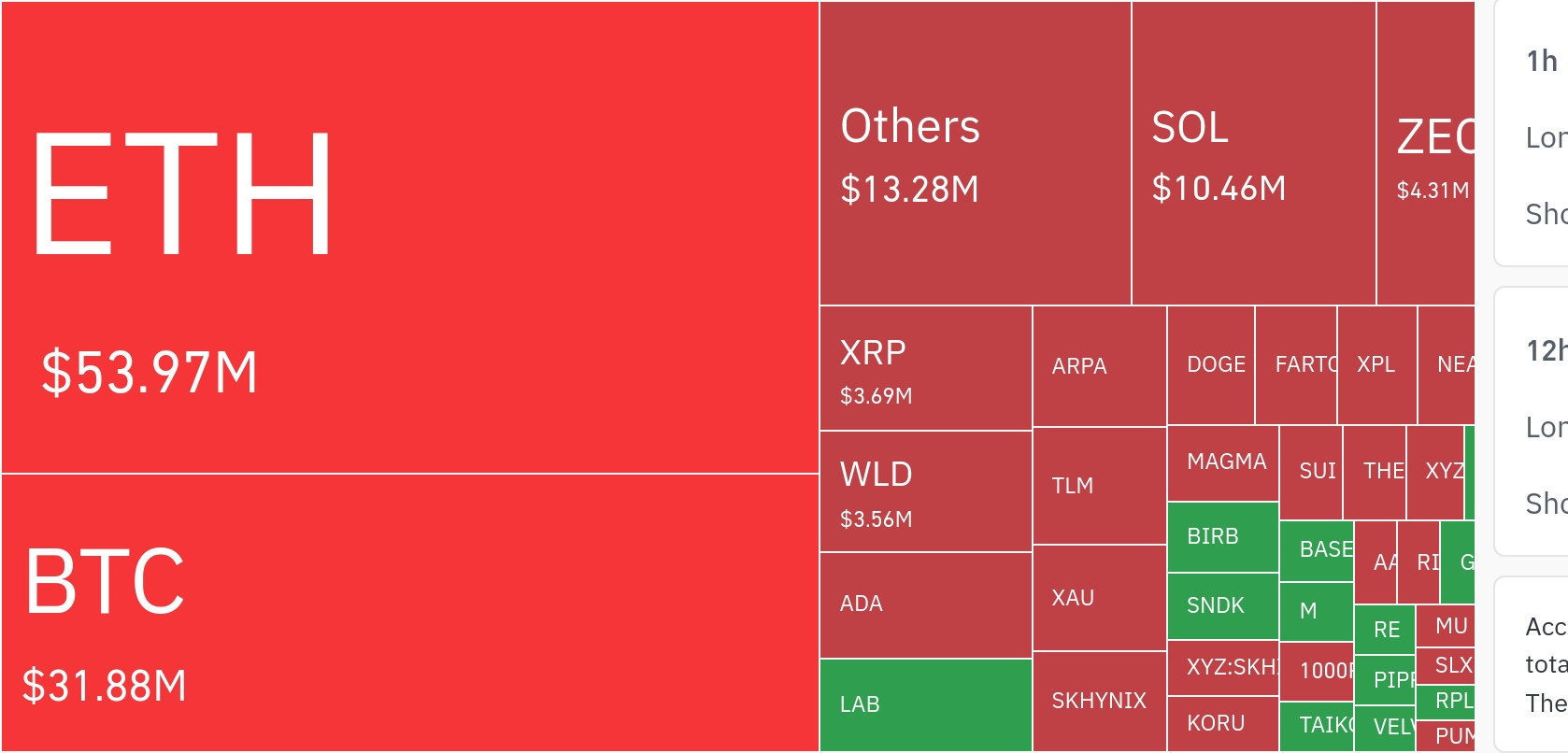
Roughly $326.71 million in leveraged crypto positions were liquidated over the past 24 hours, underscoring a fresh spike in volatility as price swings forced traders out of crowded bets.
Data aggregated by CoinGlass shows liquidations were heavily skewed toward long exposure. About $285.87 million—around 87.5% of the total—came from long positions, while short liquidations totaled roughly $40.84 million, or 12.5%.
In the most recent four-hour window, Binance led liquidation activity with approximately $105.01 million, accounting for 51.7% of the total during that period. Notably, Binance’s liquidations were dominated by shorts at about $102.65 million, representing 84.26% of the exchange’s total. Gate posted the second-largest figure at around $3.67 million (12.65%), with short liquidations making up 94.8%, while Bybit recorded roughly $3.52 million (12.13%) with shorts comprising 91.07%. HTX stood out as an outlier, where long liquidations accounted for 82.19% of the exchange’s total—suggesting a different positioning mix or a sharper move against bullish leverage on that venue.
By asset, Ethereum (ETH) saw the largest wipeout in leveraged positioning, with about $503.97 million in liquidations over 24 hours, followed by Bitcoin (BTC) at roughly $318.88 million. Solana (SOL) also registered significant liquidations at about $146.10 million, while smaller totals were reported for Zcash (ZEC) at approximately $4.31 million and XRP (XRP) at around $3.69 million.
In crypto derivatives markets, a 'liquidation' occurs when a leveraged trader can no longer meet margin requirements, prompting an exchange to forcibly close the position. Clusters of liquidations can accelerate price moves as forced selling or buying cascades through order books, often amplifying short-term volatility and reshaping market positioning.
The distribution of liquidations across major venues—particularly the concentration of short liquidations on Binance, Gate, and Bybit in the latest window—suggests that parts of the market were caught leaning the wrong way as prices moved against bearish bets. With the largest liquidation totals centered on ETH and BTC, the episode points to heightened sensitivity in benchmark assets that typically set the tone for broader risk appetite across the digital-asset complex.
While liquidation data does not, by itself, reveal the precise catalysts behind the move, the scale and concentration indicate that leverage remains elevated and that abrupt price swings continue to test market depth. The latest flush may reduce near-term 'overcrowded positioning', but it also highlights how quickly risk can propagate through the derivatives layer when volatility picks up.
🔎 Market Interpretation
- Volatility spike triggered broad deleveraging: Roughly $326.71M in leveraged positions were liquidated in 24 hours, reflecting sharp, fast price swings that forced margin breaches.
- Macro tilt was long-heavy, but the latest impulse punished shorts: Over 24 hours, liquidations were 87.5% longs ($285.87M) vs 12.5% shorts ($40.84M), indicating the broader market was positioned bullish. However, in the most recent 4-hour window, several major venues saw short-dominant liquidations—suggesting a near-term upward move or squeeze that caught bearish leverage offside.
- Exchange-specific positioning divergence: Binance led the latest liquidation burst (~$105.01M in 4 hours), with an unusually high share of short liquidations (~84.26%). Gate and Bybit also showed short-heavy liquidations, while HTX was an outlier with long liquidations ~82.19%, implying different client positioning or a venue-specific move in instrument pricing/liquidity.
- Benchmark assets drove the shock: Liquidations concentrated in majors—especially ETH and BTC—signaling that risk sentiment and derivative leverage were most stressed where market beta and participation are highest.
- Deleveraging can reset positioning but raises fragility concerns: A liquidation “flush” can reduce overcrowded trades, yet the concentration shows how quickly risk can cascade through derivatives when liquidity thins and volatility increases.
💡 Strategic Points
- Monitor liquidation mix to infer near-term bias shifts: A long-heavy 24H wipeout suggests prior bullish overcrowding, while short-heavy bursts (as seen on Binance/Gate/Bybit in the latest window) can indicate squeeze dynamics and momentum continuation risk.
- ETH/BTC liquidations are systemically important: Because these assets often anchor collateral, pricing, and sentiment, large liquidations in ETH/BTC can spill over into altcoins via risk-off de-grossing and reduced margin capacity.
- Exchange dispersion is a signal, not noise: Divergent liquidation composition (e.g., HTX long-heavy vs others short-heavy) may reflect differences in user base, contract liquidity, or funding/mark pricing—useful for identifying where positioning is most vulnerable.
- Risk management implication for traders: Elevated liquidation totals typically coincide with widening spreads and faster wicks; reducing leverage, using hard stops, and sizing for volatility can lower forced-exit risk during cascade conditions.
- Watch for post-flush behavior: After a large liquidation event, markets often experience (a) a short-lived volatility comedown, or (b) continuation if new leverage quickly re-enters—track open interest, funding, and subsequent liquidation waves for confirmation.
📘 Glossary
- Liquidation: Forced closure of a leveraged position when margin requirements are no longer met.
- Leverage: Borrowed exposure that amplifies gains and losses; higher leverage reduces the price move needed to trigger liquidation.
- Long / Short: Long positions profit if price rises; short positions profit if price falls.
- Margin: Collateral posted to support a leveraged trade; when it becomes insufficient due to losses, liquidation risk rises.
- Liquidation cascade: A chain reaction where forced buying/selling from liquidations pushes price further, triggering more liquidations.
- Order book depth: The volume of buy/sell orders available near the current price; shallow depth can worsen slippage during cascades.
- Positioning / Overcrowded positioning: When many traders share the same directional bet (e.g., heavily long), increasing vulnerability to sharp reversals.
- Derivatives (perpetuals/futures): Contracts that provide leveraged exposure without holding the underlying spot asset.






















Comment 0