

 News
News  Coin Information
  About us
  Customer Service


 Add as a preferred source on Google
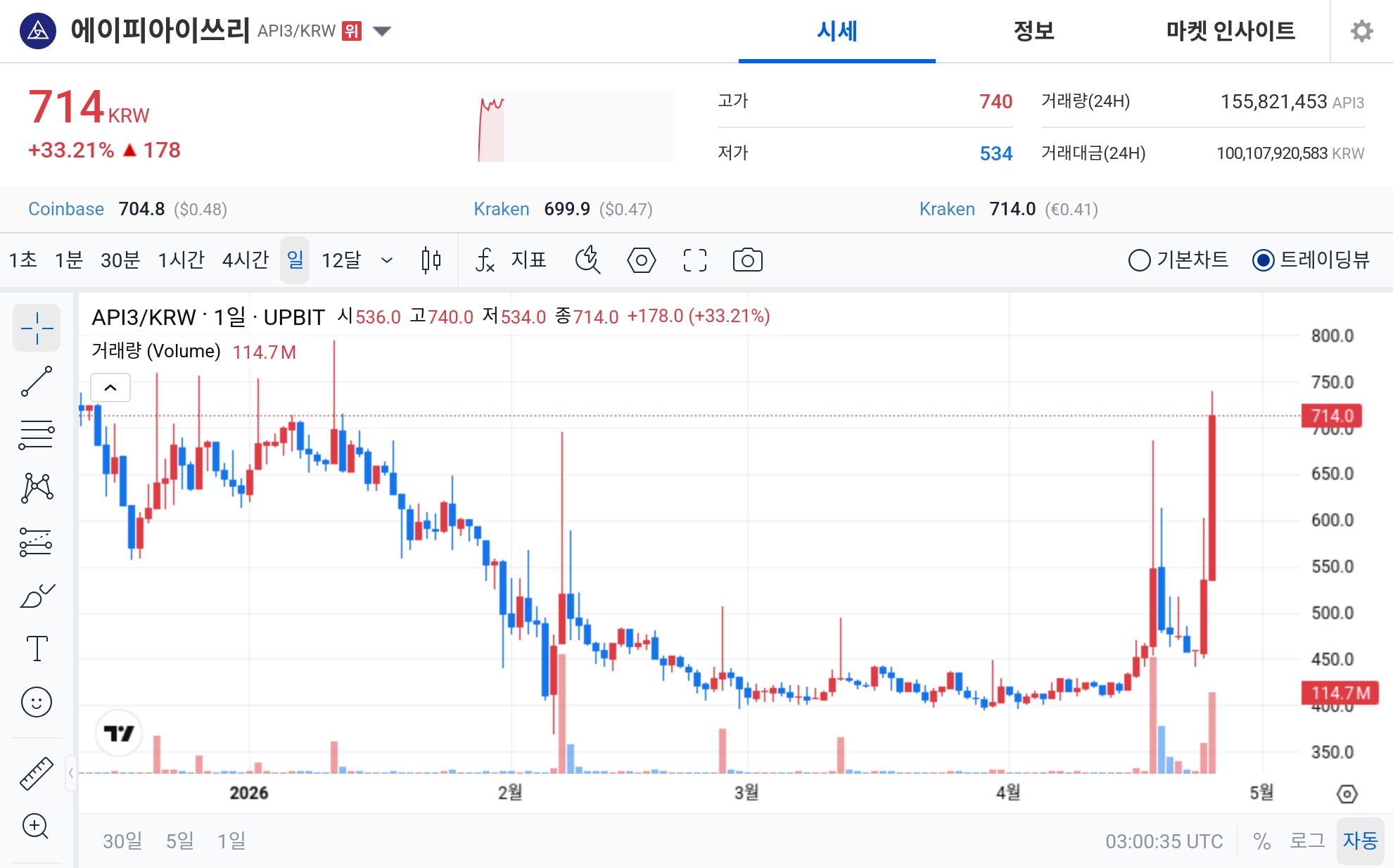
API3 (API3) surged more than 33% over the past day in Korea’s won-denominated market, climbing on sharply higher volume—a combination that signaled more than a routine technical bounce and pushed the token into the spotlight among short-term traders.
As of Saturday UTC (April 25), API3 was changing hands around 714 won, up 33.21% (+178 won) from the prior session. The token opened near 536 won, briefly dipped to an intraday low of 534 won, then rebounded aggressively and spiked to a high of 740 won before consolidating. It ultimately held much of the move into the close near 714 won, suggesting persistent bids rather than a short-lived spike.
Turnover reinforced the strength of the move. The 24-hour traded value totaled roughly 100.1 billion won, while daily volume came in around 114.7 million tokens—levels that typically indicate a broad influx of liquidity rather than isolated buying. Market participants often view such a price-and-volume pairing as evidence of stronger conviction, though it can also precede heightened volatility as leveraged and momentum positioning builds.
Sentiment indicators on Upbit also reflected a rapid shift toward risk-on behavior. API3 ranked at the top of the exchange’s Fear & Greed list with a score of 99, placing it in the ‘extreme greed’ zone and underscoring potentially overheated short-term positioning. Other high-ranking names on the greed side included Zerobase (ZBT), Blur (BLUR), Bio Protocol (BIO), and Axelar (AXL). On the opposite end, tokens such as Sign (SIGN), Drift (DRIFT), Lombard (BARD), Enso (ENSO), and LayerZero (ZRO) were grouped among the most ‘fearful’—highlighting a market where appetite is concentrated in a handful of momentum leaders while other assets lag.
In the broader high-turnover leaderboard at the same time, performance was mixed. Katichain (KAT) slipped about 5.95% to 34.8 won and Syrup (SKR) fell roughly 7.59% to 26.8 won. Bitcoin (BTC) was marginally higher, up 0.15% to about 115.636 million won. Spark (SPK) declined about 5.20% to 62 won. Against that backdrop, API3 stood out as one of the strongest gainers among the top traded names, rising more than 32% around the 708–714 won range.
API3 is best known as a decentralized oracle project designed to help blockchain applications pull reliable external data into smart contracts. Unlike many traditional oracle models that rely on intermediaries, API3 emphasizes a ‘first-party oracle’ approach, where data providers connect directly to the chain—an architecture intended to reduce inefficiencies and improve transparency. The API3 token is used for network operations, governance, and broader ecosystem participation.
With API3 breaking into the top tier of traded value while sentiment indicators flash ‘extreme greed,’ the rally places the token among the day’s market leaders. The next key question for traders will be whether fresh liquidity continues to follow through—or whether the rapid run-up invites profit-taking and a volatility reset across thinner altcoin books.
🔎 Market Interpretation
- Sharp won-market breakout: API3 rallied +33% in 24 hours on Korea’s KRW market, moving from the ~536 won open to as high as 740 won before consolidating near 714 won, suggesting sustained spot demand rather than a single wick spike.
- Volume confirms participation: Approximately 100.1B won in traded value and 114.7M tokens in 24h points to broad liquidity inflow (more than isolated buys), which often strengthens the credibility of the move while also increasing the odds of fast reversals.
- Sentiment overheating risk: Upbit’s Fear & Greed score hit 99 (“extreme greed”), signaling crowded momentum positioning and elevated short-term pullback risk if bids fade.
- Relative strength vs peers: While other high-turnover names were mixed to lower (e.g., KAT and SKR down, SPK down; BTC flat-to-slightly up), API3 stood out as a top gainer, indicating rotation into specific momentum leaders rather than a broad market lift.
- Key near-term market question: The rally’s durability hinges on whether fresh liquidity follow-through continues; otherwise, profit-taking could trigger a volatility reset, especially in thinner altcoin order books.
💡 Strategic Points
- Watch the consolidation zone: Price holding the 708–714 won area after the spike would support the case for continuation; repeated failures to reclaim/hold this band may hint at distribution.
- Track liquidity, not just price: Sustained strength typically requires traded value to remain elevated; a rising price on shrinking volume can be an early warning of momentum exhaustion.
- Sentiment as a contrarian trigger: With Fear & Greed at 99, traders may anticipate whipsaws (rapid up/down moves). Many short-term strategies reduce leverage, tighten risk limits, or stagger entries/exits in such conditions.
- Event-driven scanning: Because the article does not cite a specific catalyst (e.g., listing, partnership, protocol update), monitor for news confirmation—absence of follow-up headlines can amplify mean reversion after a momentum burst.
- Cross-market confirmation: Compare KRW strength to other venues (USDT pairs, global volume) to judge whether the move is localized or part of a broader repricing.
📘 Glossary
- Traded value (turnover): Total monetary value exchanged in a period (here, in won). High turnover often signals strong participation and liquidity.
- Intraday high/low: The highest and lowest prices reached during the day’s trading session.
- Consolidation: A phase where price moves sideways after a sharp move as buyers and sellers rebalance.
- Fear & Greed Index (exchange metric): A sentiment gauge summarizing market behavior; “extreme greed” can indicate crowded longs and heightened pullback risk.
- Risk-on / Risk-off: Market regimes where traders prefer higher-risk assets (risk-on) or seek safety (risk-off).
- Momentum positioning: Trading based on recent price strength, often attracting short-term buyers and sometimes leverage.
- Oracle (crypto): Infrastructure that delivers off-chain data (prices, events) to smart contracts.
- First-party oracle: An oracle model where data providers publish directly to the blockchain, reducing reliance on intermediaries.
- Smart contract: A self-executing program on a blockchain that runs when predefined conditions are met.
- Governance token utility: Token used to vote on protocol changes and participate in network operations/incentives.








Comment 0