
 Add as a preferred source on Google
Crypto Liquidations Hit $283 Million as Choppy Markets Wipe Out Leveraged Traders
Roughly $283 million in crypto positions were liquidated across exchanges, with Bitcoin and Ethereum leading losses as volatile, directionless trading triggered leveraged shakeouts.



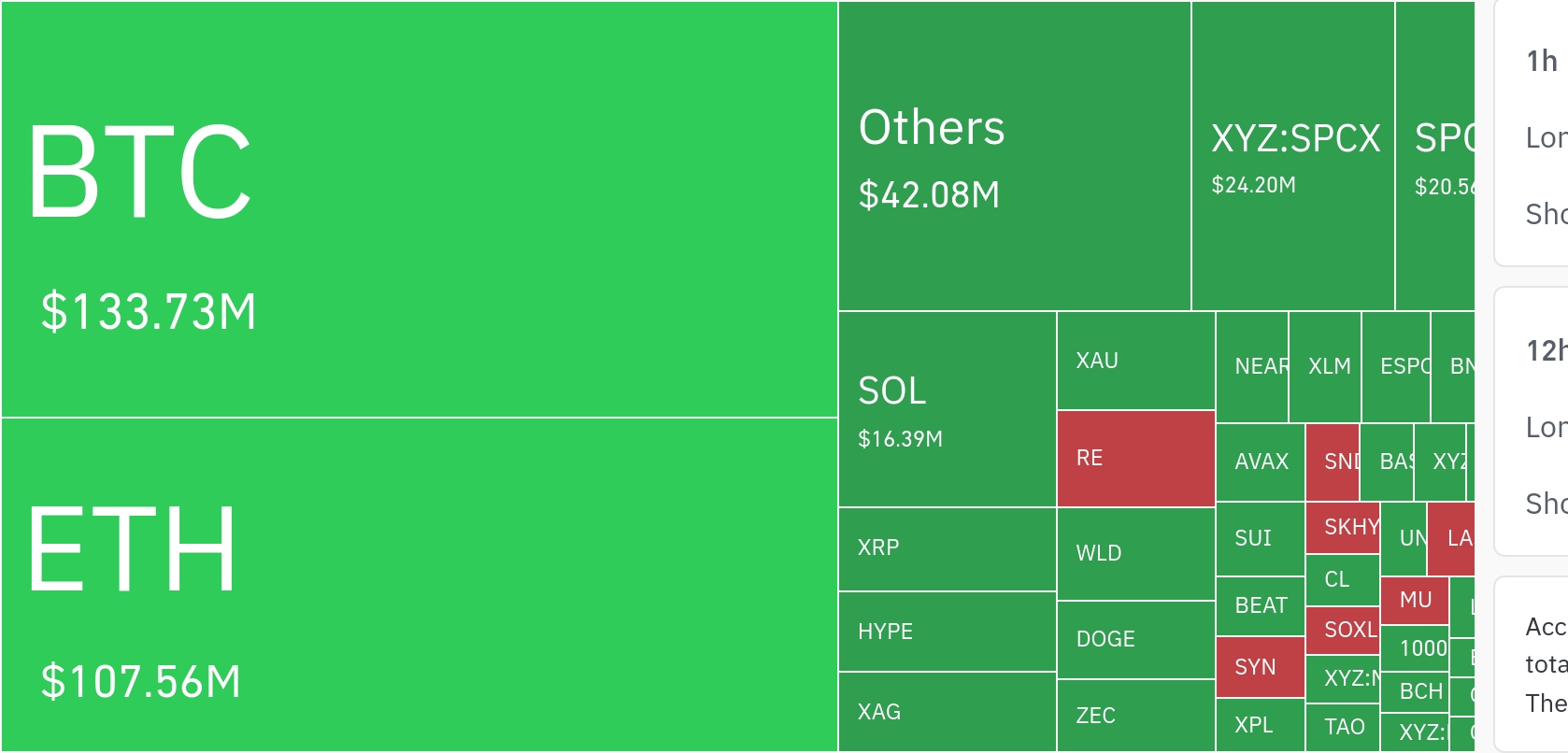
Crypto derivatives traders saw another leveraged shakeout over the past day, with roughly $283.37 million in positions forcibly closed as prices chopped around major technical levels. The data points to a market still searching for direction, where even modest spot moves are triggering outsized liquidations across futures venues.
According to CoinGlass data covering the past 24 hours, liquidations were concentrated in the two largest assets: Bitcoin (BTC) accounted for about $133.73 million and Ethereum (ETH) for $107.56 million, while the rest of the market—combined altcoins—made up roughly $42.08 million. The skew toward BTC and ETH suggests that leverage remains heaviest in the most liquid contracts, amplifying volatility when momentum stalls or abruptly reverses.
Shorter-term flow showed stress building quickly. Over the most recent four-hour window, total liquidations reached about $17.91 million, led by Binance with $9.37 million (52.3%). Notably, Binance’s wipeout was dominated by long positions—$6.94 million, or 74.02%—indicating a pullback that caught bullish traders offside. Bybit followed with $2.43 million (13.56%), OKX with $2.10 million (11.74%), Bitget with $1.23 million (6.85%), and Hyperliquid with $1.11 million (6.2%).
Exchange-level positioning also revealed sharp differences in trader behavior. Hyperliquid’s liquidations were overwhelmingly long-heavy, with long positions representing 98.41% of the total—an extreme imbalance that often appears when crowded upside bets meet a sudden downtick in price or funding conditions. Gate showed a comparatively higher share of short liquidations, with shorts at roughly 35% of its nearly $1.0 million in total liquidations, highlighting how leverage can cluster differently across venues.
Across all exchanges in the same four-hour period, long liquidations totaled about $13.69 million (76.39%), while shorts were $4.23 million (23.61%). That split implies that near-term optimism was pared back, even as broader market direction remains unsettled.
On a coin-by-coin breakdown, Bitcoin (BTC) saw $18.53 million in liquidations over 24 hours, with $8.53 million in longs and $10.00 million in shorts. BTC was last reported up slightly—about 0.13% over the day—to $62,821, meaning short liquidations outpaced longs despite a relatively muted price gain. The pattern is consistent with a choppy rebound where intermittent upside bursts force short covering, even as subsequent pullbacks punish late long entries.
Ethereum (ETH) was not fully itemized in the per-coin table referenced in the data, but the asset-category tally showed $107.56 million liquidated—keeping ETH alongside BTC as the center of gravity for leverage unwinds.
Among major altcoins, liquidation totals were smaller in dollar terms but often paired with sharper price swings. Solana (SOL) saw about $484,600 in liquidations, with SOL down 0.11% to $142.26. Dogecoin (DOGE) recorded about $862,800 in liquidations—larger than SOL—while slipping 0.77%. XRP saw around $602,600 liquidated.
Two tokens stood out for volatility and two-way positioning. Worldcoin (WLD) posted about $1.81 million in liquidations and marked the largest 24-hour decline in the tracked set, down 4.13%. Liquidations were significant on both sides—roughly $807,600 in longs and $1.00 million in shorts—suggesting rapid swings and frequent position flips. TON also drew attention, with short liquidations reaching about $1.2 million over 24 hours, while the latest four hours included a concentrated burst of long liquidations of roughly $366,700—an imprint of abrupt directional shifts.
CoinGlass heatmap data also indicated large liquidations in less prominent, potentially lower-liquidity instruments, including XYZ:SPCX with about $24.2 million and SPC with about $20.56 million. Such spikes can reflect leverage crowding in theme-driven or thinner markets, where relatively small price moves can cascade into liquidation events.
Liquidations occur when leveraged traders can no longer meet margin requirements and exchanges close positions automatically, often accelerating intraday moves. This round of forced selling and covering underscores how BTC and ETH continue to set the tone for broader risk appetite, while select altcoins—including Worldcoin (WLD), TON, and Dogecoin (DOGE)—remain prone to sharper, liquidity-driven swings when leverage builds too quickly.
Article Summary by TokenPost.ai
🔎 Market Interpretation
Leverage reset in a range-bound market: About $283.37M in 24h liquidations suggests price is chopping near key levels, where small spot moves trigger large forced closures in futures.
BTC/ETH remain the liquidation epicenter: Of total 24h liquidations, BTC ~$133.73M and ETH ~$107.56M dominated, implying the highest leverage is still concentrated in the deepest, most-traded contracts.
Near-term bias was bullish—and got punished: In the latest 4 hours, liquidations were 76.39% longs vs 23.61% shorts, indicating a pullback that caught recent dip-buyers/long adders offside.
Venue-specific crowding signals uneven risk: Binance led 4h liquidations ($9.37M), with liquidations mostly longs (74.02%). Hyperliquid was extreme (98.41% long-heavy), a classic sign of one-sided positioning vulnerable to a fast downtick.
Chop-driven "two-way pain" is visible in BTC: Despite BTC being up only ~0.13% to $62,821, its per-coin liquidation split showed shorts ($10.00M) exceeding longs ($8.53M), consistent with sudden upside bursts (short squeezes) followed by pullbacks (late-long flushes).
Altcoin liquidations smaller but more volatile: Tokens like WLD (down 4.13%) and TON showed sharper, two-way liquidation patterns typical of thinner liquidity and faster sentiment flips.
Heatmap spikes hint at fragility in thin instruments: Large liquidation prints in lesser-known markets (e.g., XYZ:SPCX ~$24.2M, SPC ~$20.56M) suggest leverage crowding where minor price changes can cascade into forced selling.
💡 Strategic Points
Expect volatility clusters around technical levels: When markets lack direction, sudden wicks can repeatedly trigger stop-outs and liquidations; risk is elevated for tight-margin, high-leverage positions.
Watch long/short liquidation balance for momentum clues: A sustained dominance of long liquidations often signals weakening near-term bullish positioning; a flip toward short liquidations can indicate squeeze risk on rebounds.
Track exchange concentration and imbalances: Heavy long wipes on a single venue (e.g., Hyperliquid’s ~98% long) can foreshadow sharp, fast moves if liquidation cascades accelerate.
Prioritize liquidity in uncertain regimes: BTC/ETH absorb the most leverage, but thinner altcoins can move more violently; position sizing should reflect liquidity and typical wick behavior, not just conviction.
Be cautious with theme-driven/low-liquidity contracts: Heatmap “outlier” liquidation spikes can reflect crowded leverage rather than fundamental shifts—conditions that can reverse abruptly.
Risk management focus: Consider lower leverage, wider invalidation levels, and predefined liquidation/stop thresholds to reduce the chance of forced closure during chop.
📘 Glossary
Liquidation: Automatic position closure by an exchange when a trader’s margin can’t cover losses, often worsening price swings.
Leverage: Borrowed exposure that magnifies gains and losses; higher leverage increases liquidation risk from small price moves.
Long / Short: A long profits if price rises; a short profits if price falls.
Long liquidation / Short liquidation: Forced closing of long/short positions, typically caused by a sharp move against that side.
Liquidation cascade: Chain reaction where initial liquidations move price further, triggering more liquidations.
Funding conditions (funding rate): Periodic payments between longs and shorts in perpetual futures that reflect positioning pressure; shifts can worsen squeezes or flushes.
Short squeeze: Rapid price rise forcing shorts to buy back, amplifying upside moves and often increasing short liquidations.
Heatmap (liquidation heatmap): Visualization of where large liquidation/stop clusters may sit, indicating potential volatility zones.
Liquidity: How easily an asset can be traded without moving price; lower liquidity often means sharper swings and more abrupt liquidation events.