

 News
News  Coin Information
  About us
  Customer Service


 Add as a preferred source on Google
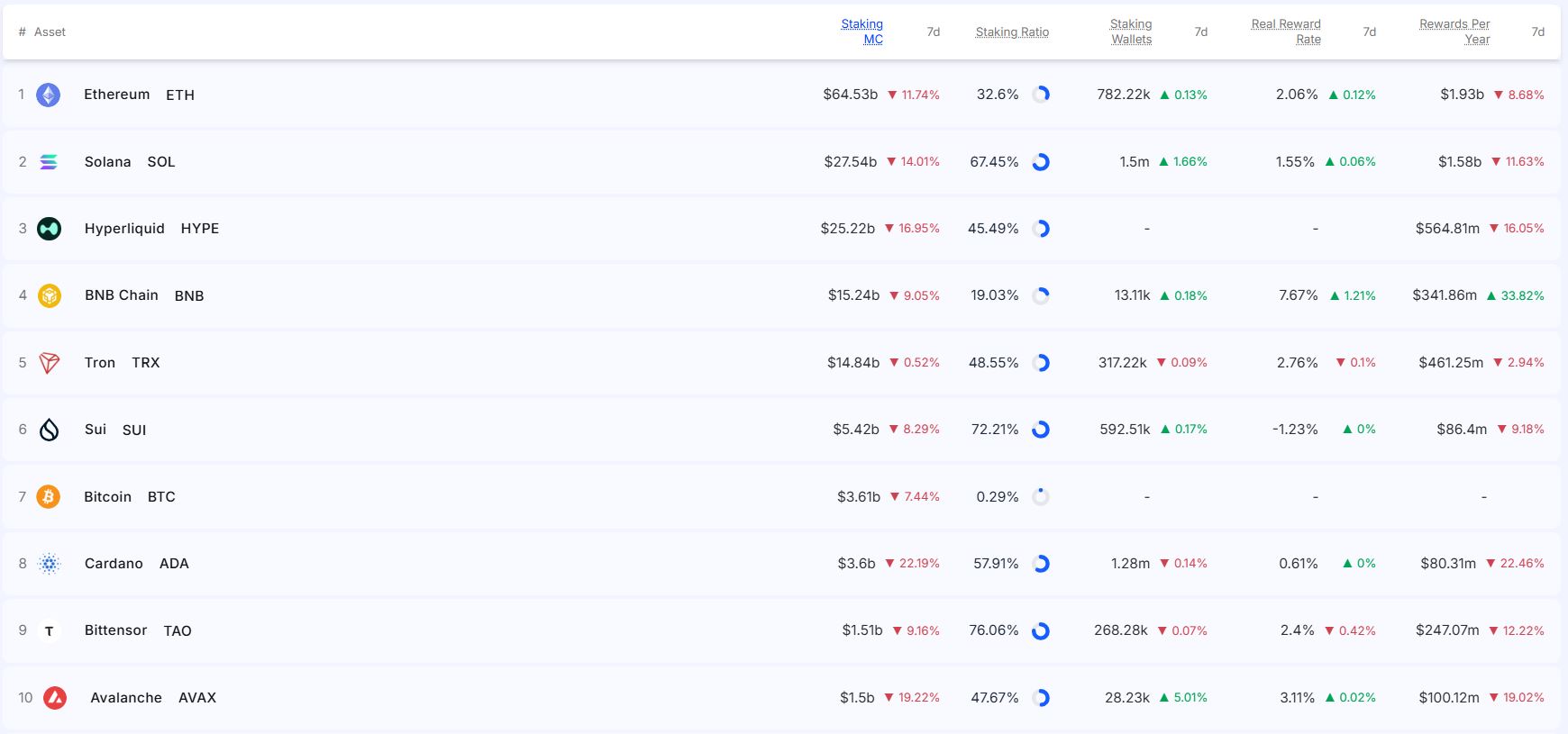
Major proof-of-stake networks saw broad contraction in staked value over the past week, with Cardano (ADA) posting the steepest drop among leading chains even as Binance’s BNB Chain (BNB) stood out for strengthening reward metrics. The divergence underscores how token price moves can pressure 'staking market cap' while protocol-level payout dynamics remain resilient—or even improve—on select networks.
According to data compiled by Staking Rewards on Tuesday ET, Ethereum (ETH) maintained the top position by staked market capitalization, but fell 11.74% week over week to about $64.53 billion. Solana (SOL) held second place at $27.54 billion, down 14.01% over the same period, while Hyperliquid (HYPE) came in at $25.22 billion, slipping 16.95%.
BNB Chain ranked next with roughly $15.24 billion staked, down 9.05% week over week. Tron (TRX) followed at about $14.84 billion and recorded the smallest decline among the top names, edging down just 0.52%. Sui (SUI) stood at $5.42 billion, down 8.29%.
Cardano’s staked market cap dropped 22.19% to around $3.6 billion—the largest weekly pullback among the major networks tracked—while Bittensor (TAO) declined 9.16% to $1.51 billion. Avalanche (AVAX) also fell sharply, down 19.22% to about $1.5 billion.
Participation metrics remained elevated on several ecosystems despite the market-wide decline in staked value. Bittensor led in staking participation relative to supply with a 76.06% staking ratio, followed by Sui at 72.21% and Solana at 67.45%, suggesting a continued preference among holders to keep tokens locked for yield or network participation.
In terms of wallets participating in staking—a proxy for breadth of engagement—Solana led with about 1.5 million staking wallets. Cardano followed with roughly 1.28 million, while Ethereum registered about 782,220. Although wallet counts were broadly steady, Avalanche posted the largest weekly increase at 5.01%, and Solana rose 1.66%.
Reward indicators painted a more mixed picture. BNB Chain posted the highest 'real yield' at 7.67%, up 1.21 percentage points week over week. Avalanche’s real yield was estimated at 3.11%, followed by Tron at 2.76%, Bittensor at 2.40%, Ethereum at 2.06%, and Solana at 1.55%. Sui remained in negative territory at -1.23%, highlighting how inflation, emissions schedules, and token price dynamics can outweigh nominal payouts when measured in real terms.
Estimated annual rewards were still led by Ethereum at about $1.93 billion, while Solana followed at roughly $1.58 billion. Hyperliquid was estimated at $564.81 million in annual rewards, Tron at $461.25 million, and BNB Chain at $341.86 million.
Over the last seven days, BNB Chain recorded the biggest jump in estimated annual rewards, rising 33.82%. By contrast, Cardano saw the sharpest decline at 22.46%, with other networks also trending lower: Avalanche fell 19.02%, Hyperliquid 16.05%, Bittensor 12.22%, Solana 11.63%, Sui 9.18%, Ethereum 8.68%, and Tron 2.94%.
The latest figures point to a staking market still highly engaged at the user level, even as staked valuation compresses alongside broader price fluctuations. For investors and builders, the split between declining staked market caps and strengthening yield metrics on chains like BNB Chain highlights how 'network incentives' and 'token performance' can move in different directions—an important consideration as staking remains central to security and liquidity across proof-of-stake ecosystems.
🔎 Market Interpretation
- Broad PoS staking value contraction: Most major proof-of-stake networks saw week-over-week declines in staked market capitalization, largely reflecting token price weakness rather than a collapse in staking activity.
- Largest staked market-cap declines: Cardano (ADA) fell the most among major networks (-22.19% to ~$3.6B), followed by Avalanche (AVAX) (-19.22% to ~$1.5B) and Hyperliquid (HYPE) (-16.95% to ~$25.22B).
- Leaders by staked market cap (still down): Ethereum remained #1 (~$64.53B, -11.74%), Solana #2 (~$27.54B, -14.01%), and Hyperliquid #3 (~$25.22B, -16.95%).
- Engagement stayed resilient: Staking participation ratios remained high (Bittensor 76.06%, Sui 72.21%, Solana 67.45%), indicating holders continued locking tokens despite falling valuations.
- Divergence in reward dynamics: BNB Chain stood out with strengthening reward metrics—highest real yield (7.67%, +1.21pp) and the biggest jump in estimated annual rewards (+33.82%)—showing incentives can improve even when market cap falls.
💡 Strategic Points
- Separate price effects from protocol incentives: A drop in staked market cap can be primarily price-driven; investors should also track staking ratio, real yield, and reward trends before concluding security/participation is weakening.
- BNB Chain’s incentive signal: Rising real yield and surging estimated annual rewards suggest stronger near-term staking attractiveness on BNB Chain versus peers—potentially drawing additional stake if conditions persist.
- Real yield matters more than headline APR: Sui’s negative real yield (-1.23%) highlights how inflation/emissions and price dynamics can outweigh nominal rewards; evaluate returns net of dilution and market moves.
- Network breadth vs. concentration: Solana led in staking wallets (~1.5M) and Cardano followed (~1.28M), indicating broad participation; Avalanche’s wallet growth (+5.01%) suggests improving engagement even as value and rewards fell.
- Risk watch—chains with both value and reward compression: Cardano showed the steepest declines in staked market cap (-22.19%) and estimated annual rewards (-22.46%), which may pressure perceived yield competitiveness versus networks with improving incentives.
- Reward scale still favors large bases: Ethereum (~$1.93B) and Solana (~$1.58B) led estimated annual rewards, implying deeper liquidity and established staking economies even during drawdowns.
📘 Glossary
- Proof-of-Stake (PoS): A consensus mechanism where validators secure the network by locking (staking) tokens, earning rewards for participation.
- Staked Market Capitalization (Staking Market Cap): The market value of tokens currently staked (typically staked amount × token price). Can fall due to price declines even if staked tokens remain constant.
- Staking Ratio: The percentage of a token’s circulating supply that is staked. Higher ratios often imply stronger holder commitment and potential security benefits.
- Staking Wallets: Number of unique wallets participating in staking; a proxy for how broadly staking participation is distributed.
- Real Yield: Yield adjusted for inflation/dilution and related factors (and sometimes price effects, depending on methodology). Can be negative if emissions and token dynamics overwhelm rewards.
- Estimated Annual Rewards: An annualized estimate of total staking rewards paid on a network, useful for comparing reward “scale” across ecosystems.
- Emissions Schedule: The planned rate at which new tokens are issued; higher issuance can dilute holders and reduce real returns.




















Comment 0