

 News
News  Coin Information
  About us
  Customer Service


 Add as a preferred source on Google

As the broader crypto market digests a prolonged pullback, one corner of digital finance is quietly gaining momentum: tokenized equities—particularly contracts traded as 'perpetual futures'. A new report from Tiger Research argues that these products are evolving beyond a speculative novelty, increasingly serving as a 24/7 conduit for 'price discovery' when traditional stock markets are closed.
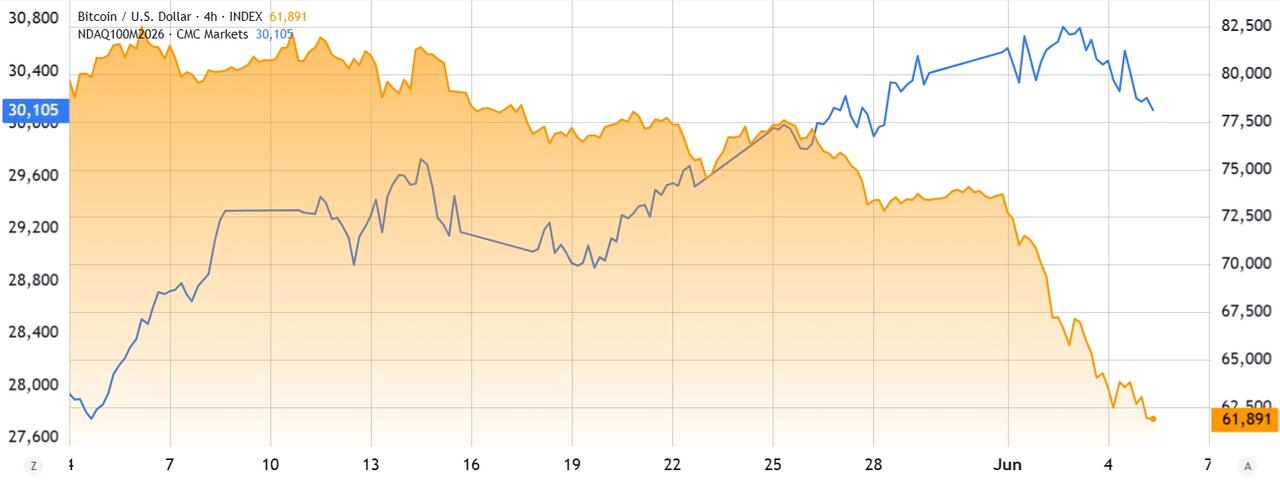
The research focused on the first quarter of 2026, a period marked by sharp divergence between digital assets and equities. Total crypto market capitalization fell 20.4% over the quarter, while spot trading volume on centralized exchanges dropped 39.1%. Over the same period, the S&P 500 continued to outperform annual targets, and South Korea’s equity market rallied on semiconductor strength. With Bitcoin (BTC) and other major tokens under pressure while global stock indices pushed toward record highs, Tiger Research said investor attention increasingly shifted to tokenized stock exposure offering around-the-clock access.
Two models, one trend: growth in perpetuals
Tiger Research breaks the tokenized equity market into two primary structures. The first is fully collateralized 'spot' tokenization, where real shares are custodied and a 1:1 token is issued against them. The second—now drawing more inflows—is padding-based 'perpetual futures', which track a stock’s price without requiring ownership of the underlying shares. Traders post collateral, typically in stablecoins, and take leveraged positions on price movements.
While these perpetual contracts do not give investors a direct claim on the underlying equity, the trade-offs are clear: 24-hour dealing, rapid listings, and leverage—sometimes up to 20x, according to the report. Tiger Research noted that this access is particularly attractive for investors in jurisdictions where certain foreign equities are difficult to trade through domestic brokerages.
Still small versus equities—yet expanding fast
By traditional market standards, tokenized equity perpetuals remain tiny. Tiger Research estimates open interest (OI) in tokenized stock perpetual futures at roughly $2.25 billion, compared with about $1.1 trillion in average daily trading value across the U.S. equity market. The comparison is not apples-to-apples, but it highlights how early the market remains in absolute size.
Even so, the report points to clear quarter-over-quarter growth in OI and rising regulatory attention. Tiger Research said both the U.S. Securities and Exchange Commission (SEC) and the Commodity Futures Trading Commission (CFTC) have begun to approach the area as an emerging category of financial products—an early signal that tokenized equities may increasingly be pulled into formal supervisory frameworks.
'Closed' spot markets vs. 'open' perpetual markets
The report’s most striking findings center on the interaction between closed-hour equity markets and always-on crypto venues. South Korea’s domestic stock market halts overnight and on weekends—but offshore platforms listing perpetual futures tied to Korean equities continue to trade. In that window, prices do more than mirror the prior close; they incorporate U.S. equity moves, FX fluctuations, global news, and company-specific developments, effectively forming a live market-implied view of the next session’s opening price.
Tiger Research found that after-hours gains in Korean equity perpetuals often aligned with the next day’s opening direction on the Korea Exchange (KRX), particularly for the country’s two semiconductor bellwethers. On days when the Samsung Electronics perpetual future rose after the local close, the stock opened higher on the next trading day 82% of the time; for SK Hynix, the figure was 95%. Conversely, when the perpetual fell, Samsung Electronics opened lower 96% of the time, while SK Hynix did so 78% of the time. Overall direction-match rates were near 85% for both names, with correlation coefficients ranging from 0.85 to 0.89.
The relationship extended beyond direction to magnitude. When overnight perpetual futures rose about 3%, the subsequent KRX opening price tended to reflect a similar move. Regression coefficients came in at 0.93 for Samsung Electronics and 1.00 for SK Hynix—suggesting the crypto-traded perpetual market was capturing much of the information that would later be priced into the next cash open.
Weekend effect: global variables priced first
Tiger Research said the signal looked even stronger across weekends. Comparing Friday’s close to Monday’s open, the direction implied by perpetual futures matched the actual opening direction 93% of the time for Samsung Electronics and 87% for SK Hynix. The report attributes the effect to global information accumulating over non-trading days—information that perpetual markets can absorb immediately, well before the underlying stock market reopens.
Trading implications: 'delta-neutral' funding capture
The report also examined how traders are using these markets tactically. One widely used approach is a 'delta-neutral' structure: buying the underlying stock while shorting the perpetual future to reduce directional exposure and potentially earn funding payments.
Unlike dated futures, perpetuals rely on a 'funding rate' mechanism to keep contract prices anchored to a reference index. When perpetual prices trade above spot, long positions typically pay shorts. In Tiger Research’s intraday analysis, Samsung Electronics perpetual futures traded at an average premium of about 0.15% to the KRX spot price, while SK Hynix traded about 0.23% higher. In that setup, a trader could go long KRX spot and short an equivalent notional of perpetuals, aiming to collect funding on the short leg while limiting market-direction risk.
However, Tiger Research cautioned that these dislocations close quickly. On average, half of the spot-perpetual gap was eliminated within roughly 40 minutes, making the opportunity episodic rather than persistent. Execution speed and monitoring, the report argues, are decisive.
Cross-exchange arbitrage: persistent basis gaps
Another opportunity comes from price discrepancies between exchanges. Even for the same tokenized Korean equity perpetual at the same moment, prices can differ materially across venues. As of June 2026, Tiger Research observed that Samsung Electronics perpetual futures on Binance were priced about 0.93% higher on average than on Hyperliquid, while SK Hynix was about 1.03% higher. In some instances, the gap widened to as much as 2.3%.
Because positions generally cannot be transferred directly across exchanges, arbitrage is typically executed by simultaneously shorting the higher-priced venue and going long the lower-priced one, targeting convergence while aiming to neutralize exposure to the underlying stock direction. In some cases, the short leg on the higher-priced exchange may also earn favorable funding, improving expected returns—though Tiger Research notes this depends on market conditions and can reverse quickly.
These divergences tend to widen during thinner-liquidity periods such as nights and weekends. Tiger Research attributes the phenomenon to differences in participant composition and price formation across platforms, as well as the market’s early-stage development, where arbitrage capital has not yet fully compressed inefficiencies. The report adds that newer venues often exhibit more persistent overpricing.
Business opportunities—and structural risks
As tokenized equity perpetuals expand, Tiger Research sees growing demand for specialized liquidity provision. Cross-exchange gaps and thin order books create openings for professional 'market makers', while the rise of regionally sensitive products points to the need for tailored 'regional oracles' that better reflect local-market dynamics during off-hours.
The report also notes that tokenized Korean equity offerings remain limited—largely centered on Samsung Electronics, SK Hynix, and Hyundai Motor—leaving room for additional listings and supporting infrastructure. Over a longer horizon, Tiger Research suggests that more institutionalized approaches could emerge, including a 'basis hedge fund' style model that seeks to capture both spot-perpetual premia and cross-exchange funding differentials.
Still, the report flags structural constraints. As trading fragments across multiple offshore venues alongside domestic cash markets, liquidity can become dispersed and market participants may struggle to identify the most reliable reference price. Thin liquidity combined with leverage also raises liquidation risk: abrupt price moves can cascade into forced unwinds, amplifying volatility.
Even with those risks, Tiger Research’s conclusion is that the trajectory is difficult to ignore. Tokenized equity perpetuals remain small compared with traditional stock markets, but their ability to trade 24/7, absorb information during off-hours, and increasingly attract regulatory attention suggests they are entering an early growth phase where trading strategies and business models are taking shape. If the market continues to mature, the report argues, the opportunity set could broaden beyond retail speculation to include liquidity providers, infrastructure builders, and more systematic capital seeking 'market-neutral' returns.






















Comment 0