
 Add as a preferred source on Google
Bitcoin Draws $26.6M Inflows as USDC Sees $285M Outflow Shift
Bitcoin attracted $26.6 million in inflows while USDC saw $285.7 million in outflows, signaling selective demand and cautious positioning across the crypto market.



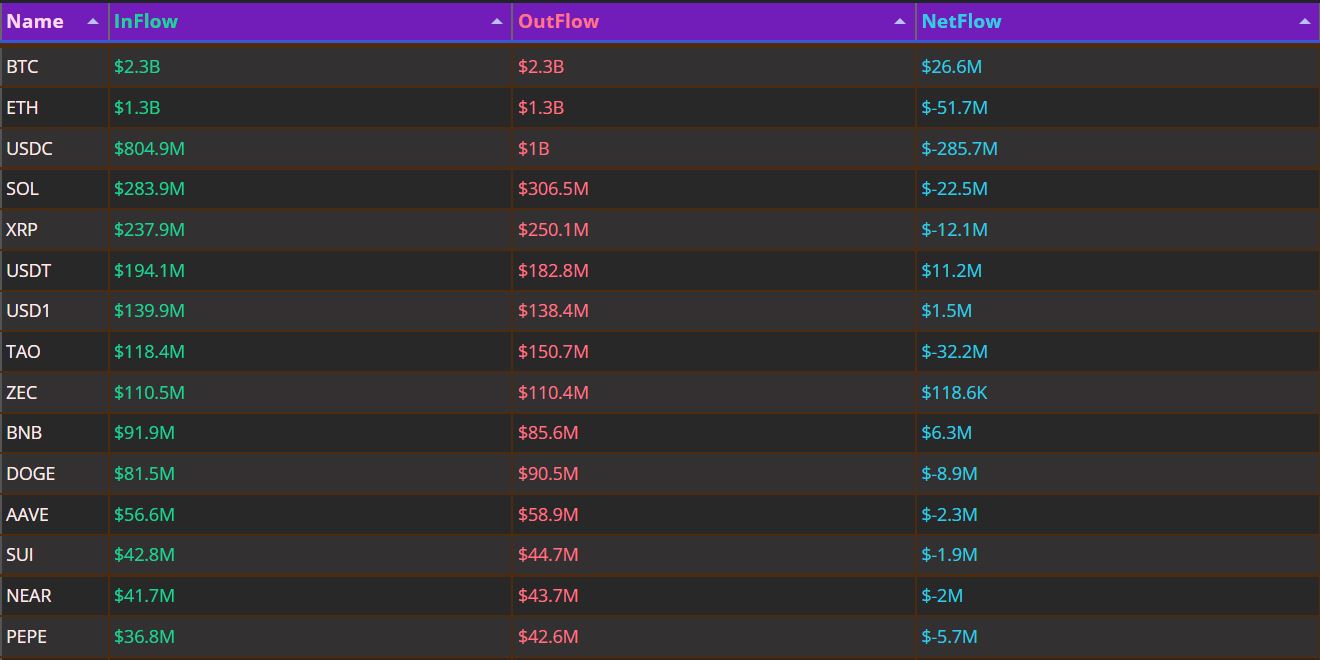
Capital flows across major crypto assets turned sharply selective over the past day, with Bitcoin (BTC) standing out as one of the few large-cap tokens to post net inflows while stablecoins—especially USD Coin (USDC)—saw heavy withdrawals.
According to data from Cryptometer, as of April 9 at 12:00 a.m. ET (04:00 UTC), Bitcoin recorded approximately $26.6 million in net inflows over the past 24 hours, maintaining a modest but consistent bid relative to other top assets. The inflow came as several key markets showed net selling pressure, highlighting a narrow risk appetite concentrated around BTC rather than broad-based participation.
The most notable move was in stablecoins. USDC posted roughly $285.7 million in net outflows—the largest across all tracked assets—suggesting a significant reduction in on-exchange or actively deployed dollar liquidity. While stablecoin flows can reflect routine treasury movements, cross-venue rebalancing, or redemptions, the size of the USDC outflow points to a more pronounced shift in where investors are parking cash-like exposure.
Ethereum (ETH) also recorded meaningful withdrawals, with net outflows totaling about $51.7 million. The divergence between BTC inflows and ETH outflows underscores an increasingly common ‘Bitcoin-led’ positioning regime, where investors favor perceived relative safety and liquidity concentration in BTC during uncertain or range-bound conditions.
Several major altcoins followed the risk-off tone. Solana (SOL) saw around $22.5 million in net outflows, while XRP registered approximately $12.1 million in withdrawals. The pattern suggests traders may be trimming exposure in higher-beta assets even as BTC demand remains intact.
Not all stablecoin activity was negative. Tether (USDT) posted net inflows of about $11.2 million, indicating some liquidity rotation rather than a uniform exit from stablecoins. Market observers often track USDT inflows as a proxy for ‘deployable liquidity,’ though the modest magnitude compared with USDC’s withdrawal implies the overall shift was more about reallocation than an immediate surge in buying power.
Looking at top net inflows, Bitcoin led with $26.6 million, followed by TRON (TRX) at $13.8 million and Tether at $11.2 million. RLUSD added $8.9 million, while BNB recorded $6.3 million in net inflows.
On the outflow side, USDC dominated at $285.7 million, followed by Ethereum at $51.7 million. Bittensor (TAO) saw $32.2 million in net outflows, with Solana and Wrapped Bitcoin (WBTC) posting $22.5 million and $16.7 million in withdrawals, respectively.
Overall, the latest flow snapshot reinforces a market characterized by ‘selective demand’—with BTC still attracting incremental capital while broader risk exposure and certain stablecoin liquidity pools contract. If the trend persists, it could signal continued preference for large-cap liquidity and cautious positioning rather than a broad rotation into altcoins.
Article Summary by TokenPost.ai
🔎 Market Interpretation
Selective risk appetite emerged: Capital concentrated in Bitcoin (+$26.6M net inflows) while many large caps and several altcoins saw net withdrawals.
Stablecoin liquidity shifted materially: USDC led all assets in net outflows (-$285.7M), indicating a notable reduction in on-exchange/active dollar liquidity or a large-scale reallocation (e.g., redemption, treasury movement, cross-venue balancing).
Bitcoin-led regime strengthened: Divergence between BTC inflows and ETH outflows (-$51.7M) points to preference for perceived relative safety and deepest liquidity in uncertain/range-bound conditions.
Risk-off pressure in higher beta: SOL (-$22.5M) and XRP (-$12.1M) outflows suggest traders reduced exposure to more volatile assets despite BTC demand holding up.
Not a blanket stablecoin exit: USDT still posted inflows (+$11.2M), implying rotation within “cash-like” instruments rather than a uniform flight from stables—though USDC’s size dominated the net picture.
Flow leaderboard snapshot: Top inflows: BTC +$26.6M, TRX +$13.8M, USDT +$11.2M, RLUSD +$8.9M, BNB +$6.3M. Top outflows: USDC -$285.7M, ETH -$51.7M, TAO -$32.2M, SOL -$22.5M, WBTC -$16.7M.
💡 Strategic Points
Positioning signal: If BTC inflows persist alongside ETH/alt outflows, markets may remain in a defensive, large-cap-led posture rather than a broad “alt season” rotation.
Watch stablecoin mix for risk-on clues: A rebound in aggregate stablecoin inflows (or USDC outflows reversing) often precedes increased spot buying; continued USDC drawdowns can indicate tightening deployable liquidity.
Liquidity concentration matters: BTC attracting incremental capital while others bleed suggests traders favor assets with highest depth and easiest execution; this can amplify BTC dominance during choppy markets.
Altcoin caution: Persistent outflows in SOL/XRP (and notable TAO withdrawals) can pressure relative performance; consider tighter risk controls or waiting for flow stabilization before increasing beta exposure.
Confirm with follow-through: Single-day flow snaps can be noisy (rebalance/redemption effects). Stronger confirmation comes from multi-day trend alignment with price action, funding, and exchange balances.
📘 Glossary
Net inflows / net outflows: The difference between capital moving into vs. out of an asset across tracked venues over a set period; positive = inflow, negative = outflow.
Stablecoin: A token designed to track a fiat currency (typically USD). Examples: USDC (USD Coin) and USDT (Tether).
On-exchange liquidity: Funds readily available on trading venues; higher levels can support faster buying/selling activity.
Deployable liquidity: Capital considered “ready to buy risk assets,” often proxied by stablecoin inflows to exchanges.
Risk-off / risk-on: Risk-off implies preference for safer/more liquid assets; risk-on implies broader appetite for volatile/higher-beta assets.
Higher-beta assets: Tokens that typically move more than the overall market (often many altcoins), rising more in upswings and falling more in downturns.
Bitcoin-led regime: Market phase where BTC attracts flows and leads performance while other crypto assets lag.
WBTC: Wrapped Bitcoin—an ERC-20 token representing BTC on Ethereum, used in DeFi and trading.