
 Add as a preferred source on Google
Bitcoin Draws $217.9 Million Inflows as Stablecoin Liquidity Rotates Into Crypto Majors
Bitcoin and Ethereum led crypto inflows as capital rotated out of stablecoins, signaling renewed risk appetite across major digital assets.



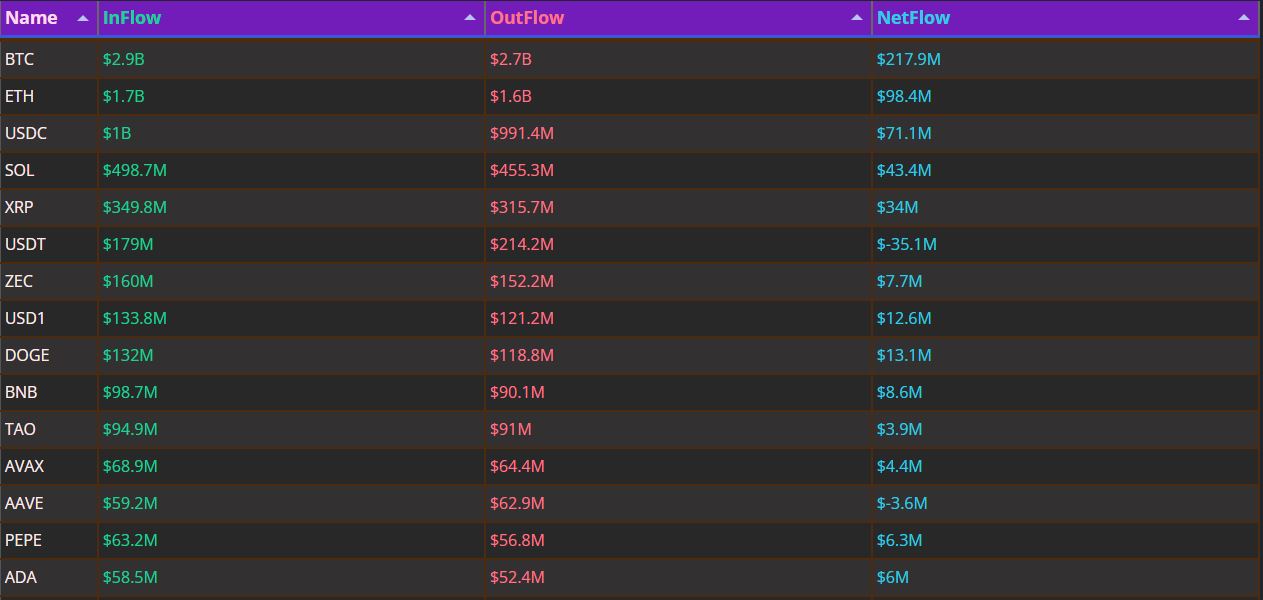
Bitcoin (BTC) led crypto capital inflows over the past 24 hours, pulling in roughly $217.9 million in net new funds as investors rotated back into major risk assets. The shift comes as several stablecoins posted notable outflows, suggesting a reallocation of on-chain liquidity away from cash-like instruments and toward higher-beta tokens.
According to data from Cryptometer, measured as of April 8 UTC, Bitcoin topped the inflow rankings by a wide margin. Ethereum (ETH) also maintained positive momentum with $98.4 million in net inflows, reinforcing the view that market participants are concentrating exposure in the most liquid large-cap assets.
Beyond the two largest cryptocurrencies, the data showed broader appetite for altcoins. Solana (SOL) recorded $43.4 million in net inflows, while XRP added $34.0 million—figures that point to incremental risk-on positioning rather than a narrowly BTC-only trade.
Stablecoin flows, however, were mixed. USD Coin (USDC) attracted $71.1 million in net inflows, standing out as the main beneficiary within the stablecoin segment. Tether (USDT), by contrast, saw $35.1 million in net outflows, indicating that part of the market’s deployable liquidity may be rotating out of USDT balances as traders reposition.
Additional net outflows were observed across several stable and derivative-linked assets, including USDG (-$31.8 million), USDE (-$20.7 million), Wrapped Ether (WETH) (-$19.4 million), and DAI (-$7.6 million). Analysts typically interpret this pattern as a sign of portfolio reshuffling: funds leaving certain 'cash-equivalent' or wrapped instruments can reflect either profit-taking, collateral adjustments, or redeployment into spot exposures.
Overall, the 24-hour snapshot suggests a market where 'liquidity inflow' is increasingly concentrating in marquee crypto assets—particularly Bitcoin—while stablecoin balances show selective drawdowns. If sustained, this flow profile could support near-term volatility and trading activity, though longer-term direction will still depend on macro conditions and broader risk sentiment.
Article Summary by TokenPost.ai
🔎 Market Interpretation
Risk-on rotation toward majors: Over the last 24 hours, capital flowed strongly into Bitcoin (+$217.9M) and Ethereum (+$98.4M), implying investors are increasing exposure to the most liquid, large-cap crypto assets.
Altcoin participation is improving: Meaningful inflows into Solana (+$43.4M) and XRP (+$34.0M) suggest broadening risk appetite rather than a purely BTC-driven move.
Stablecoin divergence signals redeployment: USDC (+$71.1M) gained while USDT (-$35.1M) declined, pointing to selective shifts in where traders park liquidity and which venues/rails they prefer for deployment.
Outflows from “cash-like” and wrapped assets: Drawdowns in USDG (-$31.8M), USDE (-$20.7M), WETH (-$19.4M), and DAI (-$7.6M) are consistent with collateral rebalancing and rotation into spot risk, rather than staying in defensive holdings.
Near-term implication: Concentrated inflows into BTC/ETH alongside stablecoin reductions can coincide with higher trading activity and volatility, while medium/longer-term direction remains dependent on macro and overall market risk sentiment.
💡 Strategic Points
Follow-the-flow bias: Persistent inflows into BTC/ETH typically support stronger relative performance versus the broader market; traders may treat these as the “core beta” exposure while monitoring whether altcoin inflows continue to expand.
Watch stablecoin leadership (USDC vs USDT): A continued preference for USDC inflows alongside USDT outflows can indicate shifting liquidity hubs and can affect where on-chain activity concentrates (DEX liquidity, CEX/bridge flows, and settlement).
Altcoin inflows as confirmation: SOL and XRP inflows can serve as a risk-on confirmation signal; if these reverse while BTC inflows persist, it may indicate a more defensive “flight to quality” within crypto.
Interpret WETH outflows carefully: WETH declines can reflect unwrapping to ETH, movement between venues, or collateral changes—so confirmation should come from ETH net flows and spot/perp positioning rather than WETH alone.
Risk management cue: If stablecoin balances keep falling while majors rise, it can imply liquidity is being deployed; that often increases sensitivity to macro headlines and can amplify intraday swings.
📘 Glossary
Net inflows/outflows: The net amount of funds entering or leaving an asset over a period (inflows minus outflows), often used as a proxy for demand or rotation.
Stablecoin: A crypto token designed to track a stable value (commonly $1), used as on-chain “cash” for trading and settlement (e.g., USDC, USDT, DAI).
On-chain liquidity: Capital available within blockchain ecosystems for trading, lending, and settlement; shifts can indicate changing risk appetite.
Higher-beta tokens: Assets that tend to move more than the market (more volatile and risk-sensitive), often attracting flows in risk-on phases.
Large-cap assets: The biggest and most liquid cryptocurrencies (typically BTC and ETH), often favored when traders want size and liquidity.
WETH (Wrapped Ether): A tokenized version of ETH used for smart-contract compatibility; conversions between ETH and WETH can reflect technical or venue-related needs rather than directional conviction.
Spot exposure: Direct ownership/trading of the underlying asset (as opposed to derivatives like futures or options).
Collateral adjustment: Rebalancing margin or pledged assets in lending/derivatives systems, which can cause stablecoin and wrapped-token flows without a simple buy/sell narrative.