

 News
News  Coin Information
  About us
  Customer Service


 Add as a preferred source on Google
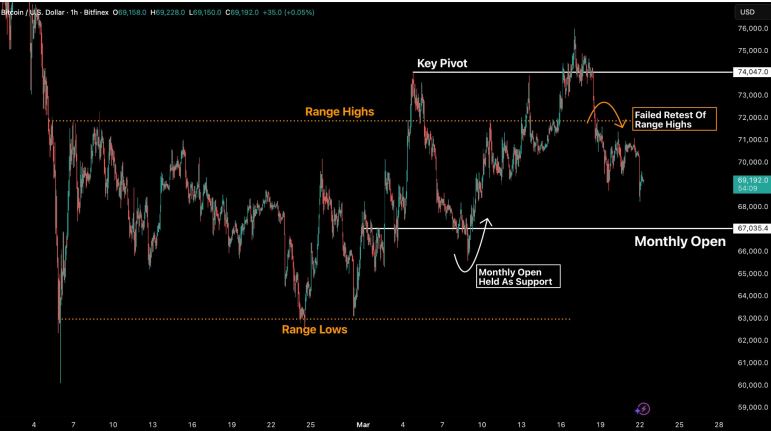
Bitcoin (BTC) shook off a brief push to $76,000 last week, only to reverse sharply as hotter-than-expected U.S. inflation data and a more hawkish Federal Reserve narrative tightened financial conditions and revived risk-off positioning across markets.
In a weekly note published Sunday UTC, Bitfinex Alpha said BTC opened the week near $71,000 and rallied roughly 7% over two sessions to around $76,000 before momentum faltered. The report characterized the move as a 'false breakout', arguing that macro pressure—amplified by rising geopolitical risk in the Middle East and fears tied to the Strait of Hormuz—quickly turned the market’s focus back to inflation and rates.
The pullback was swift. From the local high near $76,000, BTC fell as much as 10.2% to a low of $67,363, according to the report. Still, the decline stopped above March’s opening level of $67,035, a detail analysts highlighted as evidence that a key structural support zone remains intact despite the volatility.
Risk sentiment improved later in the week after President Trump said the U.S. would delay an attack on an Iranian power facility, helping spark a rebound in crypto assets. Bitfinex Alpha noted that the episode underscored how quickly digital-asset pricing can swing when macro drivers collide with headline geopolitical risk.
Notably, Bitcoin’s performance continued to diverge from equities. The S&P 500 slid to roughly 6,564—well below its March open and back toward levels last seen at a November 2025 low—while BTC managed to defend its monthly opening price. On a relative basis, the report estimated the benchmark index fell about 4.9% over the period, while BTC held up at higher levels, reinforcing the narrative of 'relative strength' in crypto versus traditional risk assets during the same macro shock.
Bitfinex Alpha also pointed to the timing of Bitcoin’s advance—beginning before the macro deterioration became dominant—as a potential sign of early 'institutional demand'. The implication is that positioning may have been established ahead of key Fed messaging, with subsequent price action reflecting a rapid re-pricing to new economic data rather than a purely technical-driven move.
On-chain indicators add another layer to the market structure. Using UTXO realized price distribution data, the report identified heavy accumulation between $59,000 and $72,000 during February and March 2026, creating what it described as a 'buying wall' and a robust cost-basis support band. That base helped push prices higher, but the breakout proved unstable as leveraged long positions piled in while holders who had previously been underwater used the rally to sell near breakeven—creating immediate overhead supply.
Technically, the $72,000 to $82,000 zone is viewed as an 'air gap'—a range with comparatively limited historical trading activity. Such areas can allow price to travel quickly when demand is strong, but they can also expose the market to abrupt reversals if buyers hesitate. Last week’s brief entry into this zone, despite geopolitical uncertainty, suggested traders were treating the shock as potentially temporary—at least until inflation and rate expectations reasserted themselves.
Spot Bitcoin ETF flows were a central variable in the week’s churn. Bitfinex Alpha said U.S.-listed spot ETFs recorded seven consecutive trading days of net inflows ahead of the Federal Open Market Committee meeting, from March 9 through March 17, totaling about $1.162 billion. BlackRock’s iShares Bitcoin Trust ($IBIT) led the move, taking in roughly $169.3 million on March 17 alone, while Fidelity, ARK, VanEck, and Franklin Templeton also posted net inflows—signaling sustained spot demand from institutional channels.
That bid flipped immediately after the Fed event. From March 18 through March 20, spot ETF flows turned decisively negative, with about $305.7 million exiting over three sessions. The largest single-day outflow came on March 18 at roughly $163.5 million, including about $103.8 million from Fidelity’s fund, which the report described as the month’s biggest redemption for that vehicle. Additional net outflows of about $90.2 million on March 19 and $52.0 million on March 20 reinforced the view that the Fed’s hawkish signals triggered a broader asset-allocation adjustment, not merely a routine dip-buying pause.
Even so, cumulative flows from March 3 through March 20 were still positive—around $966.8 million—suggesting the broader uptrend in spot demand has not been fully undone. The more important takeaway, the report argued, is the clear inflection around the FOMC meeting, which may influence near-term market conviction.
Looking ahead, Bitfinex Alpha framed ETF demand as the swing factor for the next directional move. The report said discussions that Morgan Stanley may consider offering spot Bitcoin ETFs could expand structural demand via adviser-led distribution channels, though timing and implementation remain uncertain. If ETF inflows stabilize or resume, Bitcoin could re-enter the $72,000–$82,000 'air gap' and potentially extend toward $82,000; if demand continues to fade, the market is more likely to revert to its prior range and consolidate below key resistance.





















Comment 0