
 Add as a preferred source on Google
Bitcoin, Ethereum Rise as Derivatives Volume Surges and Stablecoin Activity Drops
Bitcoin and Ethereum gains coincide with rising derivatives volume and falling stablecoin activity, signaling a shift toward leverage-driven market dynamics.



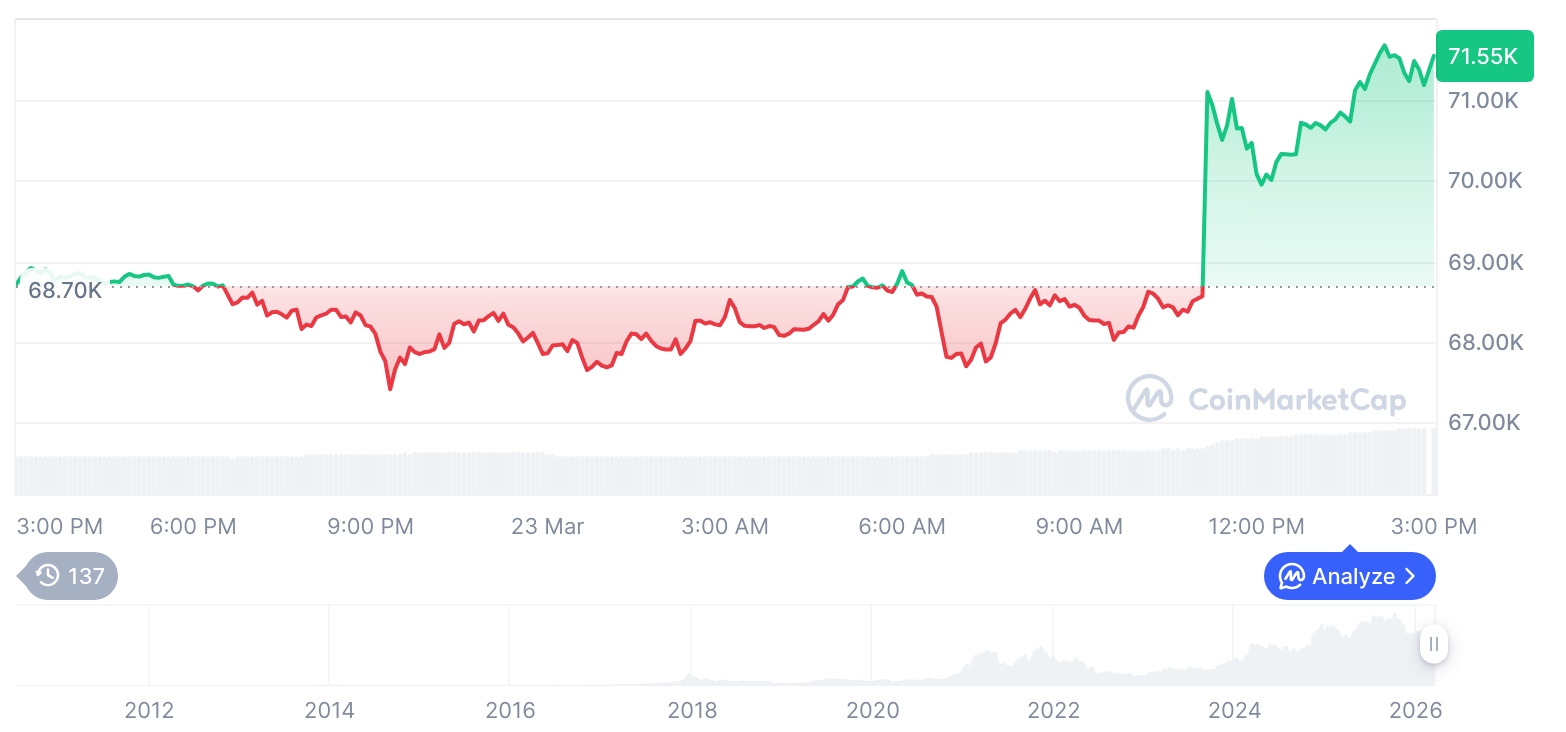
The cryptocurrency market traded mixed in the latest session, with Bitcoin (BTC) and Ethereum (ETH) extending gains even as activity data pointed to diverging risk appetite across spot, stablecoins, and derivatives. The move lifted overall sentiment, while shifts in dominance and volumes offered clues about where liquidity is flowing.
As of Tuesday UTC, Bitcoin rose 4.00% day over day to $71,457, according to TokenPostMarket data. Ethereum climbed 4.97% to $2,182 over the same period. The recovery in the two largest assets contrasted with a more uneven performance among major altcoins, underscoring a market that is still selectively bidding exposure rather than rotating broadly into higher beta tokens.
Among large-cap altcoins, XRP (XRP) gained 3.90%, BNB (BNB) added 2.51%, and Solana (SOL) advanced 4.89%. Tron (TRX) underperformed, slipping 2.08%. The mixed leaderboard suggested that while risk assets were generally firmer, positioning remained discriminating—often a sign that traders are prioritizing liquidity and ‘quality’ within crypto rather than chasing momentum across the board.
Total crypto market capitalization stood at roughly $2.44 trillion, while aggregate 24-hour trading volume reached about $114.56 billion. Dominance metrics also tilted in favor of the two largest networks: Bitcoin’s share rose to 58.56%, up 0.38 percentage points from the prior day, while Ethereum’s share increased to 10.79%, up 0.17 percentage points. Rising dominance alongside broad market stabilization is often read as a ‘flight to majors,’ particularly when macro-sensitive participants remain cautious.
In on-chain and sector flows, decentralized finance showed a notable pickup in activity. DeFi market capitalization was pegged at $59.9 billion, while DeFi trading volume totaled $11.2 billion over 24 hours—an increase of 50.89%. The surge in DeFi turnover can reflect opportunistic trading, short-term yield rotation, or renewed interest in specific protocols, though it can also be amplified by volatility-driven rebalancing.
Stablecoin data moved in the opposite direction. Stablecoin market capitalization was estimated at $290.9 billion, but 24-hour stablecoin volume fell sharply to $112.1 billion, down 68.78%. Because stablecoins frequently serve as the market’s primary settlement and collateral rail, a steep drop in turnover can imply reduced immediate deployment of cash-like liquidity—potentially leaving prices more sensitive to marginal flows.
Derivatives activity accelerated markedly. Combined crypto futures and options volume reached $111.1 billion over 24 hours, up 87.52% from the previous day. Elevated derivatives turnover typically indicates growing leverage and hedging demand, and it can magnify short-term price swings as liquidations and funding dynamics ripple through major venues.
Overall, the session highlighted a market leaning constructive at the top of the capitalization stack, with BTC and ETH leading and dominance rising. At the same time, the split between stronger DeFi activity, falling stablecoin turnover, and surging derivatives volume points to a complex liquidity picture—one where ‘risk-on’ price action may be increasingly driven by positioning and leverage rather than uniformly expanding spot demand.
Article Summary by TokenPost.ai
🔎 Market Interpretation
Majors led the tape: BTC (+4.00% to $71,457) and ETH (+4.97% to $2,182) outperformed, while large-cap alts were mixed—suggesting selective risk-taking rather than a broad altcoin rotation.
“Flight to majors” signal: Total market cap held around $2.44T with volume near $114.56B, while BTC dominance rose to 58.56% and ETH dominance to 10.79%—often interpreted as liquidity concentrating in higher-conviction, higher-liquidity assets.
Liquidity looked uneven across rails: DeFi volumes surged (+50.89% to $11.2B) even as stablecoin turnover collapsed (-68.78% to $112.1B), implying activity may be shifting from cash-like settlement into targeted on-chain opportunities and/or being driven by volatility and rebalancing rather than fresh cash deployment.
Leverage/hedging likely increased: Derivatives volume jumped to $111.1B (+87.52%), a backdrop that can amplify short-term price swings through funding, liquidations, and tactical hedging.
💡 Strategic Points
Favor majors when dominance rises: A market rally accompanied by increasing BTC/ETH dominance often rewards “quality/liquidity” positioning over high-beta chasing.
Watch stablecoin volume as a risk gauge: The sharp decline in stablecoin turnover can signal reduced immediate buying power; if prices continue higher, the move may be more fragile and sensitive to marginal flows.
DeFi spike may be opportunity—or noise: Higher DeFi trading volume can reflect renewed protocol interest and yield rotation, but can also be inflated by volatility-driven repositioning. Confirm with sustained TVL/usage metrics rather than volume alone.
Derivatives surge increases whipsaw risk: Rising futures/options activity suggests greater leverage and hedging. Traders may consider tighter risk controls (position sizing, stop discipline) and monitoring funding/open interest for overheating.
Altcoin dispersion matters: Mixed performance among large caps (e.g., TRX lagging while SOL/ETH firm) implies the market is still discriminating—sector and narrative selection may matter more than broad exposure.
📘 Glossary
Dominance: The percentage share of total crypto market capitalization attributable to a specific asset (e.g., BTC dominance).
Large-cap altcoins: Non-BTC/ETH cryptocurrencies with relatively high market capitalization and liquidity (e.g., XRP, BNB, SOL).
Stablecoins: Tokens designed to track fiat value (often USD) and commonly used as trading collateral and settlement in crypto markets.
DeFi (Decentralized Finance): On-chain financial applications such as decentralized exchanges, lending, and yield strategies.
DeFi market cap / DeFi trading volume: The aggregate value and trading activity associated with DeFi-related tokens/protocols over a given period.
Derivatives: Financial contracts (e.g., futures, options) whose value derives from an underlying asset like BTC or ETH.
Leverage: Borrowed exposure that can increase gains and losses; often expressed via futures positions and margin.
Hedging: Using derivatives (or other instruments) to reduce exposure to adverse price moves.
High beta: Assets that typically move more than the broader market—often smaller altcoins that are more volatile.
Marginal flows: Incremental buy/sell pressure that can move prices, especially when overall liquidity is thin.