
 Add as a preferred source on Google
Bitcoin Options Show Rising Put Demand Despite Call-Heavy Open Interest
Bitcoin options markets show increased short-term downside hedging as put trading volume surpasses calls despite call-heavy open interest, signaling mixed sentiment among traders.


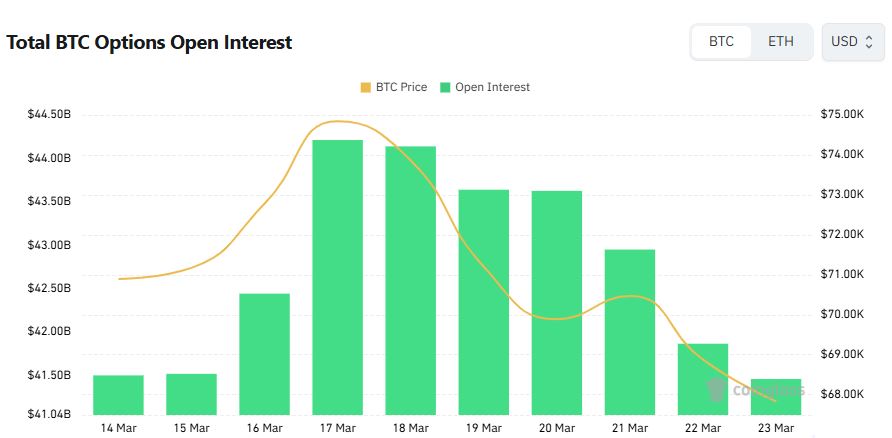
Bitcoin (BTC) options positioning showed a split between longer-dated bullish structure and near-term defensive activity, as put trading dominated the past day even while calls continued to make up the majority of open interest.
As of Monday 00:00 UTC (9:00 a.m. in Seoul), data compiled by CoinGlass showed total Bitcoin options 'open interest' (OI) at $41.46 billion, down 0.96% from $41.86 billion a day earlier. Despite the decline, the OI mix remained call-heavy: calls accounted for 58.38% of outstanding contracts versus 41.62% for puts.
The flow picture, however, leaned the other way. Total options trading volume over the past 24 hours was about $2.37 billion, with puts representing 56.65% and calls 43.35%. In derivatives markets, a higher share of put volume often reflects short-term hedging demand or positioning for downside volatility, even when the broader outstanding exposure remains skewed toward upside structures.
By venue, Deribit led activity with roughly $1.21 billion in notional volume, followed by Bybit at $454.6 million, OKX at $365.2 million, Binance at $360.5 million, and CME at $37.5 million. The concentration on offshore crypto-native venues underscores how much of BTC’s options price discovery continues to occur outside traditional U.S. futures exchanges, despite CME’s role as a benchmark for institutional participation.
The largest clusters of OI were concentrated in near-dated Deribit contracts expiring March 27, led by a $125,000 call and a $75,000 call, alongside a notable $20,000 put. The mix highlights a market balancing tail-risk hedges against the possibility of sharp upside moves—an arrangement often seen when traders expect elevated volatility but disagree on direction or time horizon.
In 24-hour volume rankings, the most actively traded contracts included a $76,000 call expiring March 23 on Bybit, as well as a $40,000 put expiring March 27 and a $60,000 put expiring April 3 on Deribit. The prominence of puts among the day’s busiest strikes aligns with the broader put-heavy turnover, suggesting that traders are paying up for protection or tactical downside exposure into the next set of expiries.
Options are leveraged derivatives that allow investors to express a view on price direction or hedge spot and futures positions. A 'call option' provides the right to buy the underlying at a set price, typically used for bullish exposure, while a 'put option' provides the right to sell, commonly used to position for declines or protect portfolios. Analysts often interpret rising OI as a sign of new position building, while divergences between OI composition and trading flow—such as call-heavy OI but put-heavy volume—can signal that participants are simultaneously maintaining medium-term upside bets while increasing short-term protection against pullbacks.
With OI slightly easing but put activity rising, the latest snapshot points to heightened sensitivity to near-term downside risk even as the market’s accumulated options exposure remains tilted toward calls. How that tension resolves may shape BTC’s volatility profile as key weekly expiries approach.
Article Summary by TokenPost.ai
🔎 Market Interpretation
Positioning split by horizon: Bitcoin options remain call-heavy in open interest (calls 58.38% vs puts 41.62%), signaling that the market’s outstanding exposure still leans bullish over a broader timeframe.
Near-term caution rising: Put volume dominated the last 24 hours (puts 56.65% vs calls 43.35%), a common sign of short-term hedging or tactical downside positioning even when longer-dated structures stay constructive.
OI slightly down, activity still elevated: Total OI slipped to $41.46B (-0.96%), suggesting mild position reduction or roll-offs, while traders simultaneously increased downside protection through put buying.
Price discovery remains offshore-led: Most BTC options volume was concentrated on crypto-native venues—Deribit leading—highlighting that key volatility/strike signaling still largely occurs outside traditional U.S. venues like CME.
Volatility expectations, not consensus direction: Heavy interest around near-dated strikes (including high strikes like $125k) alongside notable put demand implies elevated volatility expectations with disagreement on direction and timing.
💡 Strategic Points
Watch the OI–flow divergence: A call-heavy OI paired with put-heavy volume often indicates traders are maintaining upside exposure while overlaying protection into near-term catalysts/expiries.
Key expiry windows matter: Concentrated activity in contracts expiring March 23 and March 27 suggests potential for expiration-related volatility (pinning near popular strikes or sharp moves if hedges unwind).
Strike behavior to monitor:
High-strike calls (e.g., $75k, $125k) can reflect speculative upside tails or structured positioning; rising OI there can amplify upside reflexivity if spot rallies.
Busy near-term puts (e.g., $40k, $60k) point to demand for crash protection or short gamma hedging, which can exacerbate drops if spot weakens.
Venue signal: With Deribit dominating notional volume, changes in its put/call skews and front-expiry flows may be the fastest read on market hedging stress.
Practical takeaway for risk management: This setup typically favors a stance prepared for near-term drawdowns or whipsaws while recognizing the market still holds meaningful upside exposure in outstanding positions.
📘 Glossary
Options Open Interest (OI): The total number (or notional value) of outstanding option contracts that remain open. Rising OI often suggests new positions are being added; falling OI can imply closing, expiration, or reduced risk.
Call Option: A contract giving the right (not obligation) to buy the underlying at a predetermined price (strike) before/at expiry; typically used for bullish exposure.
Put Option: A contract giving the right (not obligation) to sell the underlying at the strike; commonly used for bearish positioning or portfolio protection.
Notional Volume: The dollar value of options traded over a period (often premium-adjusted or contract-value-based depending on venue), used to gauge activity intensity.
Strike Price: The fixed price at which the option holder can buy (call) or sell (put) the underlying.
Expiry/Expiration: The date when an options contract settles and ceases to exist; approaching expiries can influence hedging flows and short-term volatility.
Hedging: Using derivatives (often puts) to reduce downside risk in spot/futures holdings.
Put-heavy flow vs call-heavy OI: A divergence where traders keep accumulated bullish structures while actively adding short-term protection—often associated with heightened near-term uncertainty.