

 News
News  Coin Information
  About us
  Customer Service


 Add as a preferred source on Google
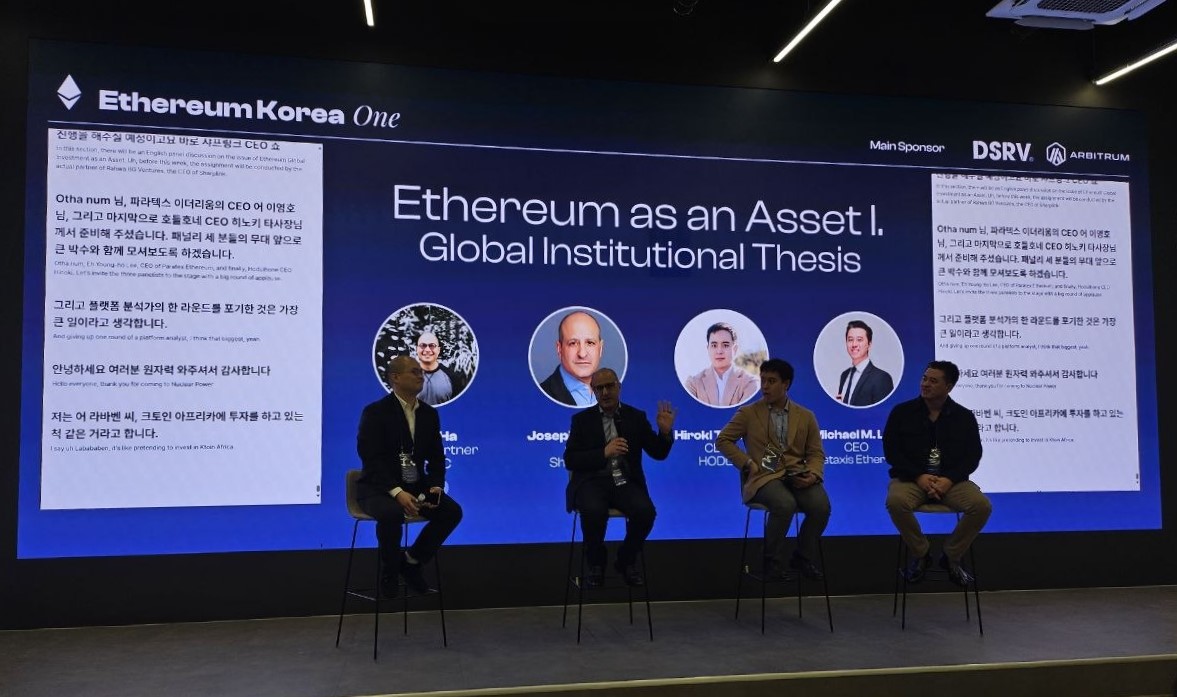
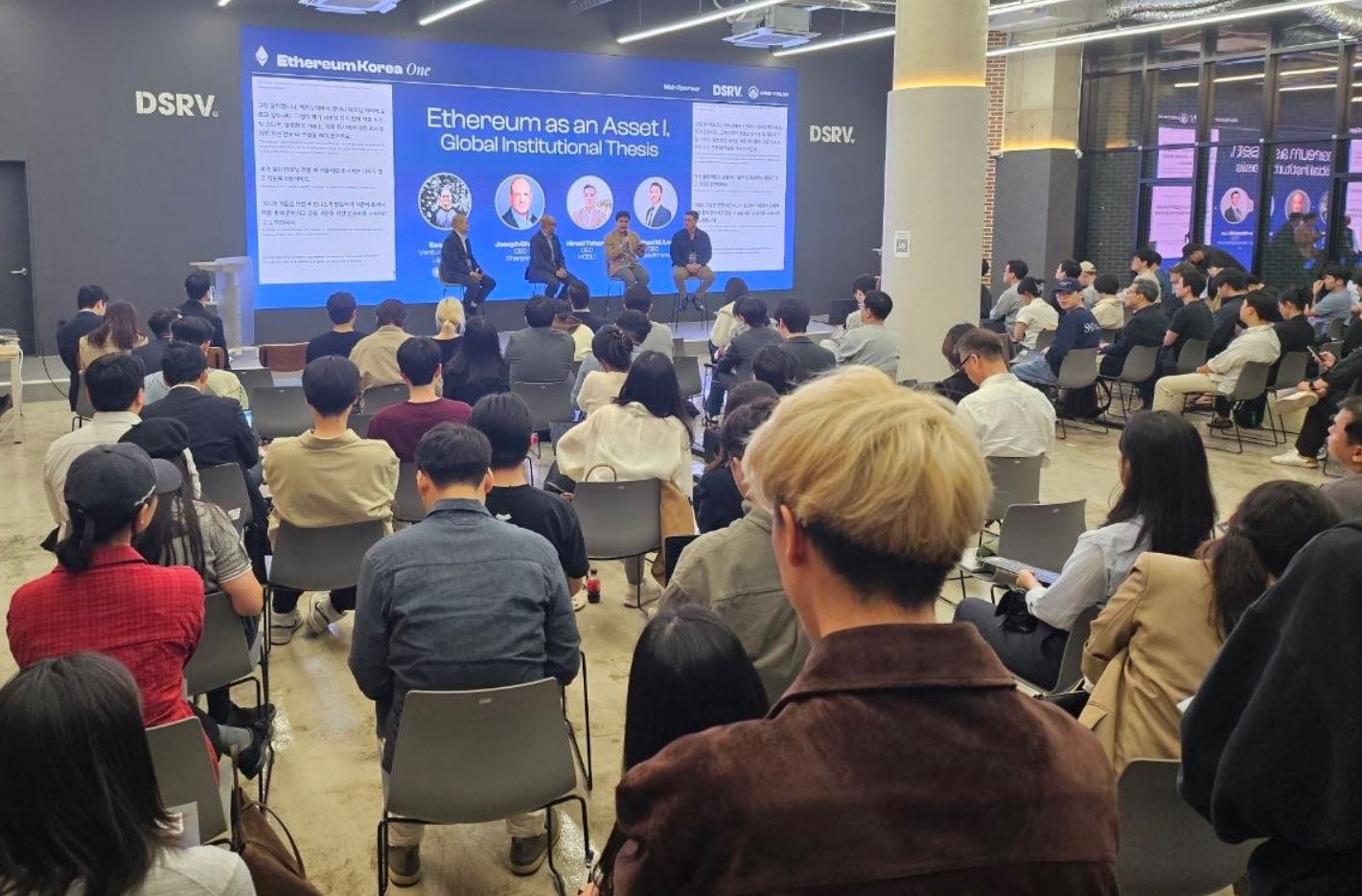
Senior executives from several of the world’s largest Ethereum (ETH) ‘digital asset treasury’ firms gathered in Seoul on Wednesday ET to make a direct case to institutional investors: Ethereum is evolving into a core layer of future financial infrastructure, and ETH offers exposure to that shift beyond short-term price swings.
The discussion took place during the first panel session of Ethereum Korea One, hosted at blockchain infrastructure firm DSRV’s headquarters in Seoul. The session—titled Ethereum as an Asset I: Global Institutional Thesis—featured Joseph Chalom, CEO of Sharplink; Hiroki Tahara, CEO of HODL1; and Michael M. Lee, CEO of Parataxis Ethereum, with Lava VC venture partner Hasieun Ha moderating.
Chalom, a former long-time executive at BlackRock where he spent roughly two decades and led its digital asset efforts, urged investors not to anchor on near-term volatility. Drawing an analogy to early Amazon, he argued that if an investor understood the magnitude of a structural shift, obsessing over daily performance metrics would miss the point. In his framing, Ethereum is poised to reshape how value moves and how assets such as equities are traded—making ETH a vehicle for gaining exposure to a ‘new financial infrastructure’ rather than a simple directional bet on price.
He also positioned the current market environment as an attractive ‘risk-reward’ zone, citing his experience through multiple crypto downturns. Across repeated drawdowns, he said, Bitcoin (BTC) and Ethereum (ETH) emerged with stronger builders and improved standards—an argument that long-run network resilience matters more to institutions than short-term sentiment.
Sharplink, which Chalom said is the second-largest corporate holder of ETH globally, currently holds more than 870,000 ETH. The company is staking its holdings and working with partners including EtherFi and EigenCloud on a liquid restaking product valued at about $200 million, highlighting the growing menu of yield and collateral strategies being built around Ethereum’s staking economy.
Tahara offered a starkly different angle: governance and rebuilding. The HODL1 CEO said the Seoul event marked his first time participating in an English-language session outside Japan, using the platform to describe how he regained operational control of the company. Originally a developer, Tahara said he uncovered alleged wrongdoing by prior management and led a shareholder initiative that replaced the entire leadership team. When he became CEO, he described inheriting an organization with effectively ‘zero employees’ and ‘zero business’—and then rebuilding around Ethereum-focused infrastructure.
In Tahara’s view, the timing is favorable as Japan’s regulatory framework continues to evolve and more financial institutions explore public blockchains. He argued that HODL1’s advantage lies in bridging the gap between technical architecture and local compliance—an increasingly critical capability as institutions demand both execution-grade systems and regulatory clarity. He also added that in an era of intensifying geopolitical uncertainty, Ethereum’s global, permissionless liquidity rails can serve as connective tissue across markets.
Lee, whose firm Parataxis Ethereum is billed as South Korea’s first KOSDAQ-listed Ethereum ‘digital asset treasury’ company, called the panel something of a public debut. He said the company has spent significant time meeting disclosure obligations and governance requirements typical of listed entities—constraints that can reduce visibility even as they improve institutional credibility.
On risks, Lee pointed to a persistent strategic question for Ethereum: the relationship between the base layer (L1) and the rapidly expanding layer-2 (L2) ecosystem. While L2s are widely viewed as scaling solutions, debate has grown around whether some designs could ‘cannibalize’ parts of the base layer’s economic activity over time. Lee framed that tension as a challenge for the broader community to solve collaboratively rather than a fatal flaw.
Chalom, meanwhile, argued that Ethereum’s most consequential risk is not technical but behavioral—what he described as the difference between ‘good actors’ and ‘bad actors’. He warned that some networks market themselves as decentralized while retaining single points of failure, and he expressed concern that institutions could gravitate toward more ‘permissioned’ chains if Ethereum’s ecosystem fails to maintain its core principles.
When asked to name a single on-chain metric that could persuade skeptical institutions, Chalom cited what he characterized as Ethereum’s scale and resilience: more than one million validators distributed across 84 countries, a track record of more than a decade of continuous operation, and the fact that over half of stablecoin circulation runs on Ethereum. Tahara emphasized validator count and geographic dispersion as indicators of censorship resistance. Lee highlighted the size of Ethereum’s staking base—about 37 million ETH—and the multi-week unbonding period, arguing that such lock-up dynamics reflect deep conviction from long-term participants.
Closing the session, Chalom struck an optimistic tone on South Korea’s developer and builder community, saying he has visited Seoul multiple times since last September and observed accelerating energy. Regardless of whether regulatory clarity arrives in weeks or months, he said, the priority for the ecosystem should be to keep building community, shipping protocols, and delivering strong user experiences—factors he suggested will ultimately determine how readily institutions adopt Ethereum-backed infrastructure.














Comment 0